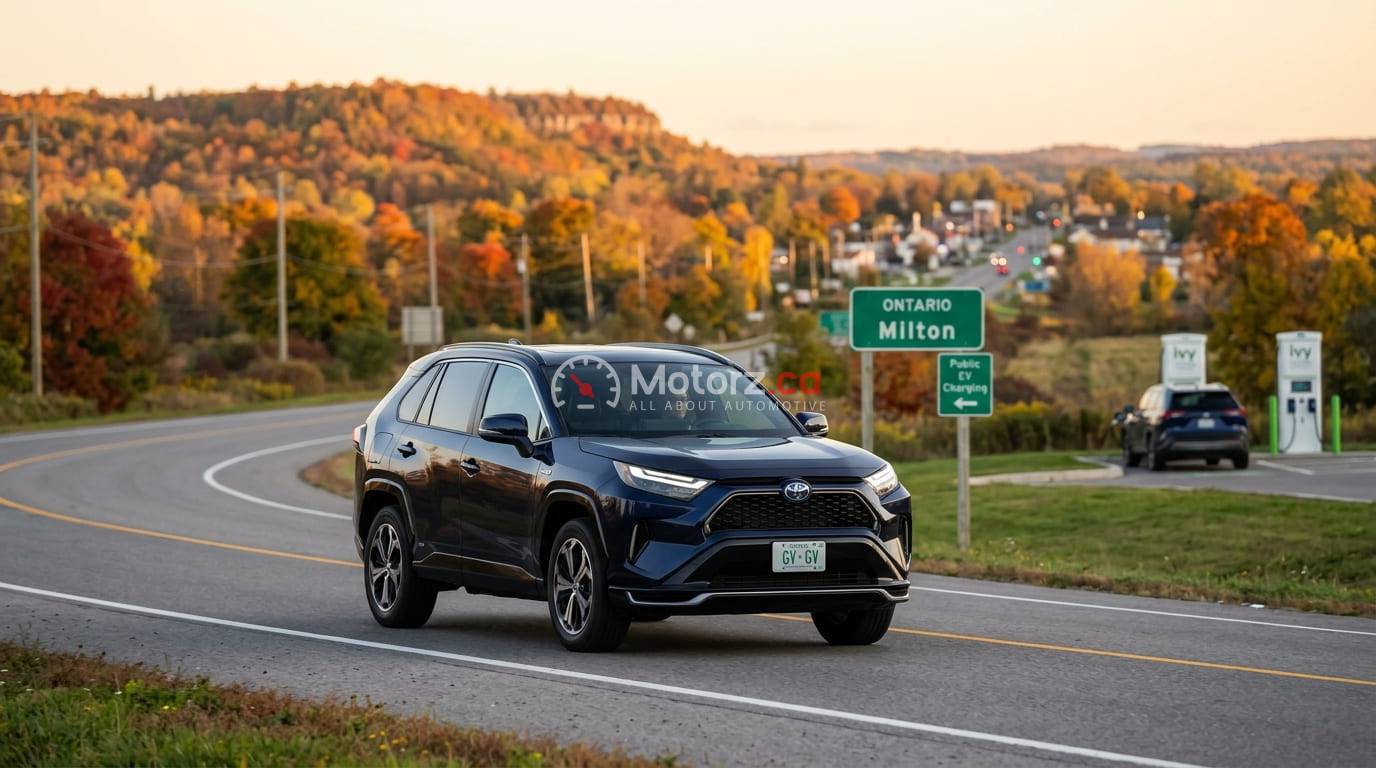
Commuting in Ontario has become an exercise in endurance. Whether you are gridlocked on the Don Valley Parkway, navigating the daily grind of the Queen Elizabeth Way (QEW), or handling a long-haul trek down Highway 401, you know the dual toll it takes: one on your patience, and the other directly on your wallet.
With gas price volatility and the realities of Canadian weather, thousands of Ontario drivers are looking for a middle ground between traditional combustion engines and full battery electric vehicles (BEVs). Enter the hybrid.
Modern hybrid vehicles provide the perfect safety net for the province’s unique landscape. They offer incredible fuel efficiency during bumper-to-bumper city crawls, reliable performance in sub-zero winter temperatures, and zero range anxiety when driving through rural areas where charging infrastructure remains sparse.
This comprehensive guide breaks down the absolute best hybrid cars for Ontario commuters in 2026, categorized by driving needs, winter readiness, and budget.
Why Hybrids Make Absolute Sense for Hybrid Cars for Ontario
The Canadian automotive landscape has shifted dramatically over the last few years. While full electric vehicles fit certain lifestyles perfectly, hybrids have quietly become the pragmatic champion for the average commuter across the Greater Toronto Area (GTA), Ottawa, and Southwestern Ontario.
The Stop-and-Go Advantage
Traditional gas engines are notoriously inefficient in gridlock. They waste energy idling and burning fuel to constantly move 4,000 pounds of steel from a dead stop. Conventional hybrids (HEVs) and plug-in hybrids (PHEVs) excel here. They use regenerative braking to capture energy every time you slow down, storing it in a small battery package to power an electric motor during low-speed crawling. This cuts your city fuel consumption nearly in half.
Defeating the Cold Weather Range Penalty
It is a well-documented fact that extreme cold impacts battery electric vehicles. Fully electric vehicles can lose up to 30 percent or more of their driving range when Ontario temperatures drop past minus 10 degrees. While hybrids also experience a dip in efficiency due to running the cabin heater, they rely on a gas engine backup. You will never find yourself stranded in a snowstorm looking for an operational public charger because your battery drained faster than expected.
Shifting Incentive Programs
Navigating financial savings can be tricky. Nationally, the updated Electric Vehicle Affordability Program (EVAP) provides up to 2,500 in point-of-sale rebates for qualifying plug-in hybrids with a final transaction value of 50,000 or less. A major perk for Ontario commuters is the Canadian-made exception: vehicles built right here in Canada have no price limit to qualify for green vehicle programs. Furthermore, driving a hybrid with green plates grants you solo access to Ontario’s High-Occupancy Vehicle (HOV) and High-Occupancy Toll (HOT) lanes on the 400-series highways, shaving precious minutes off your daily route.
Best Hybrid Sedans for Long Highway Commutes
If your daily route consists of smooth, long highway stretches mixed with high-volume urban traffic, a aerodynamic hybrid sedan provides the lowest rolling resistance and the highest fuel returns.
2026 Toyota Camry Hybrid
Toyota made a bold move by turning the iconic Camry into an all-hybrid lineup, and that bet has paid off massively for commuters.
Fuel Economy: Approximately 4.6 to 5.1 liters per 100 kilometers combined.
Drivetrain: Available Electronic All-Wheel Drive (AWD).
Why it fits Ontario: The Camry Hybrid is the gold standard for high-mileage drivers. Its ride comfort isolates you beautifully from rough pavement, and the availability of on-demand AWD provides incredible traction over unexpected slush or black ice patches on the highway without sacrificing its stellar fuel economy.
2026 Honda Accord Hybrid
For drivers who want a bit more engagement and premium interior tech during their hours behind the wheel, the Accord Hybrid stands tall.
Fuel Economy: Around 4.9 to 5.3 liters per 100 kilometers combined.
Drivetrain: Front-Wheel Drive (FWD).
Why it fits Ontario: Honda’s dual-motor hybrid system offers immediate torque, making highway merging effortless. The cabin is cavernous, providing class-leading legroom and an incredibly intuitive infotainment system that makes managing your podcasts and navigation on long trips seamless.
2026 Hyundai Elantra Hybrid
If keeping your monthly car payment and fuel bill as low as possible is your primary objective, the Elantra Hybrid is an elite budget commuter.
Fuel Economy: Outstanding efficiency frequently dipping down to 4.4 liters per 100 kilometers.
Drivetrain: Front-Wheel Drive (FWD).
Why it fits Ontario: It offers a highly competitive price point while maintaining a robust suite of standard highway safety features, including lane-centering assist and adaptive cruise control, which take the stress out of heavy highway traffic.
Top Hybrid SUVs for Winter Safety and Versatility
Sedans are excellent, but Ontario winters often demand extra ground clearance and robust cargo space for families, weekend trips to cottage country, or outdoor gear.
2026 Toyota RAV4 Hybrid
The RAV4 Hybrid is consistently one of Canada’s best-selling alternative-fuel vehicles for a reason: it is incredibly well-rounded.
Fuel Economy: Roughly 5.5 liters per 100 kilometers combined.
Drivetrain: Standard AWD.
Why it fits Ontario: With a proven reliability track record, standard all-wheel drive, and excellent resale value, the RAV4 Hybrid handles unplowed suburban side streets with ease. It features a dedicated electronic motor to drive the rear wheels instantly when slipping is detected, giving you immediate confidence in heavy snowfall.
2026 Honda CR-V Hybrid
The CR-V Hybrid focuses heavily on refined driving dynamics and a premium-feeling cabin layout.
Fuel Economy: Around 6.0 liters per 100 kilometers combined.
Drivetrain: Available Real-Time AWD.
Why it fits Ontario: Honda builds the CR-V Hybrid in Ontario (at their Alliston plant), meaning buying one directly supports local manufacturing. Its cold-weather performance is exceptional, featuring quick cabin heating and a highly predictive all-wheel-drive system that feels incredibly stable through messy corners.
2026 Hyundai Tucson Hybrid
The Tucson Hybrid blends striking, futuristic aesthetics with immense feature density for the price point.
Fuel Economy: Approximately 6.3 to 6.7 liters per 100 kilometers combined.
Drivetrain: Standard HTRAC AWD.
Why it fits Ontario: Unlike some hybrids that use a Continuously Variable Transmission (CVT), the Tucson utilizes a traditional 6-speed automatic mated to its electric motor. This eliminates the classic “engine drone” when accelerating up steep highway inclines and gives the car a punchy, responsive acceleration profile that makes navigating suburban traffic engaging.
The Best Plug-In Hybrids (PHEVs) for Maximum Savings
Plug-in hybrids represent the ultimate “best of both worlds” scenario. They feature a larger battery pack that can be charged from the wall, allowing you to complete your daily commute entirely on electric power. Once that battery runs out, the vehicle seamlessly switches over to acting like a regular hybrid gas car.
2026 Toyota RAV4 Prime (Plug-In Hybrid)
The RAV4 Plug-In remains the gold standard of the PHEV world, offering sports-car acceleration alongside extreme efficiency.
Electric-Only Range: Up to 68 kilometers on a full charge.
Total Combined Range: Over 900 kilometers.
Why it fits Ontario: If your daily commute is under 60 kilometers, you can plug this vehicle into a standard household outlet overnight and complete your entire workweek without burning a single drop of gasoline. When the weekend arrives and you want to drive up to Tobermory or Algonquin Park, you simply drive it like a normal gas vehicle without worrying about charging infrastructure.
2026 Mitsubishi Outlander PHEV
The Outlander PHEV is an incredibly popular choice across Canada due to its highly sophisticated all-wheel-drive heritage.
Electric-Only Range: Approximately 61 kilometers.
Total Combined Range: Around 640 kilometers.
Why it fits Ontario: It utilizes Mitsubishi’s Super All-Wheel Control (S-AWC) system, which was born in the world of rally racing. This gives it arguably the most advanced terrain management setup of any compact hybrid SUV on the market, offering specialized “Snow” and “Gravel” modes that actively distribute torque to individual wheels to keep you tracking straight in treacherous conditions.
2026 Kia Niro PHEV
If you want a plug-in option but do not need a large, heavy SUV, the Niro crossover sits in a perfect sweet spot.
Electric-Only Range: Up to 53 kilometers.
Total Combined Range: Close to 800 kilometers.
Why it fits Ontario: Its smaller footprint makes it incredibly easy to parallel park in downtown Toronto or Ottawa cores, and it qualifies for point-of-sale federal rebates because of its accessible pricing.
Real-World Comparison: Choosing the Right Hybrid for Your Route
To help visual learners quickly analyze how these popular commuter options stack up against one another, let’s look at their core performance metrics side-by-side:
Crucial Tips for Maximizing Hybrid Efficiency in Ontario
Buying a hybrid is only the first step. To truly squeeze every kilometer out of your tank during an Ontario commute, you need to adjust your driving habits to complement how hybrid powertrains function.
Pro Tip: Your car’s cabin heater relies on engine heat. In the dead of winter, turning your climate control to maximum immediately forces the gas engine to run continuously to generate warmth, bypassing the electric mode. Use your heated seats and heated steering wheel to stay comfortable instead; they run off the auxiliary electrical system and allow the vehicle to switch off the gas engine more frequently during city crawling.
Master the “Pulse and Glide” Technique
Hybrids thrive when you are deliberate with the throttle. Accelerate smoothly up to your desired speed (the pulse), and then ease off the gas pedal slightly to encourage the car’s computer to shut off the internal combustion engine and coast on pure electricity (the glide).
Avoid Hard Braking Whenever Safely Possible
When you press the brake pedal gently, the hybrid’s electric motor runs backward, acting as a generator to slow the vehicle down while recharging the hybrid battery pack. If you slam on the brakes hard, the vehicle has to engage its traditional mechanical brake pads to stop you safely. This friction creates wasted heat instead of captured electricity. Give yourself plenty of stopping room to maximize your regenerative braking efficiency.
Maintain Optimal Tire Pressures
Ontario temperatures swing drastically between October and January. For every drop of 5 degrees in ambient temperature, your tires can lose roughly one pound per square inch (PSI) of pressure. Under-inflated winter tires create massive rolling resistance, which can quietly destroy your fuel economy numbers by 10 percent or more. Check your tire pressures monthly.
Choose Your Driving Modes Wisely
Most modern hybrids feature Eco, Normal, and Sport modes. Save Sport mode for merging onto fast-moving highway traffic. For the majority of your bumper-to-bumper commute, leave the vehicle in Eco mode. This dampens aggressive throttle inputs and optimizes the climate control system to prioritize fuel savings without making the car feel sluggish in heavy traffic.
The Verdict: Which Ontario Hybrid is Right for You?
The absolute best hybrid car for your Ontario commute ultimately comes down to the blueprint of your daily drive:
The Long-Haul Highway Warrior: If you are driving 80+ kilometers a day along the 401 or the 407, the Toyota Camry Hybrid is your champion. Its aerodynamic silhouette and highly optimized highway cruising efficiency will save you thousands of dollars annually at the pumps.
The Suburban Family All-Rounder: If you need to navigate unplowed neighborhood roads, drop kids off at hockey practice, and haul groceries while surviving heavy traffic, the Toyota RAV4 Hybrid or Honda CR-V Hybrid offer the perfect cocktail of utility, winter security, and fuel savings.
The Urban Short-Range Commuter: If your drive to work is short, but your city fuel bills are still hurting your wallet, stepping up to a plug-in option like the Toyota RAV4 Prime or Mitsubishi Outlander PHEV allows you to completely eliminate gasoline from your daily work routine while keeping a gas tank handy for care-free weekend road trips.
Whichever route you choose, making the shift to a hybrid powertrain ensures you are insulated against unpredictable fuel prices while driving a vehicle perfectly engineered to handle everything an Ontario winter can throw your way.