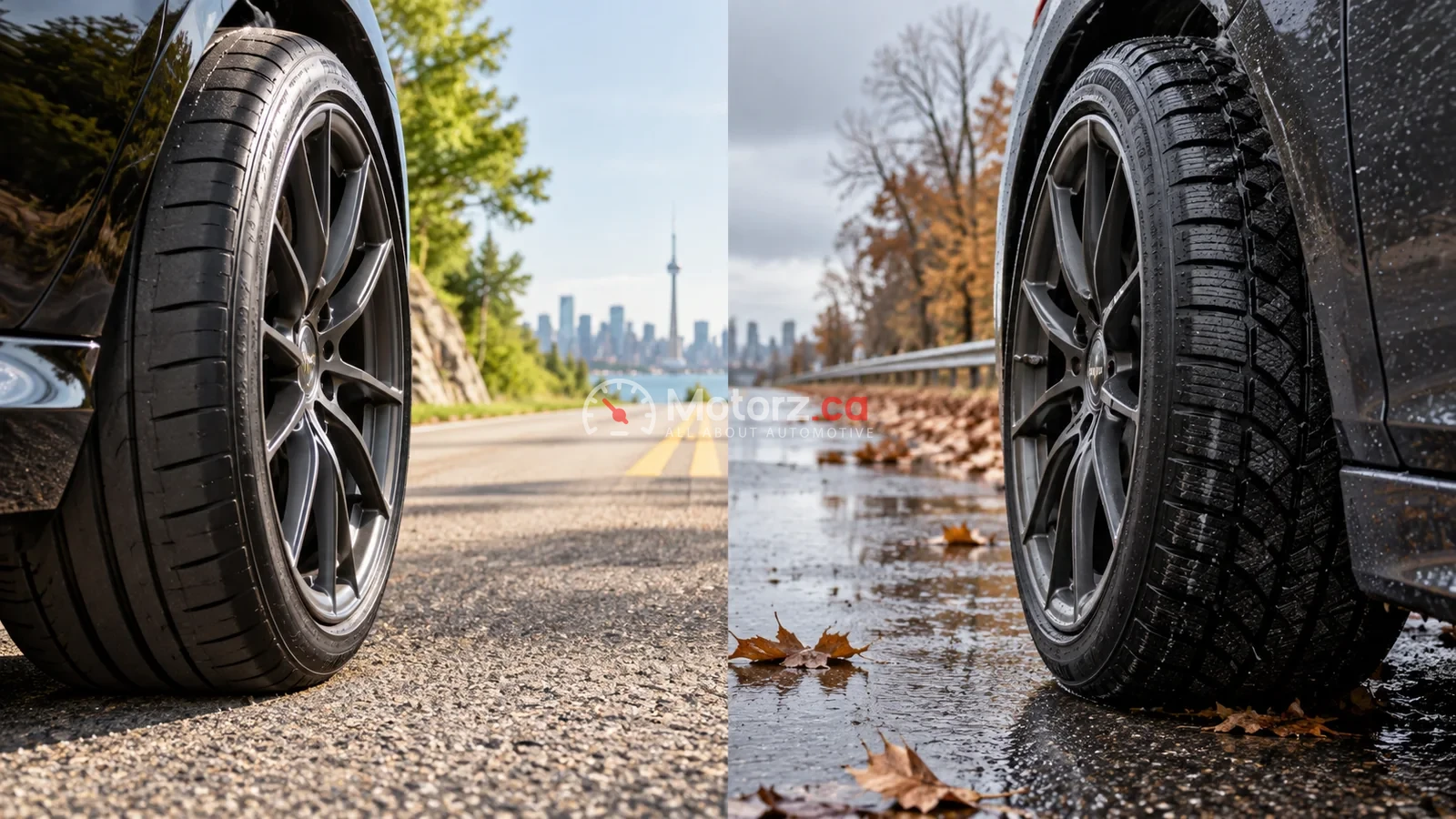
Ontario drivers choosing performance tires should decide first whether maximum warm-weather response or broader three-season flexibility matters more.
Our comparison method
Summer vs. all-season performance tire decision matrix
| Decision factor | Summer performance tire | Performance all-season tire |
|---|---|---|
| Best environment | Consistently warm dry and wet pavement | Mild-to-warm three-season use |
| Steering response | Usually the sharper category | Typically more compliant and less specialized |
| Cold weather | Compound can stiffen; not for snow or ice | More flexible shoulder-season use, but grip also falls in sustained cold |
| Tread life | Often shorter, especially with aggressive driving | Usually longer and may carry a longer treadwear warranty |
| Seasonal plan | Requires winter set before sustained cold | Still requires winter set for dependable Ontario winter use |
| Best buyer | Enthusiast prioritizing warm-weather response | Driver balancing response, mileage and shoulder seasons |
Temperature is the first boundary
Transport Canada says all-season and summer tires begin losing elasticity below 7°C, reducing traction. That does not mean every day at 6°C creates identical risk; it means the seasonal trend should trigger planning before frost and snow. Install four winter tires, not a mixed pair, when sustained conditions call for them.
Dry grip, wet grip and hydroplaning are separate
A summer tire may use a compound and tread blocks optimized for warm-pavement response, but wet performance also depends on channels, tread depth and the particular product. A category label alone cannot establish stopping distance. Compare the manufacturer’s intended use, independent standardized test data where available, and remaining tread depth.
Tread life and total cost
More responsive compounds and larger contact patches can wear faster. Rotation eligibility also matters: staggered wheel sizes may prevent front-to-rear rotation. Calculate cost per season using purchase price, expected mileage, storage, installation and alignment—not only the sticker price.
Ontario legal and insurance context
Ontario does not impose a province-wide passenger-vehicle winter-tire mandate. However, the Financial Services Regulatory Authority of Ontario states that insurers must offer a winter-tire discount; qualification dates and proof requirements vary by insurer. Legal minimums are not a performance recommendation.
A practical buying checklist
- Read the door placard for tire size and load requirements.
- Choose the category around the coldest conditions before the next changeover.
- Check wet-braking and treadwear information for the exact model, not the brand generally.
- Confirm rim width, clearance and speed/load ratings.
- Budget for four winter tires and storage.
- Inspect pressure monthly and before long trips.
For winter timing and provincial context, use the Motorz.ca winter-driving hub.
Frequently asked questions
Can summer performance tires be used in an Ontario winter?
No. Summer performance tires are not designed for snow, ice or sustained cold. Transport Canada notes reduced elasticity below 7°C. Change to four correctly sized winter tires before Ontario temperatures remain in that range.
Are all-season tires the same as all-weather tires?
No. Many all-weather tires carry the three-peak mountain-snowflake symbol for severe-snow traction; ordinary all-season tires generally do not. Check the sidewall marking and the manufacturer’s product classification.
Sources
- Transport Canada — using winter tires
- TRAC — when to install winter tires
- Michelin Canada — summer, winter and all-season tire categories
- FSRA — Ontario winter-tire insurance discount
Editorial disclosure: Motorz.ca did not road-test the vehicles or tires in this guide. Recommendations are editorial analysis of current Canadian manufacturer, government and industry information.