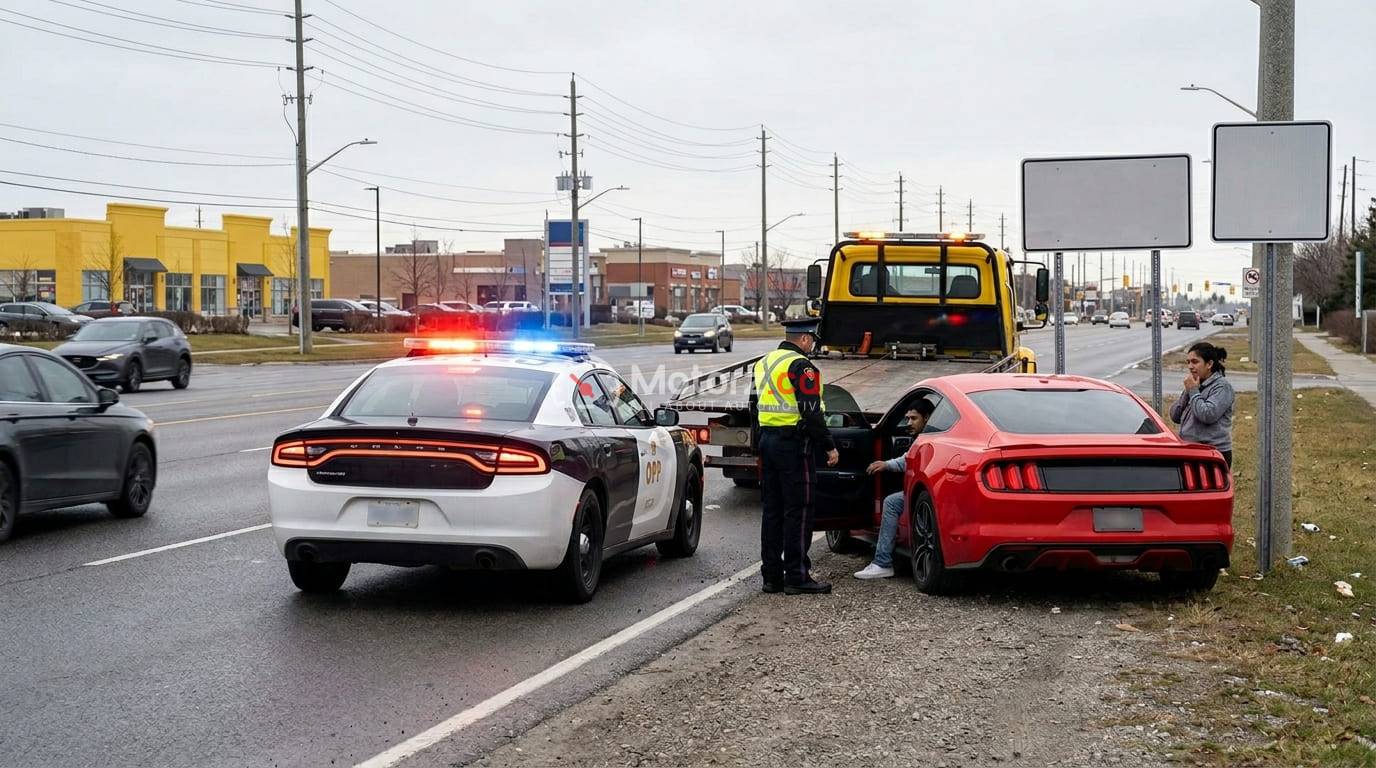
You are Brampton Driver’s, keeping up with the flow of traffic, or perhaps rushing down the Highway 410 corridor to make it home after a long shift. Your mind is on your evening plans, not your speedometer. Then, you see the flashing red and blue lights in your rearview mirror.
When the Peel Regional Police officer walks up to your window, they do not just hand you a standard speeding ticket. Instead, they tell you that you are being charged with stunt driving under Section 172 of the Ontario Highway Traffic Act (HTA).
Within minutes, your driver’s licence is confiscated for a mandatory 30 days. A tow truck arrives to hook up your car, dragging it away to a local impound lot where it must sit completely untouched for the next 14 days. You are left standing on the shoulder of a busy Brampton road, wondering how a single lapse in judgment turned into an immediate financial and logistical nightmare.
In Brampton and across the Greater Toronto Area (GTA), stunt driving enforcement has reached an all-time high. Local police forces are actively cracking down on aggressive driving.
This comprehensive guide breaks down exactly what constitutes stunt driving in Ontario, the severe penalties you face at the roadside and in court, the hidden costs of vehicle impoundment, and what you must do immediately to protect your driving record, your livelihood, and your future insurance rates.
Demystifying the Charge: What Legally Qualifies as Stunt Driving in Ontario?
Many drivers mistakenly believe that “stunt driving” only applies to extreme street racing, midnight drag strips, or drifting around empty commercial parking lots at Bovaird and Main. While those actions certainly qualify, Ontario’s legal definition under Section 172 of the HTA is vastly broader. The overwhelming majority of stunt driving charges laid in Brampton are triggered purely by excessive speed.
The province enforces strict, dual-tiered speed thresholds depending on the posted speed limit of the roadway.
The Speed Thresholds That Trigger an Automatic Charge
In speed zones under 80 km/h: If you travel 40 km/h or more over the posted speed limit, you are legally stunt driving. For example, driving 90 km/h in a 50 km/h suburban residential zone or a local Brampton school zone triggers an immediate arrest of your licence and vehicle.
In speed zones of 80 km/h or higher: If you travel 50 km/h or more over the posted limit, it is classified as stunt driving. For instance, hitting 130 km/h on an 80 km/h regional road qualifies.
The absolute cap: Traveling at a speed of 150 km/h or more anywhere in Ontario, even on 110 km/h designated stretches of 400-series highways, automatically defaults to a stunt driving charge.
Non-Speeding Behaviors Classified as Stunt Driving
Ontario law explicitly outlines more than a dozen physical actions behind the wheel that constitute a stunt, regardless of your actual speed. These include:
Traction Loss and Burnouts: Intentionally squealing tires, spinning your vehicle, doing doughnuts, or drifting around a turn.
Tailgating and Competitive Driving: Driving too closely to another vehicle, pedestrian, or fixed object, or intentionally cutting off another motorist.
Preventing Passing: Intentionally blocking another vehicle or cyclist from overtaking you or changing directions.
Out-of-Seat Driving: Operating a motor vehicle while not sitting fully in the driver’s seat (often referred to as “ghost riding”).
Unsafe Passenger Transport: Driving with a person trapped or riding inside the trunk of your vehicle.
Stunt Maneuvers: Popping a wheelie on a motorcycle or intentionally causing one or more wheels to lift completely off the surface of the asphalt.
Immediate Roadside Consequences: The 30-Day Suspension and 14-Day Seizure
One of the most brutal aspects of Ontario’s stunt driving legal framework is that you are penalized heavily before you ever step foot inside a courtroom. Under the Moving Ontarians More Safely (MOMS) Act, the province established immediate administrative roadside penalties that police officers must enforce on the spot. These penalties cannot be appealed, paused, or negotiated at the roadside.
The 30-Day Roadside Driver’s Licence Suspension
The moment the officer determines you have crossed the stunt driving threshold, your physical driver’s licence is seized. Your driving privileges are completely suspended for exactly 30 days.
Critical Warning: There are absolutely no provisional or temporary work licences available during this 30-day block. You cannot legally operate a vehicle to commute to your workplace, drop your children off at school, or handle medical emergencies. If you are caught driving while under this administrative suspension, you face secondary criminal-level charges, massive secondary fines, and further vehicle seizures.
The 14-Day Roadside Vehicle Impoundment
Your vehicle is immediately ordered to be towed and stored at a local commercial impound lot for 14 days. It does not matter if the vehicle belongs to you, your parents, a friend, or a commercial employer—the car goes to the lot regardless of ownership. The law mandates that the vehicle must remain locked in storage for the full two weeks, with zero opportunity for early release.
The Cold, Hard Math: Breakdown of Brampton Impound and Towing Fees
The initial wave of financial damage from a stunt driving charge stems entirely from commercial towing and storage fees. These are non-regulated private industry costs, meaning there is no fixed provincial flat fee. Because Brampton sits within the high-density GTA, regional storage and operating overhead rates rank among the most expensive in Canada.
You are legally required to settle the balance with the private impound yard before your vehicle is unchained. Here is how the numbers accumulate across the mandatory 14-day hold:
Flat-Rate Towing Fees
The initial hook-up and transport from the roadside scene to the designated impound lot ranges from 250 to 500 or more. This fee fluctuates based on:
The exact distance of the tow journey.
The time of day (late-night or weekend roadside responses frequently incur heavy premium surcharges).
Whether your vehicle features an all-wheel-drive layout or complex modifications requiring specialized flatbed hardware.
Daily Storage Rates
Impound facilities across Brampton charge anywhere from 30 to 75 per calendar day to store a single passenger vehicle.
At a standard rate of 60 per day, the 14-day mandatory minimum structural storage cost totals 840.
If your vehicle requires premium indoor or highly secured storage space, that subtotal can easily climb past 1,000.
Mandatory Administrative and Gate Release Charges
Most private commercial yards tack on an administrative processing fee between 50 and 150 just to file the paperwork and open the gate for release.
The Realistic Real-World Cost Summary
When you calculate the baseline financial commitments, the real-world invoice required to rescue your vehicle on day 15 typically looks like this:
Pro Tip: Do not delay your pickup arrival. On the 15th day, your mandatory administrative impound period lapses, but the facility will continue tracking standard commercial storage rates for every extra 24 hours the vehicle remains unclaimed. Leaving your car over a long weekend can add hundreds of extra obligations to your final invoice.
Post-Roadside Court Penalties: Fines, Jail Time, and License Bans
The initial 30-day suspension and 14-day impound are simply the immediate administrative setup. The real legal battle unfolds in court under the Ontario Provincial Offences Act. Stunt driving is not a minor traffic ticket that you can simply resolve by paying a clerk at the Ontario Court of Justice office on Hurontario Street. It requires a mandatory personal court appearance.
If you are officially convicted of stunt driving in an Ontario court, a Justice of the Peace is legally obligated to hand down severe statutory minimum penalties:
Substantial Financial Fines
The baseline court fine for a first-time stunt driving conviction scales from a minimum of 2,000 up to a maximum of 10,000. However, Ontario automatically appends a mandatory 25% Victim Fine Surcharge onto all provincial driving infractions.
A minimum 2,000 court fine automatically expands into a 2,500 total financial penalty out of pocket.
A maximum 10,000 penalty spikes to an absolute cost of 12,500.
Escalating Mandatory Driving Prohibitions
Upon conviction, your driver’s licence faces strict, multi-year suspension parameters enforced by the Ministry of Transportation (MTO):
First-Time Conviction: A mandatory court-ordered driver’s licence suspension lasting a minimum of 1 year up to a maximum of 3 years.
Second Conviction (Within 10 Years): A strict driver’s licence suspension spanning a minimum of 3 years up to a maximum of 10 years.
Third Conviction: An immediate, permanent lifetime driver’s licence suspension. Under highly specific, rigid criteria, a driver might apply for an administrative restoration review only after a minimum of 10 clear years have elapsed.
Fourth Conviction: Absolute, unreviewable lifetime ban from driving any motorized vehicle in Ontario.
Demerit Points and Immediate Prison Sentences
A formal stunt driving conviction places 6 permanent demerit points directly onto your current driving abstract. Furthermore, Section 172 allows the Crown prosecutor to pursue explicit prison sentences of up to 6 months in jail, even for a first-time offender, if the driving behavior involved extreme recklessness or endangered lives in dense urban settings.
The Insurance Aftermath: Moving into the High-Risk Pool
While the court fines and impound fees are heavy, the true financial devastation of a stunt driving conviction lies in the long-term impact on your auto insurance premiums.
The average, clean-record driver residing within Brampton generally pays around 1,800 to 2,500 annually for standard automotive insurance coverage due to regional accident statistics and fraud tracking. The second a formal stunt driving conviction hits your permanent corporate record, your primary insurance provider will immediately drop you. You are classified as an uninsurable, ultra-hazardous risk.
To continue driving legally once your licence suspension period concludes, you will be forced to secure alternative coverage through specialized high-risk facility automobile insurers.
The True Cost of High-Risk Insurance Premiums
Your annual premium will skyrocket by 300% to 500% almost overnight.
Your yearly high-risk facility insurance bill will average between 8,000 and 15,000 or more.
This premium inflation remains strictly attached to your abstract for a minimum of 3 full years from the exact date of conviction, with many secondary commercial insurers rating the infraction against your record for up to 6 years.
Let’s Calculate the Longitudinal Cost Breakdown:
Pre-Conviction Premium Costs (3 Years): Roughly 6,000 total.
Post-Conviction Premium Costs (3 Years high-risk): Roughly 30,000 total.
The Hidden Net Loss: An extra 24,000 in pure insurance inflation alone.
Practical Step-by-Step Recovery Strategy: What to Do If You’re Charged
If you are currently pulled over on a Brampton road or sitting at home holding an active Section 172 summons, panic will not help your situation. You must approach the issue systematically to minimize the damage.
Manage the Roadside Scene Professionally
Do not argue, yell, or become confrontational with the police officer or the arriving tow truck driver. The roadside suspension and vehicle seizure are automated mandates—the officer cannot reverse them, even if you present a logical explanation. Remaining calm and respectful ensures no additional charges, like resisting arrest or obstructing police, are added to your ticket.
Establish an Alternative Transportation Plan Immediately
Because your 30-day licence suspension begins instantly, you must immediately coordinate how you will handle work commutes, family errands, and grocery trips. Look into Brampton Transit, ride-sharing options, or carpooling arrangements with colleagues. Do not, under any circumstances, attempt to drive a different family vehicle while your licence is suspended.
Clear the Impound Lot Fees Promptly on Day 15
Locate the specific private impound yard where your car was taken. Ensure you have saved the necessary funds (generally between 1,000 and 2,000) to clear the towing and storage bill on the exact morning the 14-day hold expires. You must bring a licensed driver with you to physically pilot the car out of the lot, as you are still under your 30-day roadside suspension.
Secure Qualified Legal Representation
Never attend a stunt driving court date alone to plead guilty without a fight. Retaining an experienced traffic ticket lawyer or a licensed paralegal specializing in HTA defense is essential.
Legal experts can meticulously review the Crown prosecutor’s evidence package, check if the police officer’s radar or lidar speed measurement devices were properly calibrated, and negotiate to have your stunt driving charge reduced to a standard speeding or careless driving ticket. A successful charge reduction completely protects you from the mandatory 1-year licence suspension and high-risk insurance rates.
How Ontario’s Stunt Driving Infrastructure Impacts Brampton Commuters
Brampton drivers face unique challenges regarding stunt driving enforcement. The city’s geography plays a major role in how frequently these charges are laid.
Brampton features several expansive, wide multi-lane thoroughfares—such as Bovaird Drive, Sandalwood Parkway, and Steeles Avenue—that are engineered to look like highways but carry posted speed limits of 60 km/h or 70 km/h.
Because of the wide lanes and modern infrastructure, it is incredibly easy for a driver to let their speed drift up to 100 km/h just by matching the natural flow of traffic. However, traveling 100 km/h in a 60 km/h zone puts you exactly 40 km/h over the limit. This instantly triggers a stunt driving charge, resulting in an immediate 30-day licence suspension and 14-day vehicle impoundment right there on the commute home.
Furthermore, Peel Regional Police and the Ontario Provincial Police (OPP) run dedicated speed enforcement campaigns along the Highway 410, 407, and 401 corridors surrounding Brampton. These corridors are heavily monitored by radar units, making it critical for local commuters to use cruise control and stay highly aware of local speed limit transitions.
Awareness is Your Best Defense
Ontario’s stunt driving laws are intentionally designed to be punitive, swift, and highly expensive. The province uses these strict measures to deter aggressive driving and keep municipal roads safe. Unfortunately, everyday commuters often get caught in the dragnet due to a temporary moment of rushing or distraction.
Understanding the legal speed thresholds, the true cost of regional impound yards, and the long-term threat of high-risk insurance tracking allows you to make informed decisions behind the wheel. If you do find yourself facing a Section 172 charge, acting quickly to secure legal counsel is your best path forward to protect your licence, your wallet, and your ability to drive.