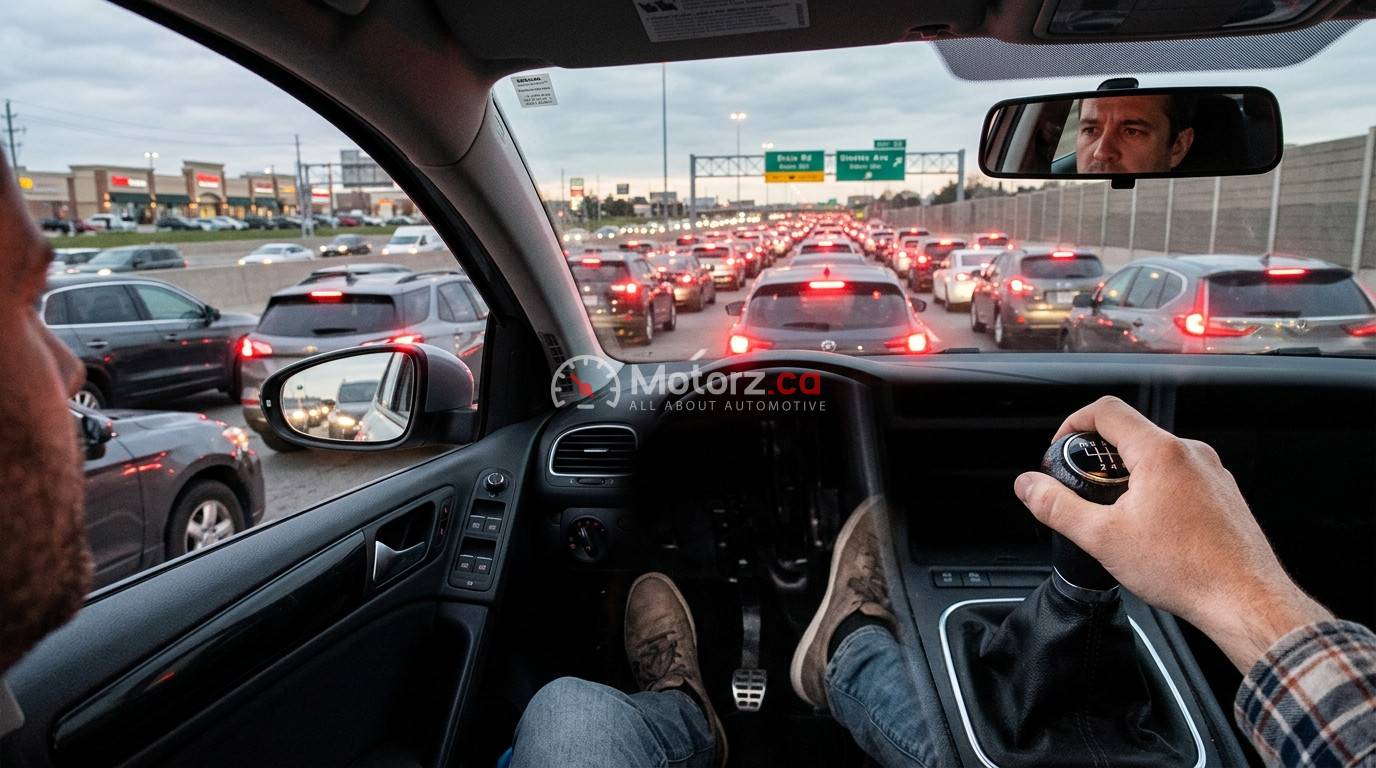
There was a time when Driving Manual Transmissions lived by a simple, unyielding creed: save the manual. The crisp click of a gear shifter sliding into place, the mechanical connection of a perfectly timed clutch release, and the absolute control over an engine’s power band were considered the ultimate expressions of automotive joy. For generations of drivers, a manual gearbox was not just a transmission choice—it was a badge of honor.
But if you take that badge of honor and place it on Highway 410 at eight o’clock on a Monday morning, the romance disappears instantly.
In Brampton, Ontario, commuting has undergone a dramatic transformation. What used to be a predictable drive through a growing suburban city has evolved into a daily battle against some of the worst congestion in the Greater Toronto Area. Whether you are crawling centimeter by centimeter along Queen Street, dodging heavy transport trucks on Steeles Avenue, or watching your life tick away on Bovaird Drive, stop-and-go gridlock is the new normal.
In this environment, operating a manual transmission changes from an engaging hobby into an exhausting physical workout. The constant clutch-in, clutch-out choreography required to move five meters at a time is forcing even the most die-hard automotive purists to throw in the towel. Let’s take an in-depth look at why Brampton traffic patterns are actively killing off the stick shift, explore the mechanics behind how gridlock destroys manual components, and evaluate whether automatic gearboxes have officially won the commuter wars.
The Changing Driving Manual Transmissions: A Nightmare Scenario for Manual Drivers
To understand the decline of the stick shift in Driving Manual Transmissions, one must look closely at how Brampton’s infrastructure has struggled to keep pace with its massive population and commercial growth.
Multi-Directional Congestion Patterns
Unlike old-school commuter hubs where traffic flows cleanly into a downtown core in the morning and empties out in the evening, Brampton experiences dense, chaotic, multi-directional traffic jams all day long. Because the city serves as a major national logistics and warehousing center, standard passenger cars must share narrow suburban streets with massive, slow-moving commercial transport trucks.
This mix creates a highly disruptive, jagged stop-and-go driving dynamic. For a manual driver, this means you can rarely find a steady gear. You are permanently trapped in a frustrating cycle of shifting between first gear, neutral, and second gear, over and over again, for kilometers on end.
The Rise of the Commuter Bottleneck
Major arterial roads such as Dixie Road, Airport Road, and the William Parkway are plagued by non-stop development, sudden lane reductions, and heavy infrastructure construction projects. When thousands of cars try to merge into a single open lane, forward speed drops to a painful crawl. In these specific conditions, managing a manual vehicle transitions from an intuitive physical habit into an overwhelming mental and physical chore.
The Physical Toll: What Gridlock Does to a Driver’s Left Leg
When automotive journalists review a manual sports car on a twisting, empty mountain highway, they talk about the “visceral, tactile connection to the machine.” They never mention the severe muscle cramps, lower back strain, and knee pain that occur when you operate that same machine in an hour-long traffic jam.
The Repetitive Strain Injury Risk
When you drive a manual transmission car in a smooth highway environment, you press the clutch pedal to set off, find fifth or sixth gear, and rest your left foot comfortably on the dead pedal for the remainder of the trip. The physical effort is practically zero.
In Brampton gridlock, your left leg never gets a break. Pressing down a heavy clutch pressure plate twelve to fifteen times every single minute means your thigh, calf, and ankle muscles remain under continuous tension. Over months and years of daily commuting, this repetitive mechanical movement can cause knee joint inflammation, tendonitis, and lower back misalignment from sitting crookedly while modulating the friction point.
The Psychological Fatigue of Constant Management
Driving in heavy traffic requires immense focus to avoid minor fender benders. When you add a manual transmission to the equation, your brain has to do extra cognitive work. You must constantly monitor the gap in front of you, calculate the exact engine RPM needed to prevent stalling, and coordinate both feet smoothly. This continuous micro-decision-making leaves drivers feeling completely drained before their workday even begins.
Mechanical Destruction: How Traffic Jams Kill the Manual Clutch
It is not just the driver’s body that takes a beating in stop-and-go conditions; the mechanical components of a manual drivetrain are subjected to extreme wear and tear that they were simply never designed to withstand.
AI Overview Key Insight: While manual transmissions are inherently simple and robust, their longevity depends entirely on spending minimal time within the clutch “friction zone.” Continuous stop-and-go traffic forces drivers to constantly slip the clutch, generating intense heat that accelerates friction material degradation.
The Destructive Physics of Clutch Slipping
A clutch disc is lined with a high-friction material very similar to a brake pad. When your foot is completely off the pedal, the clutch disc is clamped tightly against the engine’s spinning flywheel, transferring power to the wheels with zero slip and zero wear.
To move a manual vehicle forward from a dead stop, you cannot just drop the pedal instantly; you must pause briefly at the friction zone, letting the clutch disc slip against the flywheel until the vehicle matches engine speed. In heavy traffic, because you are never moving fast enough to fully engage the gear and coast, you are forced to constantly slip the clutch to creep forward. This continuous friction creates localized hot spots, glazing the friction material and leading to premature clutch slippage under load.
Throw-Out Bearing and Pressure Plate Failure
When you sit at a complete standstill on a highway off-ramp, you have two choices: put the shifter into neutral and let the clutch pedal out, or leave it in first gear and keep the clutch pedal pinned to the floor.
Many drivers choose the second option out of habit so they can react quickly when traffic moves. However, holding the clutch pedal down keeps the mechanical throw-out bearing under immense load and forces the internal pressure plate fingers to stay bent. Over time, this constant pressure dries out the bearing’s internal grease, leading to loud squealing noises, a stiff pedal feel, and eventual total system failure that will leave you stranded in the middle of a busy intersection.
The Evolution of the Automatic Transmission: Closing the Efficiency Gap
Historically, manual transmission enthusiasts had two strong arguments to justify their choice despite the physical inconvenience: fuel economy and shift performance. But over the last decade, rapid leaps in automotive engineering have completely erased those traditional advantages.
Modern Multi-Speed Automatics and CVTs
Older automatic gearboxes were slow, heavy, and lost significant power through fluid churn inside the torque converter. Modern automatic transmissions feature eight, nine, or even ten distinct gear ratios.
These electronic systems change gears in milliseconds, keeping the engine operating within its absolute sweet spot for fuel efficiency. Continuously Variable Transmissions (CVTs) take this further by continuously altering pulley ratios, delivering seamless power transitions that a human driver with a stick shift could never replicate on local roads.
Dual-Clutch Transmissions (DCT)
For driving enthusiasts who still want high performance, the Dual-Clutch Transmission represents the ultimate compromise. By using two separate internal shafts—one for odd gears and one for even gears—a DCT pre-selects your next gear before it is even engaged. When you pull the steering-wheel paddle shifter, the swap happens instantly without interrupting power delivery. You get the crisp control of a manual with the effortless convenience of an automatic when you find yourself stuck in heavy traffic.
Advanced Driver Assistance Systems (ADAS): The Final Nail in the Coffin
The ultimate reason manual transmissions are disappearing from Brampton roads is not just about the gearboxes themselves—it is about the smart safety technology built around them. Modern automotive safety features require total control over the drivetrain, an integration that manual setups simply cannot support.
Stop-and-Go Adaptive Cruise Control
As traffic congestion has intensified, Adaptive Cruise Control (ACC) with full stop-and-go capability has become an essential tool for daily commuters. Using advanced front radar sensors and cameras, this system automatically handles acceleration, braking, and maintains a safe gap from the car ahead, even bringing you to a complete halt and starting up again smoothly.
A manual car cannot do this. Because a computer cannot step on a mechanical clutch pedal for you, adaptive cruise systems in manual cars disconnect or shut off entirely below thirty kilometers per hour. Buying a manual car means opting out of the single best stress-relieving technology available for handling gridlock.
Autonomous Emergency Braking (AEB) and Lane Management
Modern safety standards demand features like Autonomous Emergency Braking and Traffic Jam Assist. If a modern automatic car detects an imminent crash while you are distracted by traffic, it can slam on the brakes and safely bring the vehicle to a stop. In a manual vehicle, if the emergency system halts the car without a driver dipping the clutch, the engine will stall instantly. While this still avoids the primary crash, it leaves the vehicle dead in live traffic, presenting a secondary safety hazard.
Market Realities: Dealership Availability and Resale Value in Peel Region
The mechanical and physical challenges of driving a stick shift have naturally shaped local buyer behavior, creating a cascading economic effect through local car dealerships and the used vehicle marketplace.
The Disappearing Factory Order
Walk onto any new car lot in Brampton today, and you will quickly notice a glaring trend: finding a manual car on display is nearly impossible. Manufacturers have systematically dropped manual options from standard sedans, SUVs, and trucks. Aside from a handful of dedicated sports cars or entry-level economy hatchbacks, the manual transmission has been entirely phased out of mainstream automotive production lines.
The Used Car Depreciation Trap
When you purchase a vehicle, you must eventually consider its future resale value. In the highly populated, commuter-heavy market of Peel Region, the pool of buyers who know how to drive a stick shift—and actually want to do so every day—is shrinking fast.
Selling a manual commuter car on the secondary market can be incredibly difficult. Dealerships routinely offer lower trade-in values for manual cars because they sit on the lot for months before finding a buyer. Choosing a manual transmission today often means accepting a financial hit when it comes time to upgrade.
Are There Any Arguments Left for the Manual Transmission Commuter?
With physics, biology, technology, and economics all stacked against the manual gearbox, is there any logical reason left to choose a stick shift for a daily drive through Brampton?
Lower Upfront Purchase Price: On the rare entry-level vehicles where a manual is still offered, it usually costs less than the automatic version, helping buyers on a strict budget get on the road.
Simpler, Less Expensive Long-Term Repairs: Manual gearboxes are simple mechanical units. If an automatic or a dual-clutch transmission fails out of warranty, replacing the complex computers and valve bodies can cost thousands. A manual transmission, by contrast, usually only requires a fresh clutch kit every few years, which is far more affordable to replace at a local repair shop.
Anti-Theft Deterrent: In an era where vehicle thefts are a major concern across Ontario, a manual shifter acts as a highly effective, built-in security system. Many modern car thieves do not know how to operate a manual clutch, often causing them to abandon the vehicle the moment they look through the window and spot the three pedals.
The Final Shift
The steady decline of the manual transmission is not a reflection of poor design; it is simply a casualty of changing environments. The stick shift was built for an era of open, flowing roads where driving was an active experience to be savored. It was never meant to survive the grinding reality of modern suburban gridlock.
For the residents of Brampton, where the daily drive involves navigating dense logistics routes, non-stop construction, and endless lines of brake lights, the automatic transmission has transformed from a luxury convenience into an absolute necessity for protecting your health and peace of mind. While we can look back fondly on the golden age of the stick shift, surviving the modern Ontario commute means embracing a two-pedal future.