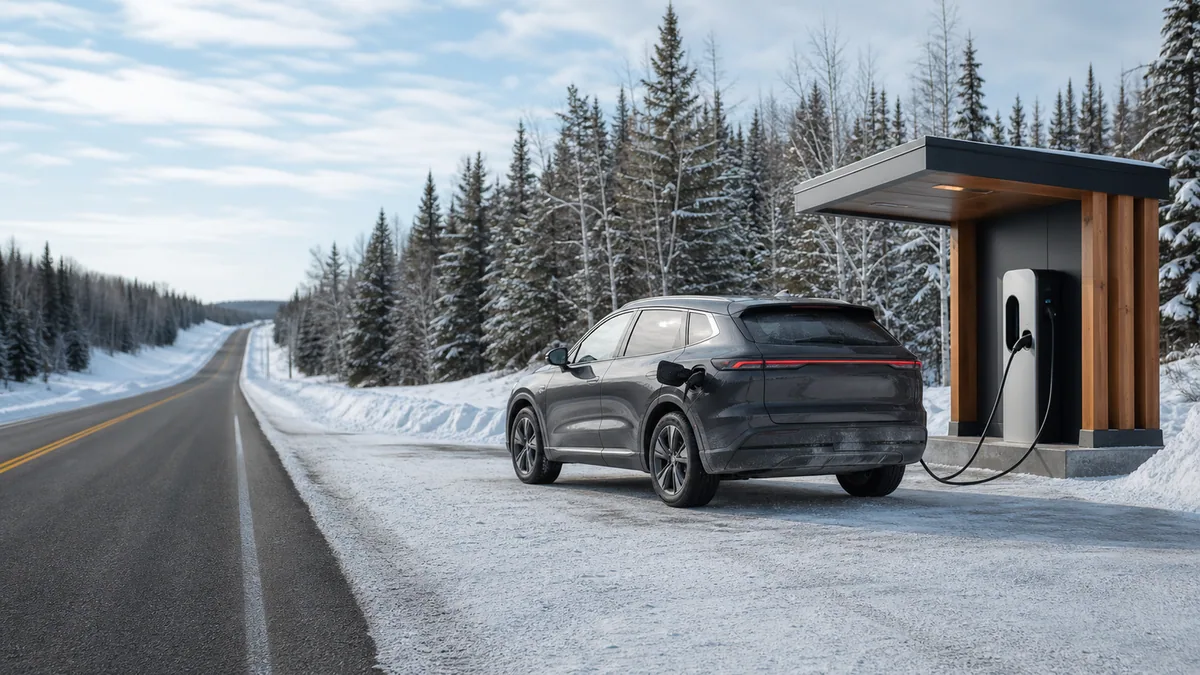
The global shift toward electric mobility is no longer a distant trend. It is unfolding right here, right now. Across Canada, electric vehicles (EVs) are transitioning from city commuter novelties to mainstream options for everyday drivers. Yet, while an EV might feel like a straightforward choice for someone navigating downtown Toronto, the narrative shifts dramatically when you move north of Muskoka.
For drivers in Northern Ontario, communities like Sudbury, North Bay, Timmins, Sault Ste Marie, and Thunder Bay present a completely different set of automotive demands. This region is defined by vast geographic gaps, rugged terrain, wildlife hazards, and winters where the thermometer routinely plummets below minus 30 degrees Celsius.
When your daily drive involves hundreds of kilometers of isolated highways flanked by dense boreal forest, “range anxiety” takes on an entirely new meaning. If a battery fails or loses charge unexpectedly in a remote stretch between Hearst and Kapuskasing, it is not just an inconvenience—it can quickly become a serious safety hazard.
This reality leaves many Northern Ontario residents asking a critical question: Is an electric vehicle truly practical for this region, or are local drivers better off sticking with reliable internal combustion engines or traditional hybrids?
To find the answer, we must separate marketing hype from real-world northern driving conditions. Let us examine how modern EV technology, charging networks, and regional economics hold up against the unique demands of life in Northern Ontario.
The Reality of Northern Ontario Winters: Battery Performance Under Pressure
The single biggest concern for any prospective electric vehicles buyer in the North is the winter weather. It is a well-established scientific fact that lithium-ion batteries dislike extreme cold. When temperatures drop, the chemical reactions inside the battery cells slow down, making the battery less efficient at storing and releasing energy.
Understanding Winter Range Loss
So, how much range do you actually lose when a true northern blizzard rolls in? On average, an EV can lose anywhere from 20 percent to nearly 50 percent of its advertised driving range when temperatures fall significantly below freezing.
This drop is caused by two distinct factors:
Reduced Electrochemical Efficiency: The internal resistance within the battery pack increases, limiting its total usable capacity.
Cabin Heating Demands: Unlike conventional internal combustion engine vehicles, which utilize the massive amount of waste heat generated by burning gasoline to warm the cabin, an EV must generate its own heat. Running an electric cabin heater draws energy directly from the high-voltage battery pack, leaving less power available to rotate the wheels.
For example, an electric crossover with an official summer range of 450 kilometers might only deliver 250 to 280 kilometers of real-world driving on a bitter January morning in Thunder Bay. For a driver who frequently commutes between regional hubs, this reality requires careful calculation and a clear understanding of vehicle mechanics.
The Critical Role of Heat Pumps and Preconditioning
Fortunately, automotive technology has advanced significantly. EV manufacturers have introduced features specifically designed to mitigate cold-weather range degradation. Chief among these is the modern heat pump system.
Instead of relying on inefficient resistive heating, which acts like a giant toaster to warm the air, a heat pump absorbs ambient heat from the outside environment and compresses it to warm the cabin. Even in sub-zero temperatures, these systems are remarkably efficient, drastically reducing the climate control system’s power draw and preserving precious driving range.
Another vital practice for northern EV owners is battery preconditioning. By using a smartphone app while the vehicle is still plugged into a home wall charger, a driver can instruct the car to warm up both the cabin and the battery pack using grid power before departing. This ensures that the trip begins with a warm, highly efficient battery pack and a comfortable cabin, without draining a single percentage point of the vehicle’s onboard energy.
Mapping the Grid: The State of Charging Infrastructure in the North
An EV is only as practical as the infrastructure supporting it. In Southern Ontario, high-powered charging stations are incredibly common. In Northern Ontario, the infrastructure network is growing, but it remains a work in progress that requires drivers to plan ahead.
The Backbone: Trans-Canada Highway Corridors
The primary driving arteries of the region—Highway 17 (the Trans-Canada Highway running along Lake Superior) and Highway 11 (the northern route through Cochrane and Hearst)—serve as the lifelines for northern travel. Historically, these corridors were complete charging deserts. Today, strategic investments have established a baseline level of connectivity.
The Ivy Charging Network, a joint venture between Hydro One and Ontario Power Generation, has made targeted efforts to install Level 3 DC fast chargers across major northern routes. Additionally, the expansion of the Tesla Supercharger network, alongside installations from providers like FLO and Circuit Électrique near the Quebec border, means that the major towns are now connected. You can reliably find fast-charging infrastructure in major centers like Kenora, Dryden, Thunder Bay, Sault Ste Marie, Sudbury, and North Bay.
The Challenge of Remote Routes and Hardware Reliability
While the highway corridors are connected, the space between chargers remains vast. In many parts of Northern Ontario, stations are spaced roughly 80 to 100 kilometers apart. While this is manageable on paper, it leaves very little room for error.
If a fast charger in a remote community like White River or Nipigon happens to be broken, frozen, or occupied by another motorist when you arrive, it can disrupt your travel schedule.
Furthermore, extreme cold places immense stress on the charging equipment itself. LCD screens on older charging pumps can freeze, cables become stiff and difficult to manipulate, and the charging stations themselves can experience communication faults with the vehicle due to extreme temperatures.
For a northern driver, relying entirely on public infrastructure is currently a risky strategy. Success with an EV in this region heavily depends on your ability to control your own charging source.
Home Charging: The Ultimate Prerequisite for Northern Success
Because public charging networks in the North face environmental and geographical hurdles, having a dedicated charging setup at home is an absolute necessity. For anyone considering an EV in Northern Ontario, a standard household outlet will simply not cut it during the winter months.
Level 1 vs. Level 2 Charging in the Cold
A standard Level 1 charger uses a typical 120-volt residential outlet. In ideal summer conditions, this method adds roughly 6 to 8 kilometers of range per hour of plugging in.
In a northern winter, however, a Level 1 connection is highly inefficient. When temperatures plummet, a significant portion of that 120-volt current is redirected away from filling the battery pack and used instead just to power the battery’s internal heating elements to keep the cells from freezing. In extreme circumstances, an EV plugged into a Level 1 outlet overnight in Kapuskasing might gain almost zero net range.
To make an EV practical here, installing a Level 2 charging station (240-volt, similar to an electric clothes dryer or stove outlet) inside a garage or on an exterior wall is essential. A Level 2 charger delivers enough electrical current to effortlessly power the battery’s internal climate systems while simultaneously delivering a full charge to the vehicle overnight.
Garage Storage: A Massive Advantage
While it is entirely possible to own an electric vehicle while parking it outdoors in a driveway, having access to an insulated or heated garage is a massive advantage for a northern driver. Keeping the vehicle sheltered from icy winds reduces the energy required to precondition the cabin and battery. It also prevents the vehicle’s door handles, charge ports, and windshield wipers from freezing solid after a winter storm.
Financial Analysis: Can an EV Save Money in the North?
One of the main reasons drivers look into electric vehicles is the opportunity to save money on fuel and maintenance. With volatile fuel pricing across Northern Ontario, the financial incentive to switch to electricity can be quite strong, though local factors must be taken into account.
Fuel Savings vs. Northern Gasoline Prices
Gasoline prices in Northern Ontario are consistently higher than the provincial average. Fuel transportation costs to remote areas mean that drivers in places like Timmins or Kenora pay a steep premium at the pump.
Conversely, Ontario features a highly clean and reliable electricity grid. For drivers who can charge at home during off-peak hours using overnight electricity rates, the cost per kilometer driven is remarkably low.
Even when factoring in winter range loss—where your vehicle requires more kilowatt-hours of electricity to travel the same distance—the cost of electricity remains far lower than buying equivalent amounts of gasoline to feed a combustion engine struggling through winter snow drifts.
Reduced Maintenance Costs in Isolated Communities
Living in a remote northern community means that routine vehicle maintenance can sometimes involve a long trip to a specialized dealership. This is an area where battery electric vehicles offer a significant advantage.
EVs have no engine oil to change, no spark plugs to replace, no timing belts to snap, and no complex exhaust systems to rust out from road salt. Furthermore, thanks to regenerative braking—where the electric motor reverses to slow the vehicle down while recapturing energy—the physical brake pads and rotors on an EV experience far less wear and tear, often lasting years longer than those on a conventional vehicle.
However, there is a counterweight to these savings. If an EV does require complex mechanical work or warranty service on its high-voltage drivetrain, you may need to have the vehicle towed over a long distance to a certified service center in a major hub like Sudbury or Barrie. Prospective buyers should always investigate where the nearest certified technicians for their specific vehicle brand are located.
Driving Dynamics: Handling Northern Terrain and Roads
Beyond batteries and budgets, a vehicle must perform safely and reliably on the road. Northern Ontario roads present distinct challenges, including frost heaves, gravel washboards, heavy slush, black ice, and frequent encounters with large wildlife like moose and deer.
Weight Distribution and All-Wheel Drive Performance
From a pure driving dynamics perspective, EVs are exceptionally well-suited for winter road conditions. Because the heavy battery pack is mounted low in the chassis beneath the floorboards, an electric vehicle features a low center of gravity and excellent weight distribution.
Instead of having a heavy engine up front and lightweight drive wheels in the back, an all-wheel-drive (AWD) EV distributes its weight evenly across both axles. This design provides superb traction when launching from a stop on an icy intersection or pulling through deep snow on an unplowed side street.
Furthermore, electric motors can adjust torque delivery to individual wheels almost instantly. While a conventional traction control system must cut engine power or apply mechanical brakes, an EV’s computer can modulate power to the electric motors within milliseconds, preventing wheel spin before it even starts.
The Moose Test and Severe Winter Road Hazards
The presence of large wildlife on northern highways requires a vehicle with excellent handling, quick braking response, and high structural integrity. The low center of gravity inherent in EVs minimizes body roll during sudden evasive maneuvers—a scenario colloquially known as the “moose test.”
Additionally, the lack of a traditional front engine block allows manufacturers to design massive, highly effective crumple zones in the front trunk area, enhancing safety in the event of a severe collision.
However, the extra weight of an EV due to its battery pack requires respect. A heavier vehicle possesses more momentum, which means stopping on black ice will take longer regardless of the drivetrain technology. Investing in top-tier, studded winter tires is a smart safety measure for anyone navigating northern highways during the colder months.
Navigating the Decision: Who is an EV Right For?
Evaluating the practicality of an electric vehicle in Northern Ontario shows that it is not a one-size-fits-all scenario. The region’s unique geography means an EV can be a perfect fit for one driver while being completely impractical for their neighbor.
The Ideal Northern EV Candidate
An electric vehicle is highly practical and cost-effective for you if:
You Can Charge at Home: You own a home with a driveway or garage and can install a Level 2 charging station.
Your Daily Commute is Predictable: Your typical daily driving stays within a 150-kilometer radius, allowing you to complete your round trips comfortably on a single home charge, even in the dead of winter.
You Live in a Major Regional Hub: You reside in or near Sudbury, North Bay, Sault Ste Marie, or Thunder Bay, where local service centers and public fast chargers are accessible.
You Own a Multi-Vehicle Household: Your household retains a secondary gas-powered or hybrid vehicle for unplanned, long-distance winter trips into remote areas.
When to Sticking to Internal Combustion or Hybrids is Better
An EV may not yet be practical for your lifestyle if:
You Frequently Drive Long, Remote Routes: Your work or lifestyle requires regular travel along remote stretches of highway without robust fast-charging infrastructure.
You Do Not Have Access to Home Charging: You live in an apartment complex or rental property without the ability to install a dedicated 240-volt charging port.
You Routinely Tow Heavy Loads in Cold Weather: Towing a heavy trailer or boat drastically reduces an EV’s range. Combining cold-weather range loss with the aerodynamic drag of towing can cut your total range down to unsafe levels for long distances.
Pro Tips for Operating an EV in the North
If you decide to make the transition to electric driving in Northern Ontario, implementing a few strategic habits will ensure a smooth, worry-free ownership experience.
Invest in Premium Winter Tires
Never skimp on winter rubber. Because electric vehicles generate maximum torque instantly from a standstill, high-quality winter tires are critical for maintaining traction. Look for winter tires specifically designed for EVs, which feature reinforced sidewalls to handle the extra weight of the battery pack and rubber compounds optimized for low rolling resistance.
Map Your Journeys with Specialized Apps
While built-in vehicle navigation systems are improving, specialized route-planning applications are invaluable for northern journeys. Apps like A Better Routeplanner (ABRP) allow you to input your specific vehicle model, starting battery percentage, ambient outside temperature, and even wind speeds. The app then calculates an incredibly accurate trip plan, telling you exactly where to stop to charge and how long you need to plug in to reach your destination safely.
Maintain a Winter Emergency Safety Kit
Given the isolation of northern driving, a robust winter emergency kit is essential for any vehicle, but especially for an EV operating in extreme cold. Always carry thick blankets, extra warm winter clothing, a small shovel, traction mats, candles, matches, and a high-capacity portable power bank for your smartphone. If you ever have to pull over and wait out a storm, you can rest easy knowing you are prepared.
Is Northern Ontario Ready for Electric Vehicles?
The answer to whether an electric vehicle is practical for Northern Ontario drivers is a conditional yes. The technology has matured to a point where a modern EV equipped with an efficient heat pump, a robust all-wheel-drive system, and a premium set of winter tires can confidently handle the harshest winters the region has to offer.
For the segment of northern drivers who can charge at home and primarily use their vehicles for local commuting or regional travel between major hubs, an EV offers an exceptional driving experience, lower maintenance costs, and substantial relief from high pump prices.
However, for those who regularly travel remote northern routes or lack access to a dedicated home charging setup, the geographic realities of the North mean that standard internal combustion engines or plug-in hybrid electric vehicles (PHEVs) remain a more practical choice for now.
Northern Ontario is undeniably moving toward an electric future, but navigating that future successfully requires understanding your personal driving patterns, recognizing the limits of the winter climate, and choosing a vehicle that matches your specific needs.


