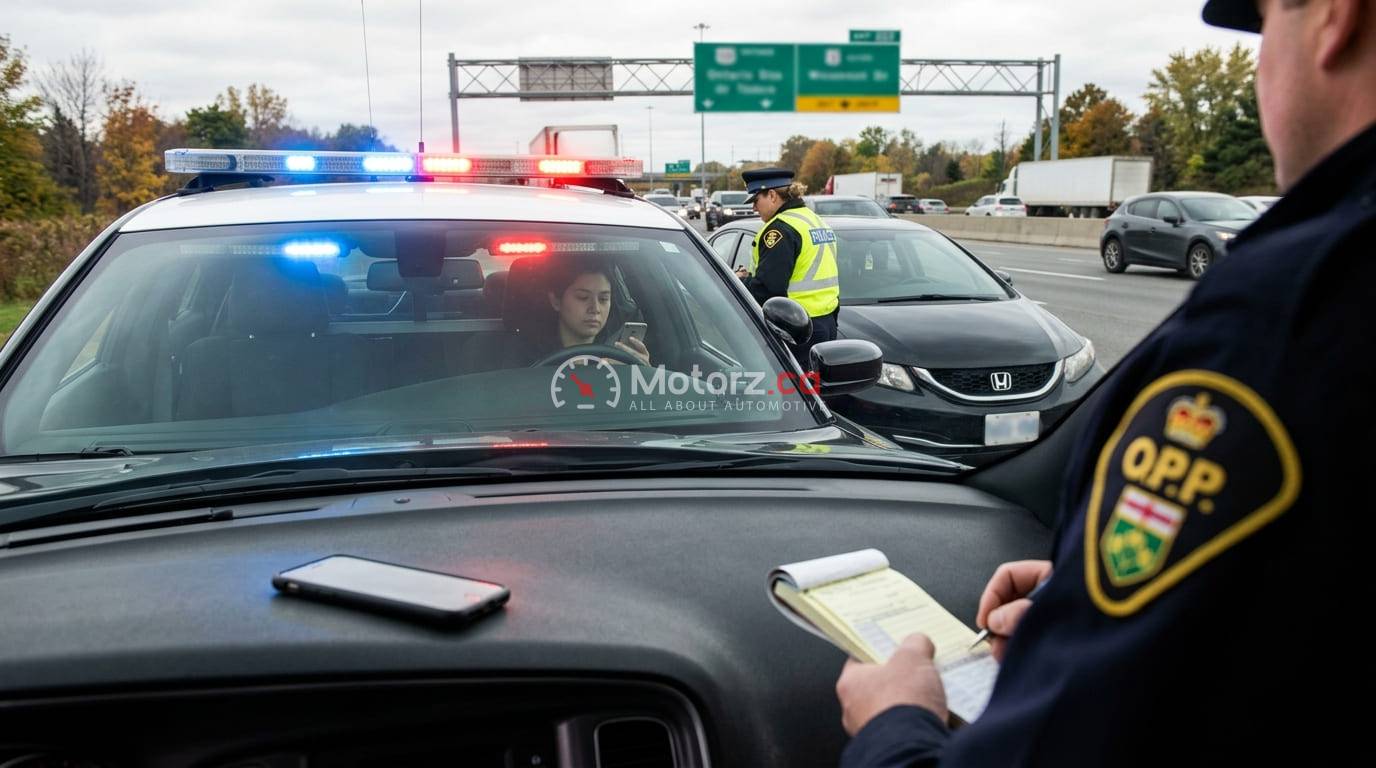
You are sitting at a red light on a busy Ontario Distracted Driving Laws, your vehicle completely stationary. Your phone buzzes in the cup holder with an important text message. You pick it up, tap out a quick reply, and look back up at the road. It feels completely harmless—after all, your car was not even moving.
However, under the Ontario Highway Traffic Act (HTA), you have just committed a serious traffic offence. If an observant police officer spots you, that single text message can trigger an immediate roadside licence suspension, hundreds of credits in out-of-court fines, and long-term financial consequences for your insurance premiums.
In Ontario, distracted driving is no longer viewed as a minor roadside oversight. The Ontario Ministry of Transportation and regional police services treat inattentive driving with strict severity, because provincial data shows that a driver is injured in a distracted driving collision every half hour.
This comprehensive legal guide breaks down everything you need to know about Ontario’s strict distracted driving framework. We will examine exactly what counts as an infraction, outline the current penalties for both fully licenced and novice drivers, explore the hidden financial fallout, and clarify how these laws are actively enforced on Ontario roads.
What Exactly Counts as Ontario Distracted Driving Laws?
To stay compliant with the law, you must understand that the Driving Laws of distraction under Section 78.1 of the Ontario Highway Traffic Act is remarkably broad. Many motorists believe they can only be charged if they are caught typing a text or talking with a phone held to their ear. The reality is far more strict.
The Direct Handheld Device Prohibition
The core of Ontario’s legislation targets the physical handling of electronic communication and entertainment devices. It is explicitly illegal to hold, look at, or manipulate any wireless communication device while you are operating a vehicle.
This means you cannot engage in any of the following activities while behind the wheel:
Texting or messaging: Reading, opening, typing, or sending any text, email, or chat notification.
Dialing or checking calls: Manually entering a phone number or holding your device to talk on speakerphone.
App navigation and scrolling: Checking social media feeds, browsing internet browsers, or selecting music playlists.
Momentary handling: Picking up your phone simply to move it from the passenger seat to the center console, check the time, or plug in a charging cable.
The Red Light Myth: The law applies whenever you are “operating” a motor vehicle. In Ontario, this includes when you are stopped at a red light, caught in slow-moving traffic on the Don Valley Parkway (DVP), or waiting in a fast-food drive-thru lane. As long as your vehicle is on a live roadway and you are in control of the wheel, holding a device is an offence.
Forbidden Entertainment and Display Screens
The law does not stop at mobile phones. It is also illegal to drive while viewing any display screen that is actively displaying content unrelated to the immediate driving task.
If you are using a personal audio player or a secondary mobile device plugged into your car’s sound system, the screen must be positioned or secured so that it is not visible to you while you are driving.
Legal Exceptions: What Is Allowed Behind the Wheel?
While the Highway Traffic Act is highly restrictive, it does carve out explicit exceptions to accommodate modern technology and safe navigation. Knowing what you are legally permitted to do can help you avoid unnecessary tickets while keeping your focus firmly on the road ahead.
The True Definition of Hands-Free Operation
You are legally permitted to use cell phones and communication devices only if they are configured for hands-free operation. This requires meeting specific structural conditions:
Secure Mounting: The device must be securely attached or fixed to the vehicle’s dashboard, console, or windshield in a commercial mount. It cannot be loose on your lap, resting on the passenger seat, or sliding around the dashboard.
Single-Touch Activation: You may press a single button on a mounted device or your steering wheel to activate, answer, or end a voice call. Prolonged interaction, such as typing out a contact name or scrolling through an address book, is strictly forbidden.
Voice-Activated Systems: You are fully permitted to use voice-activated navigation systems, integrated Bluetooth connectivity, and factory-installed infotainment dashboards (such as Apple CarPlay or Android Auto) to control your media and communications.
Real-World Allowances: GPS, Radios, and Emergency Situations
To help clarify how these exceptions function during a daily commute, review the structured breakdown below detailing exactly what you can and cannot interact with.
The Emergency Exception: Motorists are legally allowed to handle a phone to call emergency services (such as 911) if they need to report a severe collision, an immediate public safety hazard, a fire, or a medical crisis. However, this exception must be a true emergency where pulling over safely is completely impossible.
When Are You Legally “Parked”?
If you must use your hand-held phone to look up an address or read an extensive text message, you must ensure your vehicle is completely out of active traffic.
To meet the legal threshold of being safely parked in Ontario, your vehicle must be pulled over in a safe, lawful area where it is permitted to remain stationary. Acceptable locations include a designated parking stall in a commercial lot, a legal parking space on the side of a municipal street, or a highway rest area lay-by.
Pulling over to the shoulder of a busy highway like the 401 or stopping in a live curbside lane with your hazard lights flashing does not constitute being safely parked; you can still be issued a distracted driving ticket in those scenarios.
Penalties for Fully Licenced Drivers
If you hold a full Ontario driver’s licence (Class A, B, C, D, E, F, or G), you face escalating statutory penalties that increase sharply with every subsequent conviction. These penalties strike your finances, your driving privileges, and your permanent driving record simultaneously.
First Conviction
If you are caught and convicted of a distracted driving offence for the first time, the statutory penalties include:
The Fine: A standard out-of-court set fine of 615 credits, which includes the victim fine surcharge and court costs. If you choose to fight the ticket in court and lose, a judge can increase this penalty up to a maximum of 1,000 credits.
Licence Suspension: An immediate, mandatory 3-day administrative licence suspension. Your driving privileges are frozen the moment the conviction is registered.
Demerit Points: A total of 3 demerit points are added to your Ontario driving record.
Second Conviction
If you are caught committing a second distracted driving offence within a five-year window, the consequences become significantly more severe:
The Fine: The out-of-court fine remains 615 credits, but if the matter is contested in court and results in a conviction, the judge can scale the financial penalty up to 2,000 credits.
Licence Suspension: A mandatory 7-day administrative licence suspension.
Demerit Points: A total of 6 demerit points are added to your driving record, which automatically triggers a mandatory warning interview with the Ministry of Transportation.
Third and Subsequent Convictions
Drivers who continue to violate Ontario’s distracted driving laws face the maximum penalties allowed under the Highway Traffic Act for this offence category:
The Fine: If fought in court and lost, the fine can reach a maximum of 3,000 credits.
Licence Suspension: A mandatory 30-day administrative licence suspension, completely removing your ability to commute or drive for a full month.
Demerit Points: An additional 6 demerit points are added to your record.
Penalties for Novice Drivers
Ontario manages new motorists through the Graduated Licensing System (GLS). Because novice drivers are still building their defensive driving skills, the province applies an entirely different, highly disruptive set of penalties for distracted driving.
If you hold a G1, G2, M1, or M2 licence and are convicted of a distracted driving infraction, you face the exact same out-of-court and in-court financial fines as a fully licenced driver. However, you do not receive any demerit points. Instead, Ontario replaces demerit points with strict, immediate licence suspensions under the province’s escalating penalties framework.
The Ultimate Novice Penalty: Licence Cancellation
As highlighted above, a third distracted driving conviction for a novice driver results in the complete cancellation of their licence. This means you are completely removed from the Graduated Licensing System.
Any time or progress you spent accumulating driving experience is completely erased. To regain your driving privileges, you must return to a DriveTest center, pay all licensing fees again, pass the vision and written knowledge tests to get a fresh G1 licence, and wait out the mandatory graduated waiting periods before booking your road tests all over again.
Beyond the Fine: The Hidden Financial Fallout
Many drivers look at a 615-credit distracted driving ticket and view it as a one-time structural expense. They assume that once they pay the provincial court clerk, the ordeal is behind them. This is an expensive misconception. The true long-term financial cost of a distracted driving conviction shows up in your auto insurance premiums.
Classification as a Major Offence
In Ontario’s highly regulated auto insurance market, insurance providers categorize traffic convictions into three distinct groups: minor, major, and criminal.
Historically, electronic device tickets were grouped with minor infractions like failing to signal or minor speeding. Today, Ontario insurance companies classify distracted driving as a Major Infraction. This places a cell phone ticket in the exact same risk category as criminal-adjacent offences like stunt driving, failing to remain at the scene of an accident, or passing a stopped school bus.
The Reality of Insurance Premium Hikes
Because a major infraction indicates high-risk behind-the-wheel behavior, your insurance rates will react sharply at your next policy renewal date.
A single distracted driving conviction can cause your annual auto insurance premiums to skyrocket by 50 percent to 100 percent or more. For an average Ontario driver paying 2,000 credits annually, this single ticket can easily translate into an additional 1,000 to 2,000 credits in extra insurance costs every single year.
Furthermore, because convictions stay on your public driving record for three full years from the actual date of conviction, you will end up paying that elevated premium surcharge for thirty-six consecutive months. When you calculate the compounding math, a single text message can easily cost you well over 4,000 credits in total out-of-pocket expenses.
Policy Non-Renewals and Facility Insurance
If you happen to have a second distracted driving conviction on your record, or if it is paired with a minor speeding ticket, your current insurance provider will likely drop you entirely. They will issue a notice of non-renewal, stating that you no longer qualify for standard marketplace rates.
When this occurs, your only option to remain legally insured on Ontario roads is to seek out specialty high-risk insurance providers or enter the Facility Association—an insurance pool of last resort. Facility insurance premiums are notoriously expensive, often costing motorists between 5,000 and 10,000 credits annually to maintain basic road legalities, which can completely disrupt a personal or household budget.
Escalating Charges: Careless and Dangerous Driving
Holding a phone is bad enough, but if your lack of attention causes you to drive erratically or cause an accident, Ontario law enforcement will instantly upgrade your charges. You will move past simple distracted driving tickets into severe provincial and federal statutory offences.
Careless Driving
Under Section 130 of the Ontario Highway Traffic Act, you can be charged with Careless Driving if you operate a vehicle on a highway without due care and attention, or without reasonable consideration for other persons using the highway.
If a police officer notes that you were looking at your phone while drifting across solid highway lanes, tailgating the vehicle in front of you, or causing other motorists to slam on their brakes, you will face this charge.
The penalties for Careless Driving are exceptionally severe:
Fines: A minimum court fine of 400 credits that can scale up to 2,000 credits.
Demerit Points: An immediate addition of 6 demerit points to your driving record.
Licence Suspension: A maximum provincial licence suspension lasting up to 2 years.
Imprisonment: The court has the statutory authority to sentence you to up to 6 months in a provincial correctional facility.
If your careless driving results in bodily harm or death to another road user, the fine can scale from a minimum of 2,000 credits up to a maximum of 50,000 credits, alongside mandatory multi-year licence suspensions and up to two years of jail time.
Dangerous Driving
If your level of distraction is so extreme that it constitutes a willful disregard for public safety, you can be criminally charged with Dangerous Operation of a Motor Vehicle under Section 320.13 of the Criminal Code of Canada. This is a federal criminal offence, not a provincial regulatory ticket.
A conviction for dangerous driving yields permanent, life-altering structural consequences:
Criminal Record: You will receive a permanent criminal record that will show up on background checks, severely impacting your ability to secure employment or travel internationally.
Mandatory Driving Prohibition: A nationwide driving prohibition order lasting for a minimum of 12 months.
Jail Sentences: If your distracted dangerous driving causes bodily harm, you face up to 10 years in federal prison. If it causes the loss of human life, the maximum penalty climbs to 14 years in prison.
How Police Enforce Distracted Driving Laws in Ontario
Many motorists wonder how police can actually catch them handling a phone, assuming that keeping their device low on their lap hides it from view. In reality, Ontario police services utilize a variety of advanced, highly organized enforcement strategies to spot distracted drivers.
Unmarked and High-Profile Vehicles
Police forces regularly deploy plainclothes officers in unmarked civilian vehicles—such as SUVs, pickup trucks, and commercial transit vans. The elevated seating position inside an unmarked pickup truck allows an officer to look directly down through your car’s side window, giving them an unobstructed view of your lap and center console.
High-Powered Spotting Scopes
During dedicated traffic safety blitzes, officers set up elevated observation points on overpasses, highway pedestrian bridges, or transit platforms. Armed with high-powered binoculars and long-range cameras, they can easily read the illuminated screen of a smartphone from hundreds of meters away. They then radio the vehicle description down to a line of waiting cruisers to perform the roadside stop.
Public Transit Infiltration
In major urban centers like Ottawa and the Greater Toronto Area (GTA), officers have been known to ride municipal transit buses. Looking out the large passenger windows of a city bus gives police a clear view into every surrounding vehicle idling in traffic.
Officer Observation Testimony
It is important to recognize that a police officer does not need photographic or video evidence of you holding a phone to secure a conviction in a provincial offences court. The officer’s professional visual observation testimony is fully admissible as legal evidence. If the officer testifies under oath that they clearly saw you holding a rectangular electronic device, looking down repeatedly, and manipulating a screen with your thumb, that testimony alone is structurally sufficient to secure a conviction unless you can present a compelling legal defense.
Practical Strategies to Avoid Distracted Driving Charges
Eliminating distraction behind the wheel is entirely straightforward, but it requires breaking ingrained digital habits. You can use these simple, practical strategies to safeguard your licence, your finances, and your safety:
Activate “Do Not Disturb While Driving”: Modern smartphones feature automated driving modes that detect when your vehicle is in motion via GPS or Bluetooth linkage. The phone will automatically silence all incoming text messages and app notifications, sending a polite automated response to contacts explaining that you are currently driving.
Pre-Program Your Routes: Never wait until you are driving down a street to configure your destination coordinates. Enter your address into your GPS or infotainment system while your car is safely parked in your driveway. If you miss a turn, let the system recalculate automatically or pull over safely before touching the screen.
Out of Sight, Out of Mind: If you lack the self-discipline to ignore a vibrating phone, remove the temptation entirely. Place your phone inside your closed glove box, zip it into a backpack placed on the rear seat, or store it securely inside your vehicle’s trunk until you arrive at your destination.
Delegate to Passengers: If you are traveling with friends or family members, make them your designated co-pilot. Hand your phone to your passenger and let them respond to text messages, skip songs, or monitor navigation changes for you.
By understanding the strict legal framework governing Ontario’s roads and adapting your driving habits accordingly, you can protect your financial budget, preserve your driving record, and ensure everyone arrives safely at their destination.