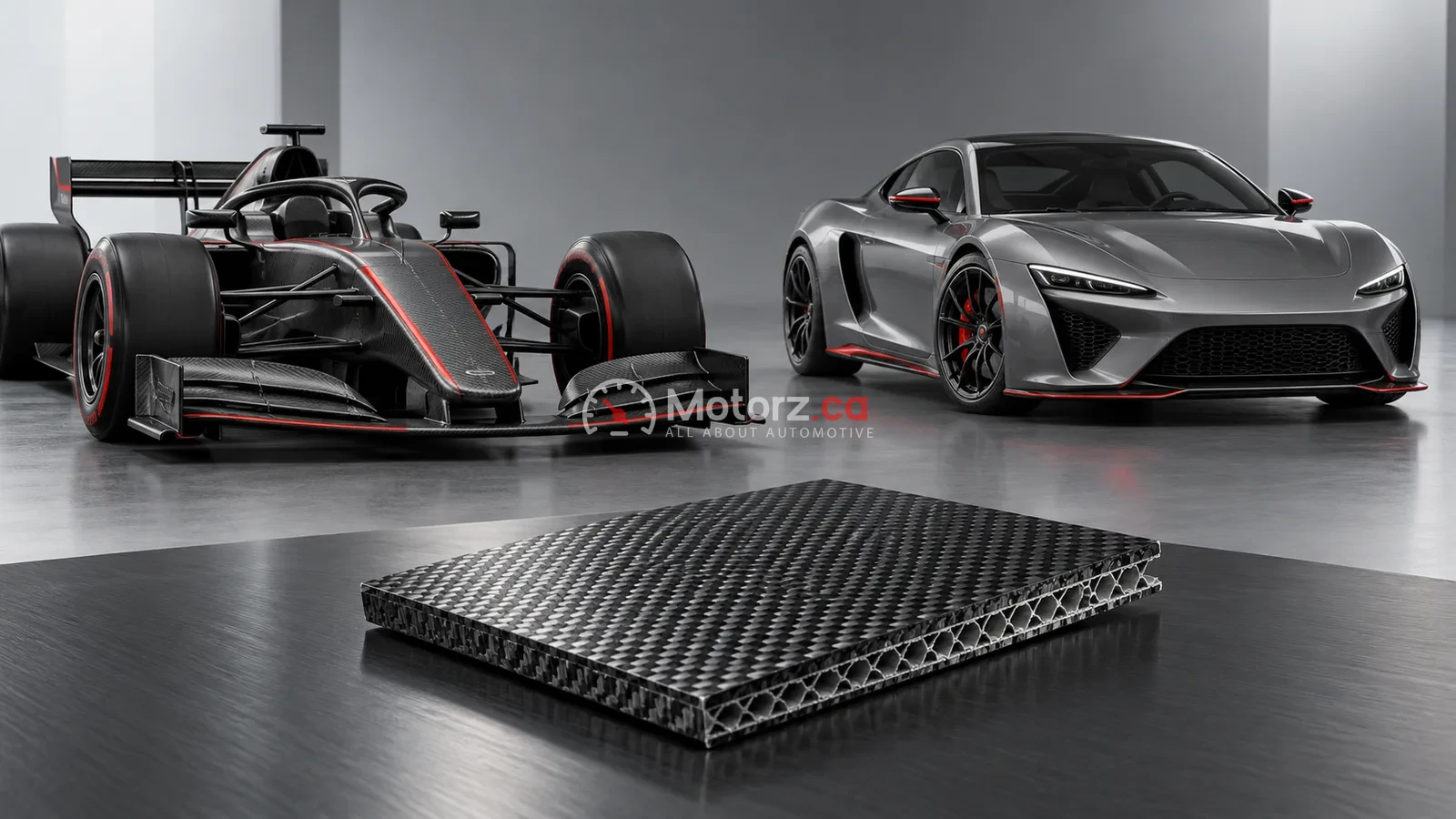
Motorsport can be a development environment for road-car technology, but a racing connection needs more than similar-looking parts. Two useful examples are McLaren's carbon-composite chassis work and Porsche's dual-clutch transmission development. Their histories identify particular vehicles and show that transfer can take years rather than happen immediately.
This is a source-led history, not a driving review or a claim that racing invented every technology in a modern car. Motorz.ca has not tested these historic vehicles.
Carbon-composite construction: McLaren MP4/1 to F1
McLaren's archive identifies the MP4/1 as its 1981 Formula 1 car with a carbon-composite chassis. It connects that material-development work with the later three-seat McLaren F1 road car. The account also discusses aerospace expertise used during development—an important reminder that motorsport itself draws on other industries. McLaren MP4/1 archive
McLaren's road-car history places the F1's realization in 1992 and describes its carbon-fibre monocoque. The defensible link is a documented progression in structural materials and construction expertise, not a claim that the road car used an unchanged Formula 1 chassis. McLaren F1 history
When reading about this example, distinguish the announcement or unveiling of a car from the start of customer production. Also distinguish a structural monocoque from a decorative carbon-fibre trim panel: a shared material name does not establish a shared engineering role.
Porsche PDK: racing development before series-road use
Porsche's historical account describes dual-clutch transmission work in the early 1980s, testing in a 944 Turbo and further development with its 956 and 962 racing cars. It records a 962 victory at Monza in 1986, but also explains that electronics, valves and clutch development delayed wider road-car adoption. PDK became an option on the 911 in 2008, followed by applications in the Panamera in 2009. Porsche's PDK history
The interval is the important part of the story. Success in competition did not mean the transmission was immediately ready for ordinary road-car use. The same account describes early shift behaviour that was unsuitable for passenger comfort. This is a development history with obstacles, not a simple tale of a race component being transferred unchanged to a showroom vehicle.
How to assess a “race-derived” claim
Use four questions to separate an engineering history from a loose marketing association:
- What is the technology? Name the structure, mechanism or development method, not just the racing team.
- Where was it used? Identify the competition vehicle and the road-car application separately.
- When did each stage occur? A concept, test vehicle, race entry and production car can have different dates.
- What actually transferred? Look for documented design knowledge or a component relationship, rather than assuming identical hardware.
For a Canadian buyer, a racing connection is context, not an equipment guarantee. Check the exact model year and vehicle specification rather than assuming a feature described in a brand's heritage is fitted to every current car.
What these examples do not establish
Neither history proves that all road-car safety systems originated on a racetrack. Nor does it establish that a current car is safer, cheaper to own or better suited to your needs merely because its manufacturer races. Those are separate claims requiring their own evidence.
The more useful conclusion is narrower: motorsport can contribute to a documented chain of development, while production-road-car adoption introduces its own requirements and timetable. Follow that chain rather than relying on the label alone.
For related vehicle-selection context, visit the Motorz.ca car-buying hub.
Image disclosure: AI-generated conceptual illustration. Not an exact McLaren or Porsche vehicle depiction.