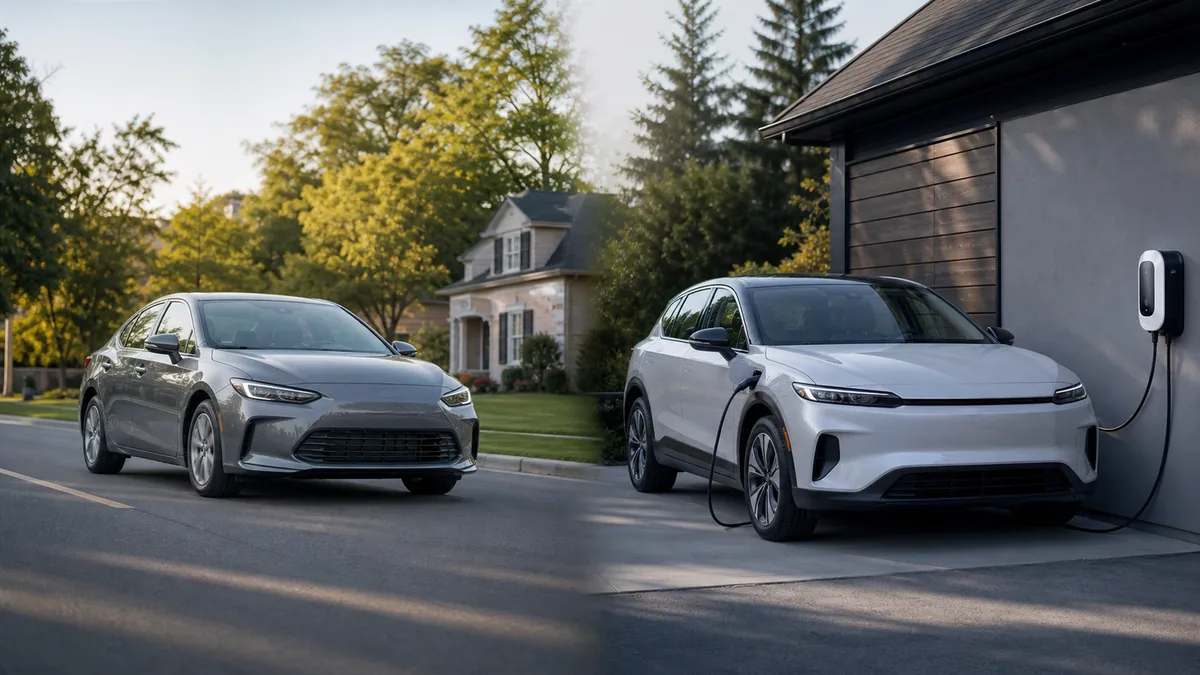
The Ontario automotive landscape is shifting quickly. For decades, choosing a vehicle was simple: you picked a car, chose a color, and fueled up at the local gas station. Today, a walk across any dealership lot in Toronto, Ottawa, or London reveals a completely new reality. Drivers are faced with a crucial choice between conventional gas engines, traditional hybrids, plug-in hybrids, and fully electric vehicles.
With fuel prices remaining unpredictable and the provincial climate throwing extreme heat waves and deep winter freezes at our vehicles, deciding on a powertrain requires careful thought. Many Ontario buyers find themselves caught in a major debate: Do you go fully electric to completely escape the gas pump, or is a hybrid variant the safer, more practical choice for our infrastructure and climate?
To crown a winner, we need to look past simple marketing slogans and analyze real data. We will evaluate how these two powertrains compare regarding upfront costs, real-world winter performance, long-term maintenance, and the everyday reality of living with them in Ontario.
Defining the Contenders: Hybrid vs. Plug-In Hybrid vs. Fully Electric
Before diving into the financial and operational details, we must clarify what we are comparing. The term “hybrid” covers two distinct technologies, both of which compete directly with Battery Electric Vehicles (BEVs).
Traditional Hybrids
A traditional hybrid, such as a standard Toyota RAV4 Hybrid or Honda CR-V Hybrid, utilizes a conventional gasoline engine paired with a small electric motor and a self-charging battery pack. The vehicle automatically alternates between gas and electric power based on driving conditions.
You cannot plug these vehicles into an wall outlet. The battery captures energy entirely through regenerative braking (capturing energy while slowing down) and from the gas engine itself. They offer excellent fuel efficiency, especially in heavy urban traffic, but they still rely one hundred percent on gasoline.
Plug-In Hybrids
A Plug-In Hybrid Electric Vehicle, like the Mitsubishi Outlander PHEV or Chrysler Pacifica Hybrid, acts as a bridge between two worlds. It features a larger battery pack that you can plug into a charging station.
A PHEV typically delivers between forty and eighty kilometers of pure electric driving range on a full charge. Once that battery capacity drops, the vehicle seamlessly switches to operating like a traditional hybrid, running on its onboard gasoline engine.
Fully Electric Vehicles
A Battery Electric Vehicle, such as a Tesla Model Y, Hyundai Ioniq 5, or Ford Mustang Mach-E, eliminates the gasoline engine entirely. It features a large high-voltage battery pack powering one or more electric motors.
A BEV relies entirely on the electrical grid for fuel. It emits zero tailpipe emissions and must be plugged into a Level 2 home charger or a public Level 3 DC fast charger to replenish its range.
Upfront Purchase Price and the Ontario Incentive Landscape
When evaluating any vehicle in Ontario, the financial analysis always begins at the point of sale. Fully electric vehicles and plug-in hybrids carry a price premium over traditional hybrids and conventional gas vehicles due to the high cost of raw battery materials.
The Federal Incentive Framework
While Ontario does not currently offer a provincial consumer rebate for purchasing a brand-new electric vehicle, buyers can access significant funding through the federal government. The Electric Vehicle Affordability Program (EVAP) provides financial support directly at the dealership counter.
Under this framework, vehicles are eligible based on clear pricing and manufacturing guidelines:
Fully Electric Vehicles (BEVs): Eligible for an incentive up to 5,000 credits for vehicles with a final transaction value under 50,000 units, though Canadian-made electric models are completely exempt from this price ceiling.
Plug-In Hybrids (PHEVs): Eligible for an incentive up to 2,500 credits under the same pricing thresholds.
- Traditional Hybrids (HEVs): Do not qualify for federal or provincial purchase incentives.
Depreciation and Total Cost of Ownership
Even with federal support lowering the initial purchase barrier for a BEV or PHEV, traditional hybrids often win on pure upfront affordability. A buyer can purchase a well-equipped traditional hybrid hatchback or crossover for less total layout than an equivalent fully electric model.
However, the calculation changes when you look at the total cost of ownership over a five-year period. Traditional hybrids maintain very high resale values in the Ontario pre-owned market due to strong consumer confidence in their long-term reliability. Fully electric vehicles experience unique depreciation curves; while early models lost value rapidly as technology advanced, modern long-range BEVs are holding their value much better as the public charging network matures.
Operating Costs: Fuel vs. Ontario Electricity Rates
Once a vehicle is parked in your driveway, your single largest ongoing expense is the energy required to move it. This is an area where Ontario’s unique electricity grid structure gives fully electric vehicles a distinct economic edge.
Navigating the Ultra-Low Overnight Price Plan
Ontario electricity customers have access to a residential pricing structure specifically tailored for electric mobility: the Ultra-Low Overnight (ULO) rate plan. Designed to encourage consumers to shift their electricity usage away from peak times, this plan offers a highly reduced rate between the hours of 11 PM and 7 AM.
Under the current pricing system, the cost differences are clear:
Ultra-Low Overnight Rate: Just 3.9 cents per kilowatt-hour during the overnight window.
Standard Time-of-Use On-Peak Rate: Reaches 39.1 cents per kilowatt-hour during weekday late afternoon peaks.
For a fully electric vehicle owner who programs their car to charge exclusively between midnight and 6 AM, the cost to travel one hundred kilometers can drop to less than two units of local currency.
The Cost to Fuel a Hybrid
In contrast, a traditional hybrid driver remains completely tied to local gasoline pricing. If gas prices hover around 1.50 per liter, an efficient hybrid averaging 5.5 liters per 100 kilometers will cost roughly 8.25 to travel that same distance.
Even a highly efficient plug-in hybrid will eventually exhaust its initial electric charge on longer commutes across the Greater Toronto Area (GTA), forcing the vehicle to consume gasoline at standard market rates. For drivers accumulating high annual mileage on commuter corridors like Highway 401 or Highway 417, the fuel savings from a BEV can offset the higher initial purchase price within a few years of ownership.
Winter Performance and the Realities of the Ontario Climate
Ontario winters pose a tough challenge for any automotive powertrain. Sub-zero temperatures, heavy lake-effect snow, and icy road conditions demand excellent performance from a vehicle’s climate and mechanical systems.
Cold Weather Battery Degradation
All battery systems experience reduced efficiency when the temperature drops. In a fully electric vehicle, winter driving causes a dual challenge. First, the internal resistance within the battery cells increases, reducing their ability to release energy efficiently. Second, because an electric vehicle lacks a combustion engine to create waste heat, it must use energy from the main battery pack to warm the cabin.
As a result, a BEV can lose thirty to forty percent of its driving range during an intense January freeze. A model rated for 400 kilometers in July might deliver 260 kilometers of range when commuting through a severe winter storm.
How Hybrids Handle the Deep Freeze
Hybrids handle extreme winter weather with much less impact on travel schedules. A traditional hybrid or PHEV uses waste heat from its gasoline engine to warm the passenger cabin. While fuel efficiency drops in the winter because the gas engine runs more often to maintain operating temperatures, the driver never faces range anxiety. When the energy drops, you simply spend five minutes pulling into any local service station to refuel.
For a commuter living in northern communities like Sudbury or Timmins—or someone who frequently travels remote corridors with limited infrastructure—the hybrid’s ability to resist cold-weather range limitations makes it an incredibly practical choice for winter travel.
The Infrastructure Race: Charging at Home vs. Public Networks
Your daily charging experience depends heavily on your housing situation and your geographic location within the province.
The Home Charging Prerequisite
For a fully electric vehicle to be truly practical, having access to reliable home charging is essential. Installing a Level 2 charging station (240-volt) in a garage or on a driveway allows a BEV owner to plug in at night and wake up every morning with a full charge, completely bypassing the gas station.
If you live in a high-rise condominium or rent an apartment without dedicated charging infrastructure, owning a BEV becomes much more complicated. In this scenario, you must rely entirely on public networks, which increases your overall fueling costs and requires setting aside time out of your week to sit at a public station. For these urban drivers, a traditional hybrid is often the more accessible and stress-free option.
The Public Charging Landscape in Ontario
Ontario’s public charging infrastructure is growing steadily. The Highway 401 corridor, the QEW, and major urban centers are well-equipped with fast-charging networks, including Tesla Superchargers and Ivy Charging Network installations. Long-distance road trips across Southern Ontario in a modern BEV are now quite straightforward.
However, once you venture off the primary highway corridors or travel into deep rural areas, public fast chargers become less common. If a public charger is broken or occupied when you arrive, it can cause delays. A hybrid vehicle removes this planning completely, since gasoline stations remain widely available in every corner of the province.
Long-Term Reliability and Maintenance Requirements
Maintenance costs are a critical element in the long-term total cost of ownership calculation. The mechanical differences between these powertrains lead to very different service experiences over time.
The Simplicity of the Electric Drivetrain
Fully electric vehicles are mechanically straightforward. They do not require engine oil changes, spark plug replacements, air filters, timing belts, or complex multi-speed transmissions. An EV drivetrain consists of an electric motor, a single-speed reduction gear, and a battery pack.
Furthermore, EVs utilize regenerative braking. When the driver lifts off the accelerator, the electric motor reverses to slow the car down, capturing that kinetic energy to recharge the battery. This system handles the vast majority of daily braking duties, meaning the mechanical brake pads and rotors experience very little wear and often last twice as long as those on a conventional vehicle.
The Complexity of the Hybrid Drivetrain
Hybrids represent the peak of automotive mechanical complexity. A hybrid or plug-in hybrid contains two complete propulsion systems packed under the sheet metal: a full combustion engine with its fuel systems, exhaust, and cooling loops, operating alongside an electric motor, an inverter, and a battery pack.
While manufacturers like Toyota have refined this technology over decades to make it incredibly reliable, a hybrid vehicle still requires all traditional internal combustion engine maintenance:
Regular oil and filter changes.
Coolant system flushes for both the engine and inverter loops.
Long-term component inspections for exhaust and emissions systems.
If a component fails out of warranty on an older, high-mileage vehicle, repairing a complex hybrid system can be more costly than servicing a simpler setup.
Making the Choice: Which Powertrain Wins For You?
Because every driver has unique needs, the ideal choice depends heavily on your daily driving habits, your budget, and your access to charging infrastructure.
Choose a Fully Electric Vehicle (BEV) If:
You Can Charge at Home: You have a garage or driveway where you can install a Level 2 home charger to take advantage of overnight electricity rates.
You Have a Consistent Commute: Your daily driving falls within a predictable range, allowing you to handle your daily travel easily on a single charge, even during winter.
You Want to Maximize Fuel Savings: You drive high annual mileage and want to eliminate gas expenses while minimizing routine maintenance.
You Primarily Travel Urban Corridors: Your long-distance driving stays mostly along major highways with robust fast-charging networks.
Choose a Traditional or Plug-In Hybrid If:
You Do Not Have Home Charging: You live in an apartment, condo, or rental property without dedicated access to a 240-volt plug.
You Frequently Travel Long, Remote Routes: You regularly drive deep into rural or northern areas where charging infrastructure is limited.
You Regularly Tow Heavy Loads: Towing a trailer or boat reduces an EV’s range significantly; a hybrid handles towing over long distances with much less impact on your travel time.
You Want a Lower Initial Price: You want an affordable vehicle with great fuel economy without moving to a fully electric option.
The Powertrain Winner in Ontario
In the current Ontario automotive market, the crown does not belong to a single powertrain—it is divided by how and where you drive.
For the suburban or urban homeowner with a dedicated driveway and a daily commute along the Golden Horseshoe, the Fully Electric Vehicle wins. When paired with the province’s Ultra-Low Overnight electricity rate and federal purchase support, a BEV delivers an unmatched combination of low running costs, minimal maintenance, and a smooth driving experience.
However, for drivers who travel long distances into rural areas, those without home charging options, and residents in northern communities facing extreme winters, the Hybrid and Plug-In Hybrid powertrain wins. It provides a practical balance, offering excellent fuel efficiency in the city while ensuring complete peace of mind on long journeys across Ontario’s vast geography.


