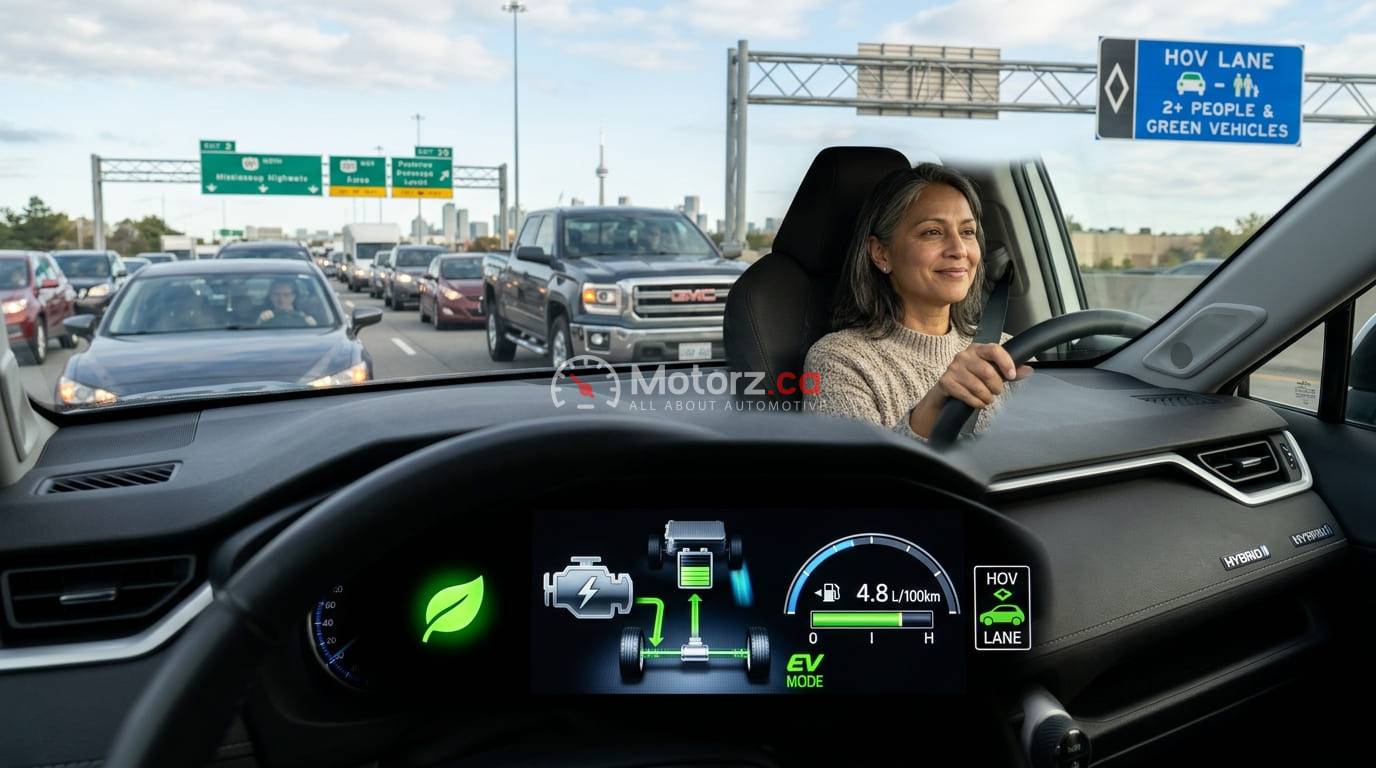
Every morning across Hybrid Worth It for Ontario Commuters, a familiar scene unfolds. Millions of commuters climb into their vehicles, check their navigation apps for the inevitable delays on the Don Valley Parkway, the Queen Elizabeth Way, or Highway 401, and begin a long, slow journey to work. But before they even hit the first bottleneck, many face a different kind of stress: the glowing numbers on the local gas station sign.
With fuel price volatility becoming the norm and the cost of living putting pressure on household budgets from Ottawa to Windsor, drivers are questioning their choice of powertrain. You have likely seen the green license plates passing you in the carpool lane and wondered if making the switch to a hybrid is a smart financial move or just clever marketing.
The automotive industry often markets hybrids as the ultimate solution for the modern commuter. They promise to slash your fuel bills while bypassing the range anxiety of fully electric vehicles. However, hybrid vehicles generally carry a higher upfront purchase price than their traditional, gas-powered counterparts. This premium raises a critical question for Ontario car buyers: does the fuel savings actually offset the higher initial price tag, and if so, how long does it take to break even?
To find out, we must look at the real math. This deep dive breaks down the actual numbers, hidden costs, and unique provincial driving conditions to determine whether buying a hybrid is truly worth it in Ontario.
The Core Formulas: Hybrid Worth It for Ontario Commuters
To understand the financial viability of a hybrid, we have to isolate a concept known as the hybrid premium. This is the difference in purchase price between a hybrid vehicle and an equivalent gas-only vehicle of similar size, trim level, and capability.
Historically, this premium was massive, sometimes requiring a decade of driving to recoup. Today, manufacturing efficiencies have narrowed the gap significantly. Let’s look at the basic mathematical framework required to calculate your personal break-even point.
The Return on Investment Formula
To calculate how many years it will take for your fuel savings to pay off the higher purchase price of a hybrid, use the following three steps:
Calculate Annual Gas Costs: (Annual Kilometers Driven divided by 100) multiplied by Fuel Consumption Rate (Liters per 100 Kilometers) multiplied by Cost per Liter of Gas.
Calculate Annual Savings: Subtract the hybrid car’s annual gas cost from the traditional gas car’s annual gas cost.
Calculate the Break-Even Timeline: Divide the upfront Hybrid Premium by your Annual Savings.
Let’s look at this framework using standard variables. Imagine an average Ontario commuter who travels 22,000 kilometers per year. If gas is priced at 1.65 per liter, and they are comparing a standard compact SUV burning 8.2 liters per 100 kilometers against its hybrid variant burning 5.4 liters per 100 kilometers, the math reveals clear patterns.
The gas-only vehicle will consume 1,804 liters of fuel annually, costing 2,976.60. The hybrid variant will consume 1,188 liters of fuel, costing 1,960.20 over the same distance. This results in an immediate annual fuel savings of 1,016.40. If the hybrid premium on that specific model is 3,000, the owner will break even in less than three years. Every kilometer driven after that point is pure profit back into the commuter’s wallet.
Real-World Scenarios: GTA Gridlock vs. Northern Transit
The math behind a hybrid is not static. It changes dramatically based on where you live and how you drive across Ontario. The province features vastly different driving environments, from the dense bumper-to-bumper crawls of the Greater Toronto Area to the high-speed, long-distance highways of Northern Ontario.
Scenario A: The GTA Stop-and-Go Crawl
Consider a driver living in Mississauga who commutes daily into downtown Toronto via the Gardiner Expressway. Their commute is relatively short in terms of physical distance—roughly 30 kilometers each way—but it routinely takes an hour or more due to heavy traffic congestion.
In this environment, a conventional internal combustion engine is at its absolute worst. It sits idling at a complete stop, burning fuel to power the air conditioning or cabin heater, and uses tremendous energy to repeatedly push two tons of metal from a dead stop.
Hybrids thrive in this exact nightmare scenario. They utilize regenerative braking to capture energy as the vehicle slows down, storing it in a small onboard battery pack. When traffic crawls at low speeds, the internal combustion engine shuts off completely, and the vehicle moves using pure electric power.
For the GTA commuter, a hybrid often achieves fuel efficiency numbers that closely match or even beat the manufacturer’s laboratory ratings. If their gas car mimics an inefficient 10.5 liters per 100 kilometers in urban gridlock, while a hybrid maintains a steady 4.8 liters per 100 kilometers, the annual savings skyrocket, dropping the break-even timeline to under two years.
Scenario B: The Open-Highway Rural Commute
Now let’s look at a driver residing in Peterborough who commutes along open rural roads and clear stretches of highway down to Oshawa. They maintain a consistent speed of 100 to 110 kilometers per hour for ninety percent of their journey.
On an open highway, aerodynamic drag is the primary force a vehicle must overcome. The electric motor of a conventional hybrid has fewer opportunities to take over because the vehicle rarely slows down to engage regenerative braking. Instead, the gas engine runs continuously to maintain highway speeds.
Modern hybrid engines still offer highway efficiency benefits because they utilize the highly efficient Atkinson cycle design, which leaves intake valves open longer during the compression stroke. However, the efficiency gap between a gas vehicle and a hybrid narrows at high, sustained speeds.
If the highway commuter saves only 1.5 liters per 100 kilometers by choosing a hybrid over a highly efficient modern gas sedan, their annual savings will be lower than the city driver’s savings. For this driver, the payback period might extend to four or five years, making the financial argument less immediate, though still viable for long-term ownership.
The Cold Weather Penalty: How Ontario Winters Impact the Math
You cannot discuss vehicle ownership in Ontario without talking about winter. From late November through March, sub-zero temperatures, heavy snow slush, and howling winds fundamentally alter how vehicles perform. This seasonal shift introduces a unique variable into the hybrid equation.
Battery Chemistry vs. The Canadian Freeze
All batteries, regardless of whether they are in a smartphone, a full electric vehicle, or a hybrid, are sensitive to temperature drops. Cold air slows down the internal chemical reactions within the battery cells, reducing their capacity to store and deliver energy efficiently.
Furthermore, a hybrid vehicle cannot rely solely on residual engine heat to warm the cabin immediately when turned on in the winter. To keep the windshield defrosted and the passengers warm, the vehicle’s computer will deliberately run the internal combustion engine more frequently than it would during a warm summer day, simply to generate thermal heat for the climate control system.
Adjusting the Real-World Fuel Economy Figures
During an Ontario winter, a hybrid’s fuel consumption will inevitably rise. A vehicle that achieves an outstanding 4.5 liters per 100 kilometers in July might climb to 5.8 liters per 100 kilometers in January.
However, it is crucial to maintain perspective: traditional gasoline vehicles also suffer a major fuel efficiency penalty in the winter. Cold, dense air increases aerodynamic drag, winter tire compounds create higher rolling resistance, and gas stations switch to winter-blend fuels that contain slightly less energy per liter.
While your hybrid will become less efficient in the winter, the relative gap between the hybrid and the gas vehicle remains largely intact. If both vehicles experience a fifteen to twenty percent drop in efficiency during a freezing January cold snap, the hybrid still delivers substantial cash savings over the gas model at the pump.
Maintenance and Longevity: Are Hybrid Batteries a Ticking Financial Time Bomb?
One of the most persistent myths surrounding hybrid vehicles is the fear of long-term maintenance costs. Skeptics often warn potential buyers that the financial savings achieved at the gas pump will be completely wiped out later by a catastrophic, multi-thousand-dollar battery replacement bill once the warranty expires.
Let’s look at what the mechanical data actually shows regarding long-term ownership costs.
The Real Lifespan of Modern Hybrid Batteries
Modern hybrid battery packs are engineered to last the entire operational lifespan of the vehicle. Unlike full electric vehicles that experience deep charge and discharge cycles, conventional hybrids keep their batteries operating within a highly managed sweet spot, rarely letting the state of charge drop below forty percent or rise above eighty percent. This precise management prevents accelerated degradation.
Major automotive manufacturers have immense confidence in this technology, which is reflected in their vehicle warranties. In Ontario, hybrid components are backed by extensive coverage:
Toyota Hybrid Warranty: Covers hybrid battery components for 10 years or 240,000 kilometers, whichever comes first.
Honda Hybrid Warranty: Covers major hybrid powertrain components for 8 years or 160,000 kilometers.
Hyundai/Kia Hybrid Warranty: Provides coverage for 8 years or 160,000 kilometers.
Because the average Ontario commuter keeps a new vehicle for roughly five to seven years before trading it in, the vast majority of original owners will never encounter an out-of-pocket hybrid battery replacement cost.
Hidden Mechanical Savings of the Hybrid Design
While critics focus heavily on the potential risks of the battery, they often overlook the mechanical components that a hybrid powertrain actively protects from daily wear and tear:
Brake Pad Longevity: Because the electric motor handles the majority of initial braking forces through regeneration, the physical brake pads and rotors on a hybrid experience significantly less friction and heat. It is common for hybrid owners in Ontario to clear 150,000 kilometers on their factory brake pads before needing a replacement, saving hundreds of dollars in routine brake maintenance.
Starter and Alternator Elimination: Many modern hybrid systems eliminate traditional mechanical starter motors, alternators, and front accessory drive belts entirely. These are common points of failure as a traditional gas car ages past its fifth year.
Reduced Engine Stress: Because the electric motor assists during high-load scenarios like accelerating up steep hills or merging onto fast highways, the gasoline engine experiences less overall mechanical strain throughout its lifetime.
The Resale Value Factor: The Second-Hand Ontario Market
A vehicle is an asset, and its true total cost of ownership cannot be calculated without looking at what it is worth when the time comes to sell it or trade it in at a dealership.
The used car market in Ontario has shifted strongly in favor of fuel-efficient vehicles. As gas prices remain persistently high, secondary market buyers are actively seeking out pre-owned hybrids to shield themselves from fuel costs. This high demand directly impacts depreciation curves.
Data from Canadian automotive valuation authorities indicates that hybrid variants of popular vehicles retain a higher percentage of their original MSRP after three, five, and seven years than the equivalent gas-only configurations.
This means that the hybrid premium you pay upfront when purchasing a new vehicle is not lost money. A significant portion of that initial investment is recovered on the back end when you sell the vehicle. If you pay a 3,000 premium at purchase but get an extra 1,800 back at trade-in time compared to an identical gas model, your real-world cost to own the hybrid technology was only 1,200, drastically accelerating your true mathematical break-even timeline.
Comparing the Options: Conventional Hybrid vs. Plug-In Hybrid
If you have decided that the math favors a hybrid, you face another financial crossroad: should you opt for a conventional hybrid (HEV) or step up to a Plug-In Hybrid (PHEV)? The math shifts dramatically between these two choices.
Conventional Hybrids (HEVs)
Conventional hybrids are entirely self-contained. You never plug them into a wall outlet. You fill them up with regular gasoline at any station, and the vehicle manages its own internal energy allocation seamlessly.
Upfront Cost: Lower initial investment, with a modest premium over standard gas cars.
Ideal Passenger: Commuters who lack access to an electrical outlet at home, live in apartments without charging infrastructure, or routinely drive hundreds of kilometers daily across rural routes.
Plug-In Hybrids (PHEVs)
Plug-In Hybrids feature a much larger battery pack and a charging port. They can typically travel between 40 and 70 kilometers on pure electric power before running out of charge and functioning exactly like a conventional hybrid.
Upfront Cost: Higher initial purchase price, but they qualify for federal financial support. Under Canada’s active green vehicle initiatives, eligible PHEVs can receive point-of-sale rebates up to 2,500 or 5,000 depending on the vehicle’s electric range capabilities.
The Electric Utility Rate Trick: The financial viability of a PHEV in Ontario depends heavily on when you charge it. If you plug your vehicle in overnight to take advantage of Ontario’s Ultra-Low Overnight (ULO) electricity rate tier, your cost to travel 100 kilometers on electricity can drop significantly compared to running the same distance on regular gasoline.
The Commute Match: If your daily commute from a suburb like Oakville to a workplace in Burlington is 45 kilometers round-trip, and you possess a driveway with a standard household plug, you could theoretically complete your entire workweek using cheap overnight electricity. You would only burn gasoline on long-distance weekend trips, tipping the financial math heavily in favor of the PHEV option.
The Intangible Math: HOV Lanes and Time Savings
Not all financial calculations are confined to line items on a spreadsheet. For a busy commuter, time is a highly valuable currency that can be directly translated into quality of life and financial value.
In Ontario, vehicles displaying valid Green License Plates are granted special permission to utilize High-Occupancy Vehicle (HOV) lanes on provincial highways, including the 403, 410, 417, and the QEW, even if there is only one occupant in the vehicle. To qualify for these green plates, a vehicle must be a Plug-In Hybrid or a full Battery Electric Vehicle (conventional hybrids do not qualify for green plates).
If your daily commute involves navigating the congested HOV corridors of the Greater Toronto Area, having solo access to the carpool lane can easily shave fifteen to twenty minutes off your drive each way.
Over the course of a standard working year consisting of roughly 240 days, saving thirty minutes daily adds up to 120 hours of avoided traffic congestion. If you value your personal time at a modest professional rate of 30 per hour, that time savings alone delivers an intangible economic value of 3,600 per year. For many professionals, this benefit alone justifies the purchase premium of a qualified plug-in hybrid vehicle, completely independent of the gas pump math.
Calculating Your True Financial Path
To help you visualize how the numbers play out across different vehicle segments, look at this standardized comparison based on typical Ontario driving parameters over a five-year ownership cycle: