
In this transparent five-year Ontario scenario, a three-year-old used compact SUV costs $36,350 to own versus $42,450 for a comparable new vehicle—a $6,100 used-car advantage. That is a model result, not a universal forecast. Purchase price, financing, repairs and resale value can reverse the outcome, so every input is shown.
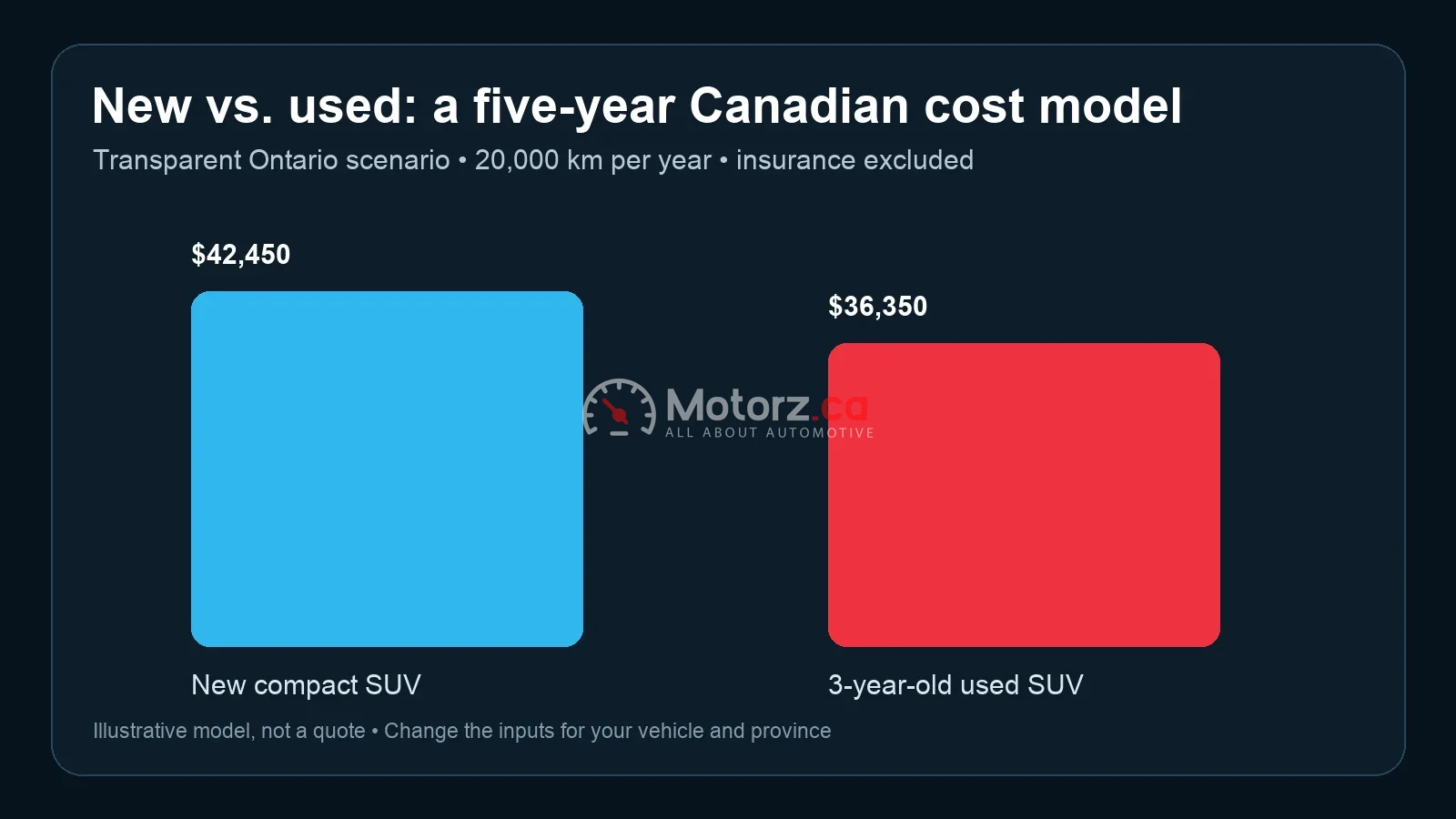
Quick answer: Used wins this base case because the $14,000 lower acquisition price outweighs higher financing and $2,500 of additional maintenance. New becomes more competitive when used prices stay high, used-loan rates widen, repair costs rise or the new vehicle retains more value.
New vs. used five-year cost comparison
| Five-year component | New compact SUV | Three-year-old used SUV |
|---|---|---|
| Acquisition | $42,000 | $28,000 |
| Financing | $5,150 | $4,450 |
| Tax and registration | $5,800 | $3,900 |
| Fuel | $9,000 | $9,000 |
| Maintenance and repairs | $3,000 | $5,500 |
| Resale value (credit) | $-22,500 | $-14,500 |
| Five-year net cost | $42,450 | $36,350 |
The model assumes the same compact-SUV class, 20,000 kilometres per year and comparable fuel consumption, so fuel is held constant. Insurance is excluded because driver, postal code, coverage, claims history and vehicle-specific rating differences cannot be represented responsibly by one national estimate.
Assumptions behind the 2026 model
- Location: Ontario; provincial sales tax and registration approximated in the tax/registration line.
- New vehicle: $42,000 acquisition price, financed with a five-year interest cost of $5,150, and $22,500 resale value after five years.
- Used vehicle: three years old at purchase, $28,000 acquisition price, $4,450 financing cost, and $14,500 resale value after another five years.
- Driving: 20,000 km annually, or 100,000 km over the model.
- Fuel: $9,000 for either vehicle because the comparison holds class and consumption constant.
- Maintenance and repairs: $3,000 new and $5,500 used; these are planning allowances, not quotes.
Why the used vehicle wins this scenario
The used vehicle starts $14,000 cheaper. After allowing for financing, taxes, fuel, maintenance and resale, that initial gap narrows to $6,100. The new vehicle recovers more cash at resale and carries a lower repair allowance, but not enough to offset the higher entry price in this base case.
When buying new can make more financial sense
- The new-car financing rate is materially lower than the used rate.
- A manufacturer incentive reduces the transaction price without inflating optional add-ons.
- The used example is priced close to new despite having less warranty remaining.
- Your chosen used vehicle needs near-term tires, brakes, major service or repairs.
- You plan to keep the vehicle long enough that the first five-year resale estimate matters less than long-term condition and reliability.
How to personalize the model
Replace the acquisition prices with written out-the-door quotes. Use the total borrowing cost from each lender disclosure rather than comparing monthly payments. Estimate fuel from Natural Resources Canada consumption data multiplied by your annual kilometres and a conservative fuel price. Add inspection findings and scheduled service to the used maintenance allowance. Finally, obtain vehicle-specific insurance quotes outside this model.
For the purchase process, see Motorz.ca’s Canadian car-buying hub, new-or-used decision guide, and vehicle-history report explainer.
Important exclusions and limitations
- Insurance, parking, tolls and opportunity cost are excluded.
- The model does not predict a particular vehicle’s depreciation or repairs.
- Financing costs are scenario inputs, not advertised rates.
- Taxes and fees vary by province and transaction type.
- A pre-purchase inspection and service history can materially change the used-vehicle risk.
Bottom line
A used compact SUV is cheaper in this five-year base case, but the margin is $6,100—not the full $14,000 purchase-price gap. Compare total borrowing cost, expected repairs and resale value rather than sticker price or monthly payment alone.
Sources and calculation basis
- Natural Resources Canada Fuel Consumption Ratings Search Tool for vehicle-specific consumption inputs.
- Financial Consumer Agency of Canada, financing a car for loan-comparison guidance.
- Motorz.ca original scenario calculations, September 10, 2026.
For current advertised-price context, review Motorz.ca’s 20-listing Canadian used-car basket.