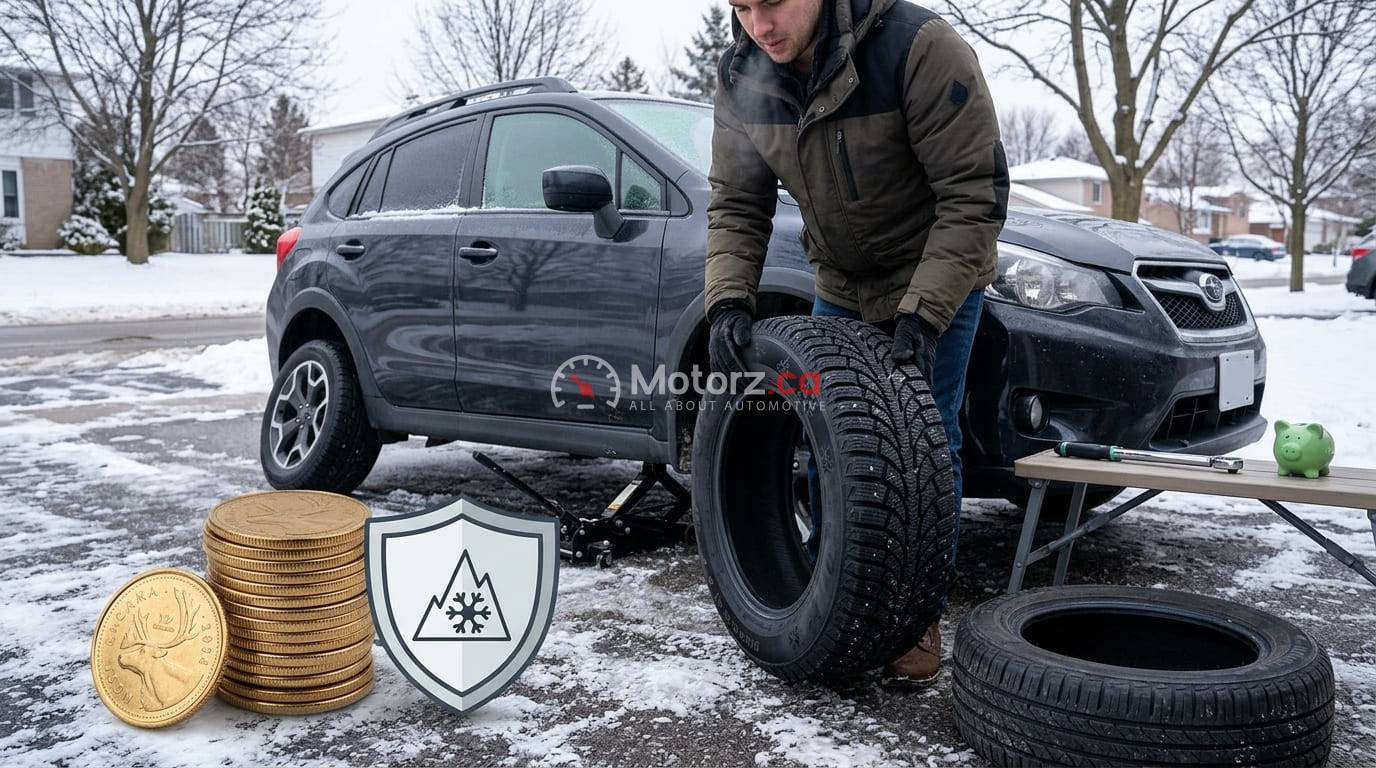
When autumn leaves begin to blanket the streets of the Ontario Winter Tire, Ottawa, and London, Ontario drivers know exactly what is coming. The smooth, predictable dry pavement of summer will soon give way to black ice, slushy intersections, and intense lake-effect snowstorms. Driving in an Ontario winter can quickly transform from a routine daily commute into a high-stress test of focus and vehicle capability.
As weather patterns turn unpredictable, preparing your vehicle for the cold becomes a high priority. One of the most important decisions you face each autumn is determining exactly when to swap out your summer or all-season tires for a dedicated set of winter rubber.
It is not just a matter of basic road safety or ensuring you do not get stuck in your own driveway after a heavy northern blizzard. In Ontario, managing your seasonal tire swap properly has major financial implications. Since January 2016, the provincial government has mandated that all private passenger auto insurance companies operating in Ontario must provide a dedicated consumer discount to drivers who equip their vehicles with a full set of certified winter tires.
Yet, despite this clear financial incentive, many motorists remain confused about the specifics. When exactly should you schedule your service appointment to ensure you remain fully compliant with your policy rules? What specific symbols must be stamped on your tire sidewalls to qualify for the premium reduction? And how much money can you actually expect to save on your annual insurance premiums?
To ensure you stay safe on the roads and maximize your financial savings, let us break down the mechanics of winter tires, explore the specific legal frameworks governing Ontario auto insurance, and outline a step-by-step strategy for timing your seasonal tire switch perfectly.
The Science of the Seven-Degree Rule: Why All-Season Tires Fail in the Cold
A common misconception among Ontario Winter Tire is that “all-season” tires are perfectly capable of handling a Canadian winter. The name itself implies they are built for year-round operation. However, from a chemical and structural engineering perspective, standard all-season tires are simply not designed to withstand sub-zero temperatures.
The Compound Problem
The primary difference between an all-season tire and a dedicated winter tire comes down to the rubber compound chemistry. All-season tires are manufactured using a hard rubber compound formulated to maintain its structure and resist rapid wear during the intense heat of summer asphalt.
When the ambient temperature drops below seven degrees Celsius, this hard rubber compound undergoes a physical transformation known as “glass transition.” The material loses its elasticity, hardens significantly, and begins to act like hard plastic. Instead of flexing to grip the microscopic imperfections in the road surface, a cold all-season tire simply slides over them, drastically increasing your stopping distances on dry or wet pavement long before the first snowflake ever falls.
Engineered for Ice: Sipes and Tread Depth
Winter tires are engineered using high-silica rubber compounds that remain soft, supple, and highly flexible even when temperatures plummet well below minus thirty degrees Celsius. This flexibility allows the tire tread to mold itself directly against the road surface, creating mechanical grip.
Furthermore, winter tires feature distinct mechanical design elements:
Deep Tread Grooves: Designed specifically to channel heavy slush, water, and packed snow away from the tire’s contact patch, minimizing the risk of hydroplaning.
Thousands of Microscopic Sipes: Tiny slits cut into the tread blocks that act like miniature biting edges. As the tire rotates, these sipes flex open, scratching into ice and packed snow to provide traction during acceleration and braking.
According to data verified by Transport Canada, using a dedicated winter tire instead of a standard all-season model can reduce your total stopping distance on an icy road by up to twenty-five percent. In an emergency braking situation on a busy commuter route like Highway 401, that twenty-five percent difference can easily mean the difference between stopping safely or experiencing a severe multi-vehicle collision.
Navigating the Ontario Winter Tire Insurance Discount Mandate
Because winter tires drastically lower the risk of visual collisions and single-vehicle control loss, the Financial Services Regulatory Authority of Ontario (FSRA) requires auto insurers to incentivize their use.
How the Discount Structure Works
While Ontario law mandates that every auto insurance provider must offer a winter tire discount, the province allows individual insurance companies to determine the exact percentage reduction they provide. On average, most Ontario motorists receive a premium discount ranging between three percent and five percent off their total annual auto insurance costs.
For a driver paying an average Ontario premium of 1,500 units of currency per year, a five percent reduction yields seventy-five units in direct annual savings. Over a five-year vehicle ownership cycle, these premium reductions accumulate to three hundred and seventy-five units. When you consider that a second set of tires doubles the lifespan of your summer rubber because you split your annual mileage between two separate sets, the insurance discount makes winter tire ownership an incredibly sound long-term financial decision.
The Strict Qualification Requirements
To successfully secure and maintain your provincial winter tire discount, you cannot simply tell your broker you have good tires. Your vehicle must meet several specific underwriting requirements:
The Three-Peak Mountain Snowflake Symbol (3PMSF): To legally qualify as a certified winter tire in Canada, the tire sidewall must feature the official Transport Canada designation icon—a graphic depicting a snowflake inside a distinct mountain peak outline. Standard “M+S” (Mud and Snow) markings common on all-season tires do not meet this standard and will not qualify you for the insurance discount.
The Rule of Four: You must install a matching set of four winter tires across both axles of the vehicle. Mixing all-season tires on the rear axle and winter tires on the front drive axle is incredibly dangerous, as it creates unbalanced traction levels that can cause a vehicle to spin out violently during cornering. Insurers will completely deny the discount if a full set of four matching tires is not used.
Verification Proof: While many insurance providers will apply the premium discount based on your verbal or written confirmation during a policy renewal, you are legally required to keep documentation on file. If you make a collision claim during the winter months, your insurance adjuster may request a copy of your tire purchase receipt or the mechanical work order showing the installation date to verify your eligibility. Misrepresenting your vehicle setup can lead to a complete denial of your insurance claim.
The Calendar Guide: When Exactly Should You Switch Your Tires?
Timing your seasonal tire changeover requires balancing local meteorological trends against the explicit date restrictions written directly into your auto insurance policy document.
Understanding Insurance Policy Cutoff Dates
To protect themselves from drivers who wait until after the first major blizzard to schedule a mechanical appointment, insurance companies establish hard calendar windows during which your winter tires must be continuously installed on the vehicle. If you experience an accident outside these designated windows while claiming the discount, you could face financial complications.
The specific installation windows vary depending on your chosen insurance carrier:
Strict Insurers (e.g., Travelers, Gore Mutual): Often require your certified winter tires to be fully installed on the vehicle no later than November 1, and they must remain on the car until at least April 1.
Standard Insurers (e.g., CAA Insurance): Frequently mandate that tires must be installed by November 20 and kept on the vehicle until April 15.
Late-Start Insurers (e.g., Aviva, Intact, Jevco): May set their mandatory winter window from December 1 through to March 31.
Because these dates are determined individually by each underwriting company, you must review your specific policy endorsement or contact your insurance broker directly to verify your precise operational window.
The Autumn Booking Rush
As a practical piece of advice, you should never wait until the final deadline to book your installation. In Ontario, automotive service centers experience an incredible volume of service requests the moment the first morning frost appears on local windshields. Waiting until mid-November to call your local garage can result in waiting weeks for an available service bay.
The ideal strategy is to proactively monitor local autumn weather forecasts. Once afternoon high temperatures in your region consistently hover around seven to eight degrees Celsius—which typically occurs in late October across Southern Ontario and early October in Northern Ontario—it is time to make the switch.
Spring Transition: When is it Safe to Take Winter Tires Off?
Just as switching to winter tires too late can cause safety hazards and insurance compliance issues, removing your winter tires too early in the spring introduces distinct mechanical and operational risks.
The Problem of Premature Removal
Ontario spring weather is famous for its sudden, volatile shifts. A beautiful, sunny ten-degree afternoon in late March can easily be followed by a sudden freezing rain storm or an unexpected five-centimeter snowfall the following morning.
If you rush to remove your winter tires on the very first warm day of spring, you risk violating your insurance policy window if your carrier mandates coverage until April 15. Getting into a collision on icy roads in early April without your winter tires installed could lead to a cancellation of your policy discount or a detailed investigation into your claim eligibility.
High Temperatures Damage Winter Rubber
Conversely, you must not leave your winter tires on your vehicle deep into the summer months. Because winter tires are constructed using specialized soft rubber compounds, they are highly sensitive to warmth.
When ambient temperatures consistently rise well above ten degrees Celsius, the soft winter rubber compound degrades rapidly against the hot pavement. Driving on winter tires during hot summer weather causes fast, uneven tread wear, decreases your fuel efficiency, and results in vague, unresponsive steering dynamics during high-speed highway cornering.
As a general rule of thumb, plan your spring tire changeover for mid-to-late April. This ensures you have completely cleared the mandatory insurance windows for the vast majority of Ontario providers, safely bypassed the final threat of early-spring black ice, and preserved the life of your winter tread for the upcoming season.
Maximize Savings: Smart Strategies for Your Tire Investment
Purchasing a dedicated set of four winter tires requires a significant upfront financial commitment. However, by employing a few deliberate asset management strategies, Ontario drivers can drastically reduce their ongoing operational expenses.
Invest in a Dedicated Set of Winter Rims
When buying winter tires, you face a choice: you can either pay a mechanical shop to repeatedly dismount your summer tires and mount your winter tires onto your vehicle’s factory wheels twice a year, or you can purchase a dedicated set of inexpensive steel or aluminum rims specifically for your winter tires.
While buying a separate set of steel rims adds an extra upfront expense, it saves you a substantial amount of money over time:
Lower Bi-Annual Installation Costs: Swapping a pre-mounted wheel set onto a vehicle takes a technician a fraction of the time required to unmount, remount, and rebalance loose rubber tires. Most garages charge less than half the price for a simple wheel swap compared to a full tire mount and balance service.
Wheel Rim Protection: Ontario winter roads are covered in salt, brine, and hidden deep potholes. Running cheap, rugged steel rims during the winter protects your expensive, decorative factory alloy wheels from getting corroded by salt or bent by structural road hazards.
Prioritize Proper Tire Storage
How you store your off-season tires during the summer months directly dictates how many years of service they will deliver. Tire rubber is highly susceptible to environmental degradation caused by extreme heat, moisture, and direct exposure to ultraviolet light.
Before placing your summer or winter tires into storage, wash them thoroughly with plain water and mild soap to remove any accumulated road salt, mud, and corrosive brake dust. Once completely dry, seal each individual tire inside a large, airtight plastic garbage bag. This simple step prevents the essential lubricating oils within the rubber compound from evaporating over time.
Finally, store the bagged tires in a cool, dry, covered location—such as an insulated basement, crawlspace, or climate-controlled garage—away from hot sun exposure or proximity to electric motors, which generate rubber-damaging ozone gas.
The Smart Alternative: Are All-Weather Tires an Option?
In recent years, tire manufacturers have introduced a new category of tire that has generated immense interest among Ontario motorists: the “all-weather” tire. It is vital to understand that all-weather tires are entirely different from traditional all-season tires.
Understanding the All-Weather Distinction
An all-weather tire, such as the Michelin Cross Climate 2 or Nokian Remedy, is engineered as a true hybrid solution. It utilizes an advanced rubber compound that remains flexible at temperatures below seven degrees Celsius while resisting rapid wear during hot summer driving.
Most importantly, all-weather tires feature an aggressive tread pattern designed to handle slush and light snow, and they are officially stamped with the Transport Canada Three-Peak Mountain Snowflake symbol.
Because they carry the official mountain snowflake logo, all-weather tires legally qualify for the Ontario winter tire insurance discount.
Who Should Choose All-Weather Tires?
All-weather tires are an exceptional option for specific Ontario drivers, particularly those who:
Want to Avoid the Bi-Annual Service Hassle: You completely eliminate the need to visit a garage twice a year for a seasonal tire changeover or find physical space to store a second set of tires in your home.
Primarily Drive in Urban Environments: You live within well-plowed urban areas like downtown Toronto or Ottawa, where roads are quickly cleared and salted after a snowstorm.
However, all-weather tires do represent a minor compromise. In deep, unplowed snow drifts or on solid sheets of rural black ice, a dedicated, single-purpose winter tire will still outperform an all-weather tire. For motorists who frequently travel isolated northern highways or rural county roads, sticking with a dedicated two-set tire system remains the safest option.
Checklist for Ontario Drivers
To ensure you stay completely safe and fully maximize your insurance savings this upcoming winter season, implement this quick seasonal action checklist:
Verify Your Insurance Requirements: Contact your insurance broker or check your policy documents to identify your carrier’s exact winter tire installation and removal dates.
Confirm the Snowflake Logo: Ensure your winter set features the official Three-Peak Mountain Snowflake symbol stamped clearly on the rubber sidewall.
Book Your Appointment Early: Schedule your autumn service appointment in early October to beat the mid-November service rush.
Keep Your Receipts Safely: Store your tire purchase receipt and installation work orders with your active vehicle insurance documents as proof of compliance.
Monitor the Temperature: Use the seven-degree Celsius rule as your physical guide for scheduling your tire transition in both autumn and spring.
By understanding the physics of cold-weather traction and carefully navigating your specific auto insurance policy requirements, you can navigate Ontario’s challenging winter roads with complete confidence, knowing you have protected both your physical safety and your household budget.