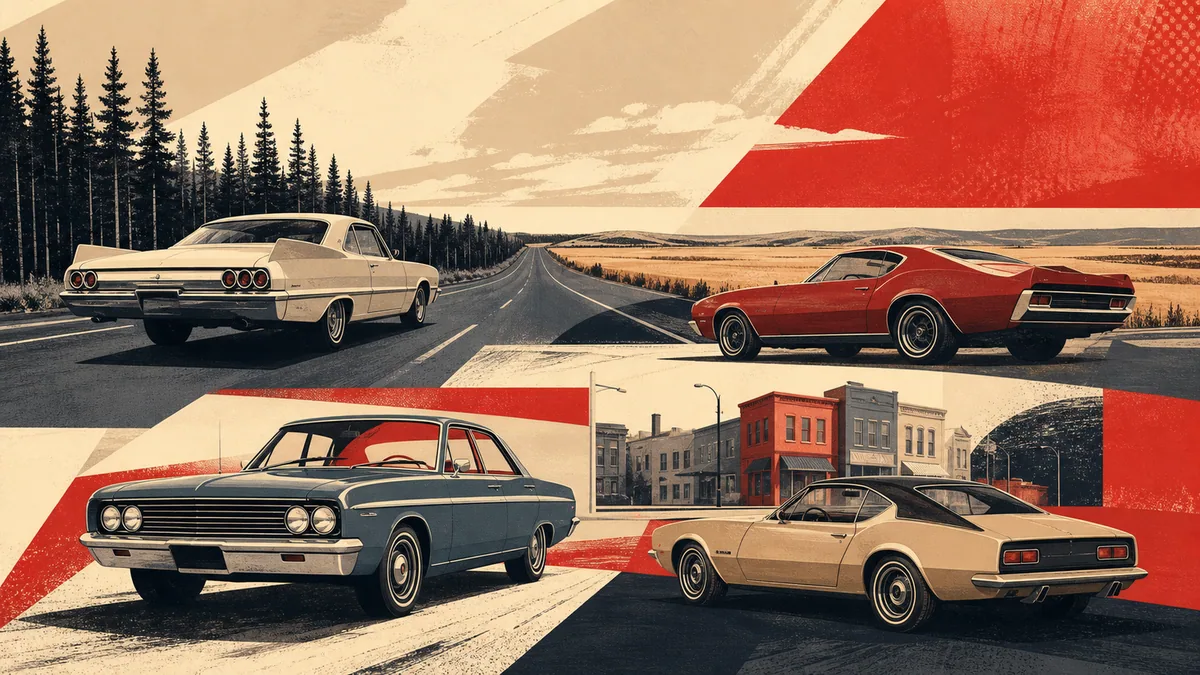
Scope: Canada.
A source-led selection of vehicles that illustrates changes in Canadian invention, manufacturing and identity—not a definitive national ranking.
Key takeaway: These vehicles were selected because each represents a documented change in Canadian invention, manufacturing or market identity and can be supported by a museum or archive source. The list is illustrative, not a ranking of Canada’s “best” cars.
Canadian automotive history includes one-off experiments, carriage companies that became automakers, Canadian versions of international models and ambitious projects that did not last. The Canadian Automotive Museum’s collection and Library and Archives Canada records make it possible to tell that story without relying on folklore or unsupported superlatives.
On this page
- Selection method
- Early experiments
- Manufacturing takes shape
- Distinctly Canadian models
- How to explore further
How the vehicles were selected
- A documented connection to Canadian design, assembly or automotive identity.
- A reliable museum, archive or institutional source.
- A role that illustrates a broader change rather than rarity alone.
- Coverage across more than one era.
- No claim that the selection is exhaustive or definitive.
Early Canadian experiments widened the possibilities
The Canadian Automotive Museum identifies the Fossmobile as Canada’s first successful gasoline automobile and the Galt as an early Canadian gas-electric hybrid experiment. These small projects did not create the later mass market by themselves, but they show that Canadian inventors were testing different propulsion ideas near the beginning of the automotive era.
The 1908 McLaughlin Model F represents the carriage-to-car transition
The museum describes the McLaughlin Motor Car Company as an Oshawa enterprise established in 1907 after its carriage-building roots. Its collection record says 154 Model F vehicles were built in Oshawa in 1908 and calls them the city’s first mass-produced automobiles. The model used Buick-derived mechanical ideas while applying Canadian coachbuilding and trim.
Canadian manufacturing became tied to cross-border companies
The museum records Ford Motor Company of Canada’s establishment in Windsor in 1904 and McLaughlin’s later relationship with General Motors. Library and Archives Canada describes General Motors of Canada as growing from a partnership involving McLaughlin and Buick, with General Motors purchasing McLaughlin Carriage Company in 1918. These records show why Canadian automotive history is both domestic and integrated with the United States.
Postwar Canadian identity appeared in market-specific models
The Canadian Automotive Museum explains that Canadian-built cars remained distinct from U.S. counterparts after the Second World War. Its collection includes names such as Meteor, Pontiac Laurentian, Frontenac and Dodge Regent—vehicles that reflected Canadian production and branding for a smaller market. The 1965 Auto Pact later reduced tariffs and changed the conditions that supported unique Canadian model lines.
The Bricklin SV-1 represents ambition and limits
Built in New Brunswick during the 1970s, the Bricklin SV-1 is preserved by the museum as a distinctive Canadian project. Its unusual body construction, safety-oriented concept and short production history make it useful for understanding the risks of launching a new automaker. It belongs in this selection for what it reveals, not because the article declares it a success or failure by one metric.
How to use this history responsibly
Museum and archive catalogues can disagree on dates or corporate details, so future expansions should cite the exact collection record used. Historical images require separate permission even when the facts are public. Motorz.ca should acquire a licensed museum or archive image and preserve the required credit; no existing undocumented WordPress image is approved.
Sources
- Canadian Automotive Museum: The Car in Canada (current exhibit page; accessed 2026-07-26)
- Canadian Automotive Museum: Canadian Vehicles (current collection page; accessed 2026-07-26)
- Library and Archives Canada: General Motors of Canada fonds (current catalogue record; accessed 2026-07-26)
Verified: 2026-07-26. Review if the museum updates its exhibit interpretation or before adding another vehicle or archival image.