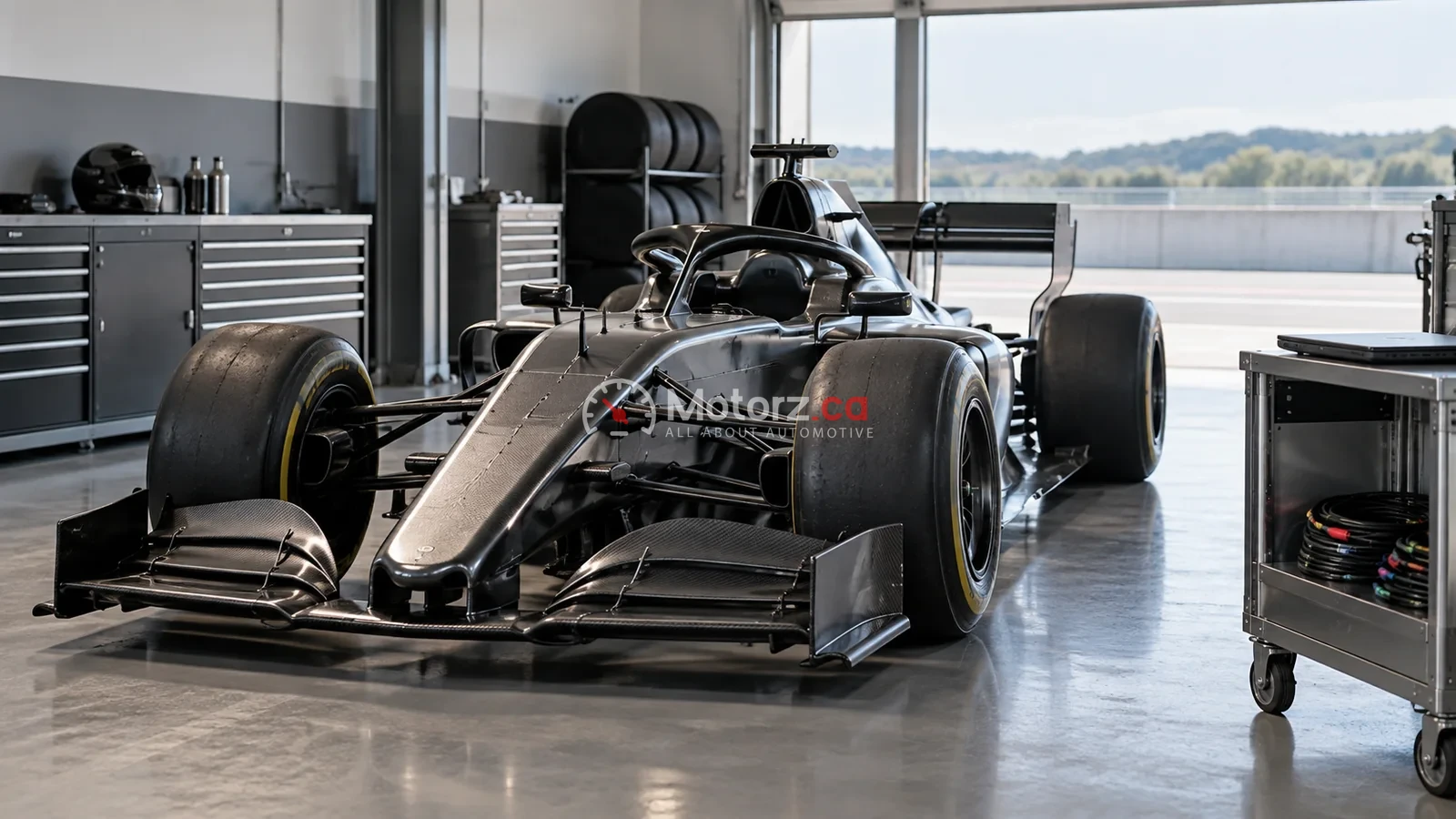
Hero: AI-assisted conceptual illustration, not a photograph of a specific vehicle, test, facility or historical event.
Motorsport data systems turn measurements into information that engineers can interpret. Sensors measure conditions, a data-acquisition system records signals, and telemetry transfers information away from the vehicle. The terms are related, but recording data and transmitting it live are not the same thing.
Key takeaway: a graph is evidence to investigate, not an automatic diagnosis or a guaranteed route to a faster lap. This is a high-level explainer, not racing instruction. Motorz has no private team telemetry access and has not tested a racing data system for this article.
Sensors, acquisition and telemetry do different jobs
A sensor measures a physical quantity. The acquisition system brings signals together with a time reference; the logger retains data for analysis. Telemetry provides a communications path. Which measurements are available depends on the vehicle, equipment and competition rules.
The Bosch Motorsport equipment catalogue documents loggers that combine engine and chassis channels, network connections and telemetry support. These are examples of equipment capabilities, not a universal specification for every race car. There is no single credible “data per race” number that applies to all series.
Temperature, braking and tire information need context
Engine or fluid temperature, speed and other recorded channels can help identify a change worth examining. A value should be assessed against the appropriate engineering limits and the conditions in which it was recorded—not an arbitrary threshold copied from another vehicle.
Similarly, a braking-related signal does not by itself prove a mechanical fault or a driver’s intent. Tire-related information must be interpreted with the tire, surface, weather and operating context in mind. The practical distinction for a reader is between measurement, interpretation and a verified conclusion. Our maintenance hub concerns road-car ownership; race data is not a substitute for diagnosis by a qualified technician.
Lap analysis is a comparison, not a command
Comparing laps can show where recorded traces differ. Before attributing a difference to a driver or setup, an analyst needs to consider traffic, conditions, vehicle configuration and the reliability of the channels. Two traces that look different may not represent comparable runs.
The FIA has described the use of data in stewarding and incident analysis. That is a different purpose from coaching or setup development. This article does not provide braking points, speeds or instructions to reproduce a race manoeuvre on a public road.
Strategy and simulation remain conditional
A simulation evaluates a model under assumptions. For readers, the important question is not only what it predicts, but what inputs it uses and whether those inputs still match the situation. A scenario based on one set of conditions cannot establish what must happen after conditions change.
Think of a hypothetical strategy comparison as a set of questions: what is being held constant, what can change, and how sensitive is the result? This is an explanatory framework rather than a description of a particular team’s software. Publicly available information cannot establish the contents of a private race strategy model.
Driver feedback adds another kind of evidence
A driver can describe a sensation or a change that suggests what to investigate. A logged channel can then help narrow the question, but neither should be treated as infallible. Clear timestamps, comparable runs and an explanation of uncertainty make the discussion more useful than a dramatic screenshot.
Data also has safety-research uses. The FIA’s impact data recorder programme is distinct from performance telemetry. A crash-recording device should not be assumed to offer all the live channels or analysis functions of a race-team logger.
What road-car readers should take away
Good data work asks a defined question and checks whether the evidence can answer it. That principle is useful when evaluating automotive technology claims, including our separate electric-vehicle explainers. It does not make motorsport equipment a necessary purchase for ordinary driving.
If the issue is an actual vehicle symptom, describe when it occurs and follow the professional process explained in why repair timelines vary. For motorsport, keep three questions separate: what was measured, how trustworthy was the measurement, and what conclusion is justified?