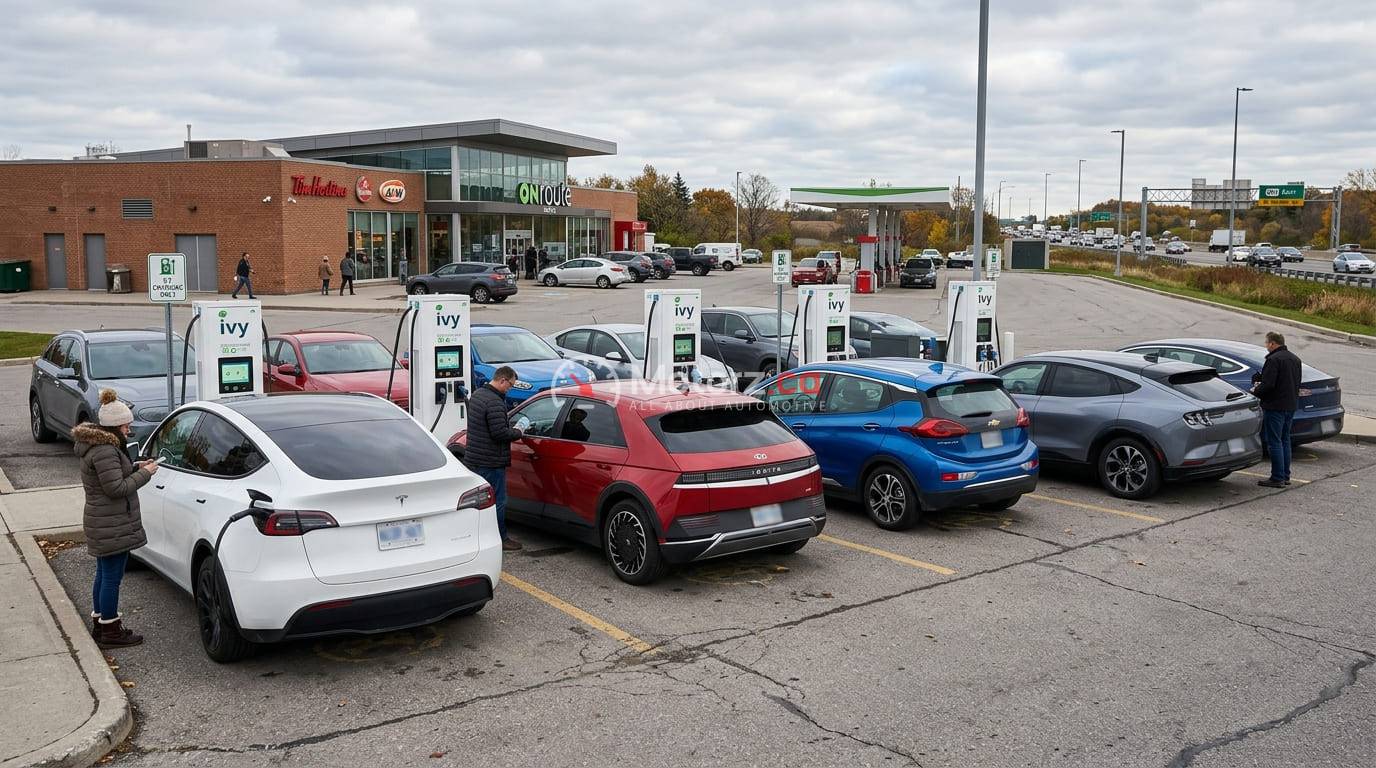
For years, the decision to purchase an electric vehicle (EV) in Ontario was framed as a visionary environmental choice. Today, it is a mainstream consumer consideration. Driven by expanding manufacturer lineups, fluctuating fuel prices, and federal zero-emission mandates, thousands of drivers across the province have traded internal combustion for lithium-ion battery packs.
However, as the initial wave of early adopters gives way to everyday commuters, the conversational focus has shifted. Buyers no longer ask how fast an EV can go from zero to 100 kilometers per hour. Instead, they want to know whether they will be stranded in a snowstorm on Highway 401 searching for a functional plug.
The public narrative surrounding Ontario’s charging infrastructure remains highly polarized. On one hand, government press releases celebrate multi-million-dollar funding rollouts and the rapid deployment of new highway corridors. On the other hand, online automotive forums are filled with accounts of broken public stations, confusing network apps, and severe grid bottlenecks.
An objective look at the data, the geography, and the daily consumer experience reveals the true state of EV charging infrastructure in Ontario.
The Current Landscape: A Province EV Charging Infrastructure in Ontario
To accurately evaluate electric vehicle charging network, it must be divided into two distinct realities: the urbanized Greater Toronto and Hamilton Area (GTHA) corridors, and the sprawling rural regions of Northern and Southwestern Ontario.
The GTHA and Highway 401 Corridors: High Density, High Demand
In urban centers like Toronto, Mississauga, Oakville, and Ottawa, finding a place to plug in is no longer a logistical challenge. According to regional transit and charging network tracking dashboards, the province features thousands of public charging ports.
The structural backbone of long-distance travel in the province relies heavily on partnerships like the Ivy Charging Network—a joint venture between Hydro One and Ontario Power Generation. Ivy, alongside private operators like Electrify Canada, Petro-Canada, and Tesla, has systematically targeted the major travel corridors.
The most significant success story of this infrastructure expansion is the deployment of Level 3 Direct Current Fast Chargers (DCFCs) across ONroute travel plazas along Highways 401 and 400. Most ONroute locations offer dedicated fast-charging stalls capable of delivering speeds up to 150 kW, enabling drivers to add roughly 100 kilometers of range in under twenty minutes.
The Rural and Northern Gap: The Range Anxiety Frontier
Move outside of the urban sprawl and the major commuter highways, and the charging landscape changes dramatically. For drivers traveling through Northern Ontario—along Highway 11 or Highway 17 toward Thunder Bay—or navigating the rural concessions of Grey-Bruce and Huron counties, range anxiety remains a valid concern.
In these regions, charging stations are often spaced far apart, sometimes exceeding 100 kilometers between plugs. Furthermore, many of these rural locations rely on a single Level 3 charger with no backup unit. If an EV driver arrives at a remote northern station with five percent battery remaining only to find the lone charger out of service, they face an expensive tow bill rather than a quick top-up.
The Technology Breakdown: Level 2 vs. Level 3 Fast Charging
A common source of confusion for new EV owners is the practical difference between the types of chargers available in public spaces. Not all plugs are created equal, and mistaking one for the other can completely disrupt a travel schedule.
Level 2 Destination Chargers: The Slow and Steady Approach
Level 2 stations utilize a 240-volt alternating current (AC) setup, identical to the electrical outlet used for a residential clothes dryer or stove. These stations typically deliver between 7.2 kW and 11.5 kW of power.
Charging Speed: Level 2 chargers add roughly 30 to 50 kilometers of range per hour of charging.
Best Use Cases: These are designed as “destination chargers” where your vehicle is expected to sit idle for multiple hours. They are ideally deployed at municipal parking garages, commuter GO Transit stations, hotels, and workplace office parks.
The Reality: While highly abundant across Ontario, Level 2 chargers are functionally useless for road trips. They are designed to supplement your battery while you work, watch a movie, or sleep.
Level 3 DC Fast Chargers (DCFC): The Road Trip Fuel Pump
Level 3 chargers bypass a vehicle’s internal conversion limits by feeding high-voltage direct current (DC) electricity directly into the battery pack. These units start at 50 kW and can scale up to 350 kW at ultra-fast charging hubs.
Charging Speed: Depending on your vehicle’s acceptance rate, a Level 3 charger can replenish an EV battery from 10 percent to 80 percent in fifteen to forty-five minutes.
Best Use Cases: Essential for highway corridors, commercial fleet depots, and quick turnarounds during long-distance travel.
The Reality: These machines are incredibly expensive to build and install, often requiring specialized utility transformers and major grid connections. Consequently, they feature higher usage fees than Level 2 options.
The Real-World Consumer Pain Points
If Ontario has thousands of registered public charging plugs, why do so many drivers still experience frustration? The issue is rarely the total number of plugs; rather, it stems from reliability, software fragmentation, and winter weather performance.
The Broken Charger Epidemic and Downtime
Unlike conventional gas pumps, which are strictly regulated for operational uptime, public EV chargers are prone to frequent mechanical and software failures. It is common to arrive at a public station to find a blank screen, an error code, or a physically damaged charging handle.
The root cause is a historical lack of maintenance accountability. Many public stations were installed using one-time government grants, leaving small municipalities or private property owners responsible for long-term repairs. When a cooling fan fails or a payment module breaks, parts can take weeks to arrive, leaving the charger dead in the meantime.
Software and App Fragmentation
Gas stations accept any standard credit or debit card directly at the pump. The public EV charging ecosystem in Ontario, however, remains frustratingly fragmented. To travel seamlessly across the province, a driver often needs to download and create accounts for a dozen different networks, including:
ChargePoint
Flo
Ivy Charging Network
Circuit Électrique (when traveling near the Quebec border)
Electrify Canada
Each network requires users to link a credit card, load a minimum pre-paid balance into a digital wallet, and navigate an individual smartphone app just to initiate a charging session. While federal and provincial regulations now push for mandatory credit card readers on all new public installations, hundreds of legacy stations still require app authentication.
The Cold Weather Penalty
Ontario winters present a unique challenge for electric mobility. When temperatures drop well below freezing, two phenomena occur simultaneously:
Reduced Battery Efficiency: The chemical reactions inside an EV battery slow down, reducing driving range by 20 to 40 percent depending on cabin heater usage.
Slower Charging Speeds: To protect the cold battery cells from damage, the vehicle’s onboard software deliberately restricts the incoming charging speed. A Level 3 charger that delivers 150 kW in July might top out at 50 kW in January, significantly extending your time spent waiting at a highway rest stop.
Major Infrastructure Developments Across Ontario
Despite these real-world friction points, Ontario’s charging network is undergoing significant structural upgrades. Strategic public and private initiatives are actively addressing historical weaknesses.
The EV Charge ON Initiative
To combat regional infrastructure disparities, the Ontario government launched the EV ChargeON program. Managed through the Ontario Vehicle Innovation Network (OVIN), this program provides financial support to small businesses, municipalities, and Indigenous communities to build public charging infrastructure.
Crucially, the EV Charge ON guidelines prioritize rural communities and northern transit corridors. By explicitly directing funds outside of Toronto and Ottawa, the province is systematically eliminating the geographic gaps that have historically fueled range anxiety.
The Opening of the Tesla Supercharger Network
For years, Tesla operated a private, highly reliable charging network exclusive to its own vehicles. That competitive advantage has shifted. In alignment with North American industry standards, Tesla has begun retrofitting its Ontario Supercharger stations with integrated adapters or opening them up via software to non-Tesla vehicles using the North American Charging Standard (NACS) port.
This change provides drivers of Ford, General Motors, Hyundai, and other brands access to some of the most reliable, fast-charging hardware in the province, instantly expanding the functional highway network for all EV owners.
Commercial and Grid Realities: The Behind-the-Scenes Challenges
Building a robust charging network requires more than just bolting a plastic pedestal to a concrete sidewalk. It demands massive electrical infrastructure and creative commercial utility solutions.
Managing Demand Charges and Utility Costs
For commercial property owners and businesses looking to install fast chargers, the biggest financial hurdle is not the cost of the charger itself. Instead, it is the utility company’s “demand charges.”
Electrical local distribution companies (LDCs) charge commercial customers based on the highest amount of electricity they draw at any single moment during the month. If a retail plaza operates four 150 kW fast chargers, and four vehicles plug in simultaneously, the sudden 600 kW spike can trigger thousands of dollars in demand charges, making the station financially unviable for the property owner.
To combat this hurdle, Ontario energy operators have introduced targeted relief programs. For example, Toronto Hydro introduced a dedicated Electric Vehicle Charging (EVC) rate structure. Designed for qualifying commercial charging stations that operate with sharp, high-powered intervals, this initiative reduces transmission costs, making it significantly cheaper for businesses to host and operate public fast chargers.
Pro Tips for Navigating Ontario’s EV Network
If you currently drive an EV in Ontario or are actively shopping for one, you can bypass most infrastructure challenges by adopting a few strategic habits.
Leverage Crowdsourced Apps
Do not rely on your vehicle’s built-in navigation system alone to find chargers. Download PlugShare. This crowdsourced platform functions as the Wikipedia of EV charging. Drivers post real-time updates, photos, and comments detailing whether a specific station is functional, iced (blocked by a gas vehicle), or suffering from reduced charging speeds.
Pre-Condition Your Battery on Route to a Fast Charger
When planning a highway stop in cold weather, use your vehicle’s built-in navigation system to route directly to the Level 3 station. Many modern EVs will recognize the destination and automatically initiate “pre-conditioning”—using an internal heater to warm the battery to its ideal temperature while you drive. This step ensures that you achieve maximum charging speeds the moment you plug in.
Prioritize Reliable Networks
If your route gives you a choice between a standalone, unnetworked charger behind a local arena or a multi-stall hub operated by an established brand like Flo, Electrify Canada, or a Tesla Supercharger station, choose the multi-stall hub. Multi-stall hubs offer built-in redundancy; if one plug is broken, you can simply back into the adjacent stall.
Charging Network Strengths and Weaknesses
The following breakdown highlights where Ontario’s EV infrastructure currently excels and where it requires urgent development: