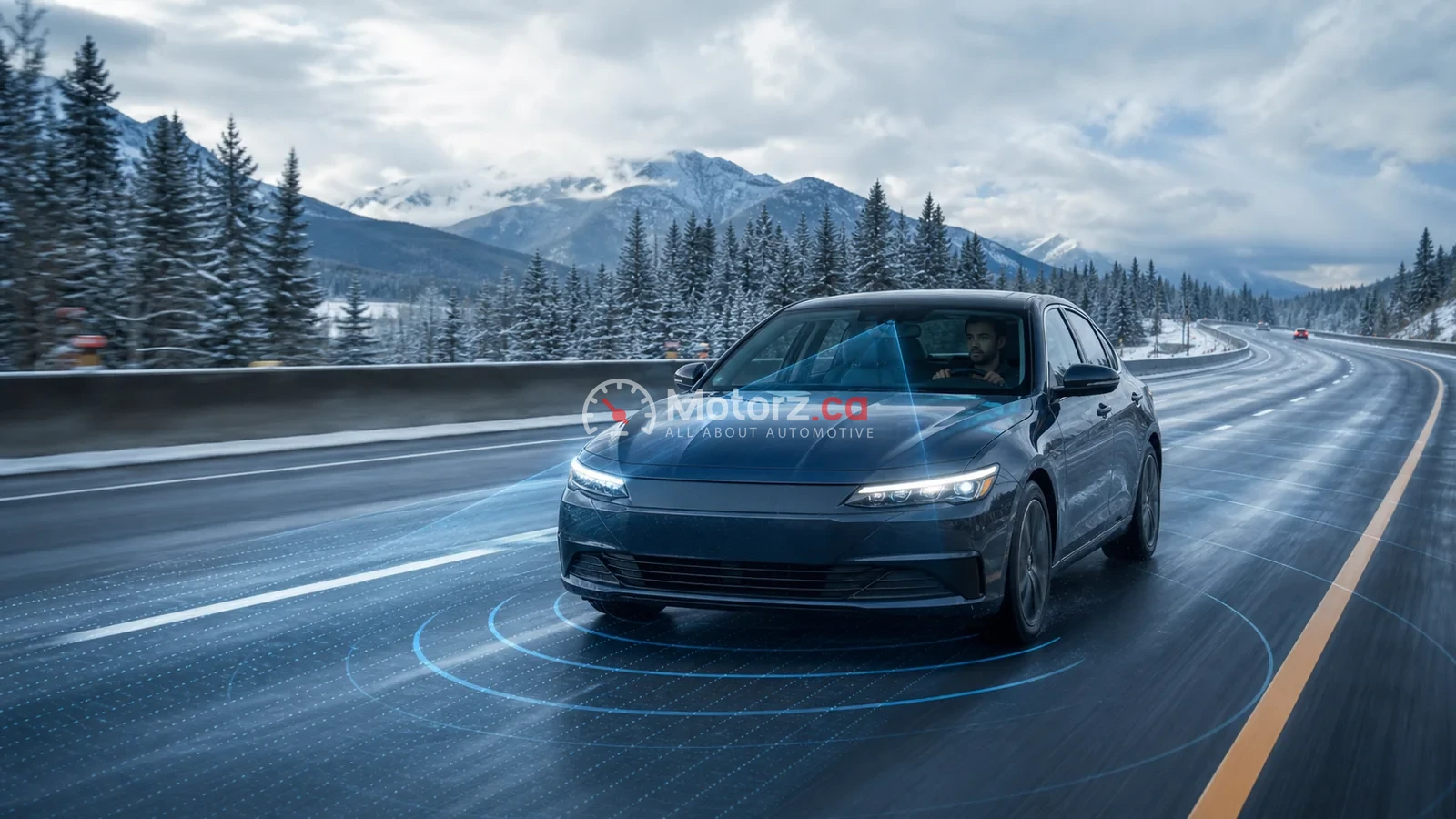
Canadian shoppers mostly encounter driver-assistance—not a vehicle that replaces the driver. Here is how to understand the technology without the hype.
The direct answer
In Canada, features that steer, brake or accelerate are generally driver-assistance systems. Transport Canada says many vehicles currently use automation Levels 0 to 2. At Levels 1 and 2, the person behind the wheel must monitor the road and be ready to respond. A feature marketed as hands-free or assisted driving should not be treated as a car that can drive itself.
Driver assistance and automated driving are not the same
The SAE scale runs from Level 0, where the driver performs the driving task, to Level 5, where a system could operate under all conditions without a human driver. Level 1 can assist with either steering or speed. Level 2 can assist with both, but the driver remains responsible. Transport Canada says Levels 3 to 5 are not currently available for public purchase in Canada.
Feature names vary by manufacturer and can sound more capable than the underlying system. Check the exact name, supported roads, speed range, driver-monitoring requirements and warnings in the owner’s manual.
What benefits are realistic?
- Assistance during routine driving: a system may help maintain speed, distance or lane position when its operating conditions are met.
- Earlier warnings: some features can alert a driver to a hazard or intervene in a limited way.
- Longer-term potential: higher automation could improve access or traffic flow, but those outcomes are prospective rather than guaranteed.
Canadian weather and road limits matter
Snow, rain, poor visibility, covered sensors, faded lane markings, construction zones and some tunnels can limit a system. Transport Canada advises drivers to understand when a feature may disengage or behave differently. Clear required sensors as directed by the manufacturer and never assume assistance will compensate for winter conditions.
Privacy and cybersecurity questions
Connected vehicles can collect or retain information, and software introduces security responsibilities. Ask what data is stored, how updates are delivered, how accounts are protected and how personal data is removed before sale. The same caution applies to digital car keys.
A practical shopper checklist
- Identify the exact feature and automation level.
- Read the operating limits in the owner’s manual.
- Confirm how the system monitors driver attention.
- Ask how software and maps are updated.
- Try the controls in a safe setting without assuming they replace observation or judgement.
Bottom line: evaluate today’s systems as assistance. Stay engaged, follow the manual and match every feature to the conditions in which it was designed to work.