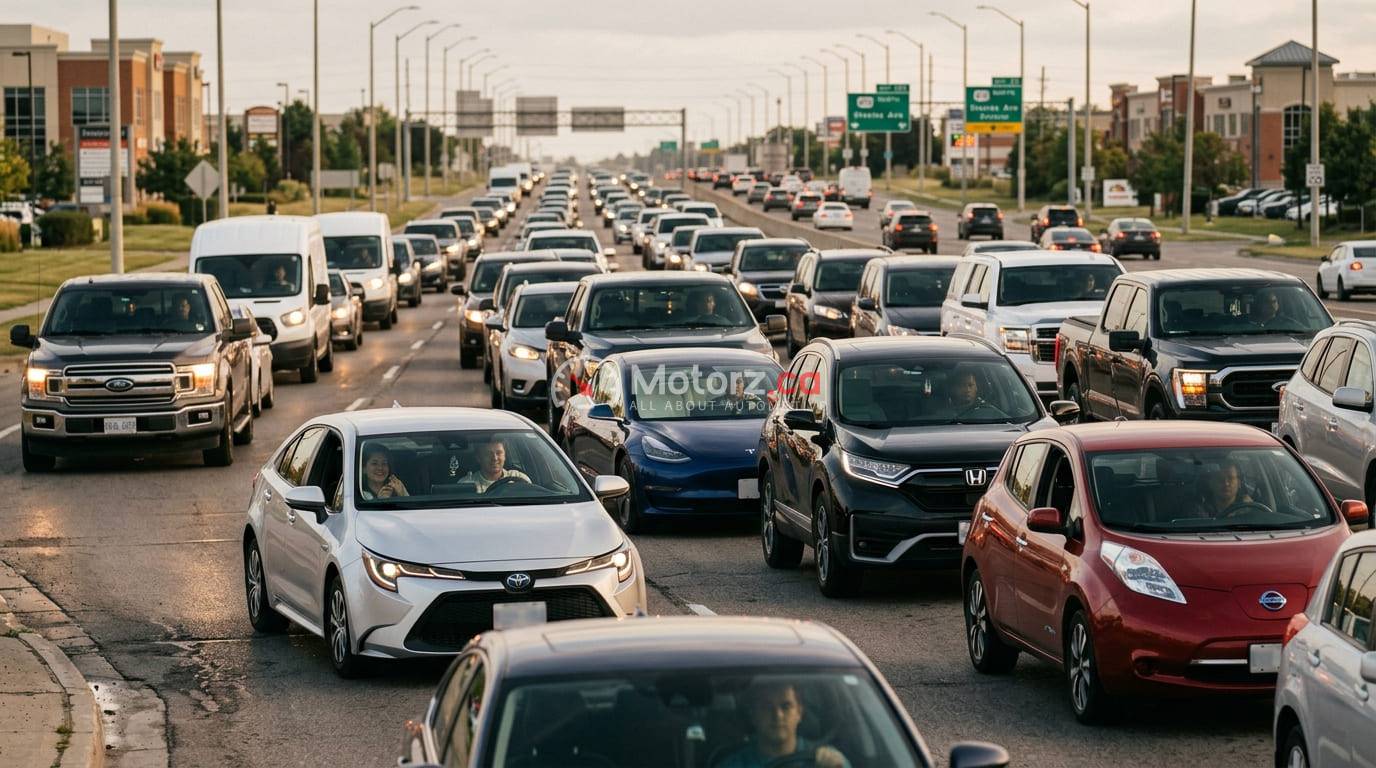
If you have ever found yourself crawling down Cars for Heavy Stop-and-Go Traffic, or watching your dashboard clock tick away while completely stationary on Highway 410, you know that driving in Brampton is a unique test of patience. The city’s rapid growth has turned everyday commuting into a grueling endurance sport. Stop-and-go congestion does not just drain your energy; it aggressively wears down your vehicle and eats away at your hard-earned fuel budget.
When you spend hours trapped in gridlock, standard automotive metrics like zero-to-100 km/h acceleration or sporty cornering quickly lose their relevance. Instead, your priorities shift entirely. You need a vehicle that can idle without wasting fuel, crawl forward seamlessly without jerky transmission shifts, insulate your ears from aggressive honking, and keep you comfortable when your commute stretches long past its expected arrival time.
Surviving Brampton traffic requires a specific kind of machinery. This comprehensive guide breaks down the engineering demands of heavy traffic and highlights the top-performing vehicles built to handle the daily crawl.
The Cars for Heavy Stop-and-Go Traffic: Why Standard Cars Struggle
Before looking at specific vehicles, it helps to understand why stop-and-go traffic is so destructive to conventional internal combustion engines. Vehicles are at their least efficient when accelerating from a dead stop. Overcoming inertia requires a massive surge of energy, meaning your engine burns a disproportionate amount of fuel just to move a few meters forward.
Constant idling in traditional gasoline vehicles creates a continuous loop of wasted energy. While your car sits motionless at the intersection of Queen Street and Kennedy Road, the engine keeps running to power the alternator, air conditioning, and water pump, yielding zero kilometers per liter.
Furthermore, conventional automatic transmissions constantly hunt for gears at low speeds. The repetitive shifting between first, second, and neutral builds intense heat within the transmission fluid, accelerates clutch wear, and causes the frustrating, jerky riding experience common in older vehicles. To survive this environment without frequent visits to the mechanic, you need a powertrain engineered explicitly for low-speed efficiency.
What Makes a Great Gridlock Vehicle?
To survive the worst traffic conditions, look for a vehicle that excels in four key areas:
Advanced Powertrain Efficiency
The ideal gridlock commuter relies on electrification. Full hybrids (HEVs), plug-in hybrids (PHEVs), and battery electric vehicles (EVs) are inherently suited for heavy traffic. They use regenerative braking to capture energy as you slow down and store it in a battery pack. When traffic crawls forward, these vehicles use smooth, high-torque electric motors instead of firing up a gas engine.
Low-Speed Transmission Refinement
Look for vehicles equipped with electronic continuously variable transmissions (eCVTs) or single-speed direct drives. Unlike traditional geared automatics or dual-clutch systems, which can shudder and jerk when constantly shifting between 0 and 20 km/h, these setups offer completely seamless, linear acceleration.
Active Cabin Isolation
The sound of gridlock is loud. Heavy trucks, emergency sirens, and constant honking create a stressful environment. Vehicles featuring acoustic laminated glass, extensive wheel-well soundproofing, and active noise cancellation transform a chaotic commute into a calm, quiet sanctuary.
Advanced Stop-and-Go Driver Assistance
Modern traffic requires continuous focus, which quickly leads to driver fatigue. The best commuter cars feature adaptive cruise control with stop-and-go functionality. These systems automatically manage your speed, brake to a complete halt when traffic stops, and resume crawling with a simple tap of the pedal or steering wheel button.
Top Full Hybrids (HEVs) for Brampton Commuters
For drivers who want exceptional city fuel economy without relying on a home charging setup, traditional full hybrids remain the gold standard for navigating gridlock.
Toyota Prius: The Undisputed Efficiency Champion
The Toyota Prius remains a dominant force in urban commuter efficiency. Its fifth-generation hybrid system seamlessly blends a 2.0-liter four-cylinder engine with potent electric motors.
Why it conquers gridlock: At low speeds, the Prius functions almost entirely as an electric vehicle. Its eCVT delivers smooth acceleration without any shift shock, and its small footprint makes it easy to maneuver through tight lanes.
The Traffic Advantage: The Prius delivers spectacular city fuel economy, often keeping consumption well under 4.5 liters per 100 kilometers during heavy stop-and-go driving. It turns bumper-to-bumper delays into opportunities to maximize energy recapture.
Honda Civic Hybrid: The Engaging Commuter
Returning to the Canadian market with impressive engineering, the Honda Civic Hybrid pairs a refined chassis with a highly efficient dual-motor hybrid system.
Why it conquers gridlock: Honda’s hybrid layout operates primarily as an electric series hybrid in city environments. The gasoline engine mostly acts as a generator to feed electricity to the drive motor, resulting in instant, smooth throttle response during low-speed crawling.
The Traffic Advantage: The Civic features steering-wheel-mounted deceleration paddles. These let you manually adjust the regenerative braking intensity, allowing you to slow down smoothly without constantly stepping on the brake pedal.
Hyundai Elantra Hybrid: Value Meets High Tech
The Hyundai Elantra Hybrid offers a compelling blend of aggressive styling, digital real estate, and structural efficiency.
Why it conquers gridlock: Unlike its Japanese competitors, the Elantra Hybrid uses a specialized six-speed dual-clutch transmission designed to work alongside its electric motor. Hyundai has tuned this system to deliver crisp, clear engagement, cutting down on the elastic feeling some drivers dislike in traditional hybrids.
The Traffic Advantage: The standard Highway Driving Assist system pairs adaptive cruise control with precise lane-centering, noticeably reducing the physical effort required during long delays on the regional roads.
Top Plug-In Hybrids (PHEVs) for the Ultimate Balance
Plug-in hybrids give you the best of both worlds: a substantial all-electric driving range for your daily city commute, backed up by a gasoline engine for weekend road trips beyond the Greater Toronto Area.
Toyota RAV4 Prime / Prius Prime
Toyota’s Prime lineup represents the pinnacle of dual-energy commuter design. The Prius Prime offers an all-electric driving range of over 60 kilometers, while the larger RAV4 Prime provides robust all-wheel-drive capability alongside a generous electric buffer.
Why they conquer gridlock: Your typical cross-Brampton commute can be completed entirely on battery power. Because electric powertrains do not suffer an efficiency penalty when sitting stationary, you can run the climate control indefinitely without burning a drop of gasoline.
The Traffic Advantage: If your battery runs low while sitting on Bovaird Drive, the vehicle transitions into a standard hybrid seamlessly, eliminating any range anxiety.
Mitsubishi Outlander PHEV
The Mitsubishi Outlander PHEV is a popular choice across Ontario, combining a spacious three-row cabin with an advanced twin-motor all-wheel-drive system.
Why it conquers gridlock: It relies on a large battery pack to drive its front and rear electric motors, delivering an exceptionally quiet, stable ride. Its sophisticated Super All-Wheel Control system provides excellent traction and composure during messy winter gridlock.
The Traffic Advantage: The Outlander offers an Innovative Pedal mode, which amplifies regenerative braking so you can accelerate and decelerate using only the accelerator pedal. This single-pedal style significantly cuts down on ankle fatigue when crawling through traffic.
Top Battery Electric Vehicles (EVs) for Zero-Emission Crawling
If you want to completely eliminate fuel costs and engine vibration from your daily commute, a battery electric vehicle is the ultimate solution for heavy traffic.
Tesla Model 3
The Tesla Model 3 is a familiar sight on Ontario roads for good reason: its efficiency and software ecosystem are purpose-built for demanding commutes.
Why it conquers gridlock: Its minimalist cabin keeps physical distractions to a minimum, and its electric motor delivers instant, completely silent torque. The Model 3’s cabin heating and cooling systems rely entirely on a highly efficient heat pump, meaning long delays have a minimal impact on your total range.
The Traffic Advantage: Tesla’s standard Autopilot handles steering, acceleration, and braking within its lane. The central screen provides a clear, real-time visual map of surrounding vehicles, keeping you well-informed of local traffic patterns.
Hyundai Ioniq 5
With its unique retro-futuristic design and spacious interior, the Hyundai Ioniq 5 is an outstanding urban commuter platform.
Why it conquers gridlock: Built on a dedicated electric platform, it offers a completely flat interior floor and an adjustable center console, giving you a remarkably open and relaxing space to sit in during long delays.
The Traffic Advantage: The Ioniq 5 features an advanced i-Pedal system alongside smart regenerative braking. This system automatically adjusts your deceleration rate based on the distance to the vehicle ahead, taking the guesswork out of low-speed slowing.
Comparing Fuel Consumption in Stop-and-Go Traffic
To see how different powertrain styles perform under heavy urban driving conditions, let’s look at typical real-world consumption estimates: