


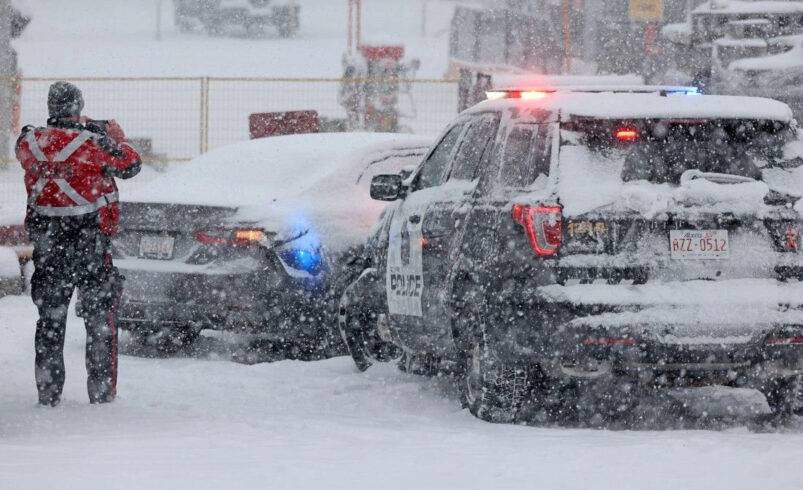

It started as a simple forecast for spring Winter Driving, but by the morning of Wednesday, March 25, 2026, Calgarians woke up to a “winter wallop” that turned the morning commute into a battle against the elements. A narrow, stationary band of heavy snow parked itself directly over the city, dumping up to 16 cm in the north while leaving southern communities relatively dry.
The result? Over 280 collisions reported in just a four-hour window, whiteout conditions on major arteries like Stoney Trail, and a firm advisory from the Calgary Police Service: Do not travel unless absolutely necessary. As we navigate the tail end of March—statistically Calgary’s snowiest month—understanding how to handle these sudden, treacherous road conditions is essential for every driver in the Bow Valley.
The Winter Driving: Why This Storm Was Different
Meteorologists from Environment and Climate Change Canada (ECCC) compared this recent event to a summer thunderstorm. It was a relatively small, localized system that carried an oversized punch. While the south end of Calgary saw mostly wet pavement, the north end was hammered with snow falling at rates of 3 to 5 cm per hour.
Why Road Temperatures Matter
Early spring storms are particularly dangerous because Winter Driving often assume the ground is warm enough to melt falling snow. However, the intensity of this March 2026 storm meant the snow accumulated faster than the pavement could melt it, creating a “slush-on-ice” effect that is notoriously difficult to steer through.
Treacherous Hotspots: Where Calgary Drivers Struggle Most
When the snow flies, certain areas of the city become magnets for collisions and stalled vehicles. Knowing these hotspots can help you plan a safer route.
Stoney Trail NW and Beddington Trail
During the peak of the March 25 storm, Stoney Trail north of Glenmore was the site of multiple multi-vehicle pileups. The open exposure of the ring road allows north winds to blow snow across the lanes, creating localized whiteouts and drifts.
Deerfoot Trail Bridges and Overpasses
Bridges always freeze before the rest of the road. Because there is no warm earth beneath the concrete, moisture from snow quickly turns into black ice. Even if the rest of Deerfoot looks “just wet,” the bridge decks can be skating rinks.
North Calgary Hills
Steep inclines in communities like Huntington Hills and Panorama Hills became impassable for many buses and trucks during the recent snowfall. If your vehicle lacks winter tires or All-Wheel Drive, these residential “hill zones” should be avoided during active snowfall.
Essential Survival Tips for Treacherous Calgary Roads
If you must head out when the “Police Advise Against Travel” warning is in effect, follow these safety protocols to ensure you make it home.
The “Two-Second” Rule is Not Enough
In ideal conditions, you should stay two seconds behind the car in front. In a Calgary snowstorm, increase that to at least six to eight seconds. Heavy, wet spring snow acts like a lubricant between your tires and the asphalt, significantly increasing your stopping distance.
Gentle Inputs are Key
Sudden movements are the enemy of traction.
Braking: Apply pressure slowly and early.
Steering: Avoid “jerking” the wheel to compensate for a slide.
Accelerating: If you are at a red light on an icy patch, start in second gear (if your car allows) to reduce wheel spin.
Clear YOUR Entire Vehicle
It is not just about your windshield. In Alberta, you can be fined for having “unsecured cargo” if a sheet of ice flies off your roof and hits another car. More importantly, clearing your taillights ensures the person behind you can see your brake signals through the blowing snow.
Is it Too Early to Take Off Your Winter Tires?
The March 2026 surprise storm serves as a stark reminder: Do not swap your winter tires for “all-seasons” until at least mid-April in Calgary.
Winter tires are made of a softer rubber compound that remains flexible at temperatures below 7 degrees. Even if the sun is shining on Monday, a Tuesday dip back into freezing temperatures means your summer or all-season tires will turn “hard as a hockey puck,” losing the grip necessary to stop on icy patches.
What to Do If You Get Stuck or Involved in a Collision
With nearly 300 crashes reported in a single morning this week, knowing the protocol is vital for your safety and your insurance.
Check for Injuries: If anyone is hurt, call 911 immediately.
Move to Safety: If the vehicles are drivable and there are no serious injuries, the Calgary Police Service requests that you move to a parking lot or a side road to exchange information. This prevents “secondary collisions” on high-speed roads like the Deerfoot.
Report the Crash: If the total damage to all vehicles exceeds 5,000 units of currency, or if there is any injury, you must report the accident at a local police station.
Stay in Your Vehicle: If you are stuck on a high-speed road like Stoney Trail in whiteout conditions, stay in your car with your seatbelt on. Stepping out of your vehicle in a storm puts you at extreme risk of being hit by a sliding car.