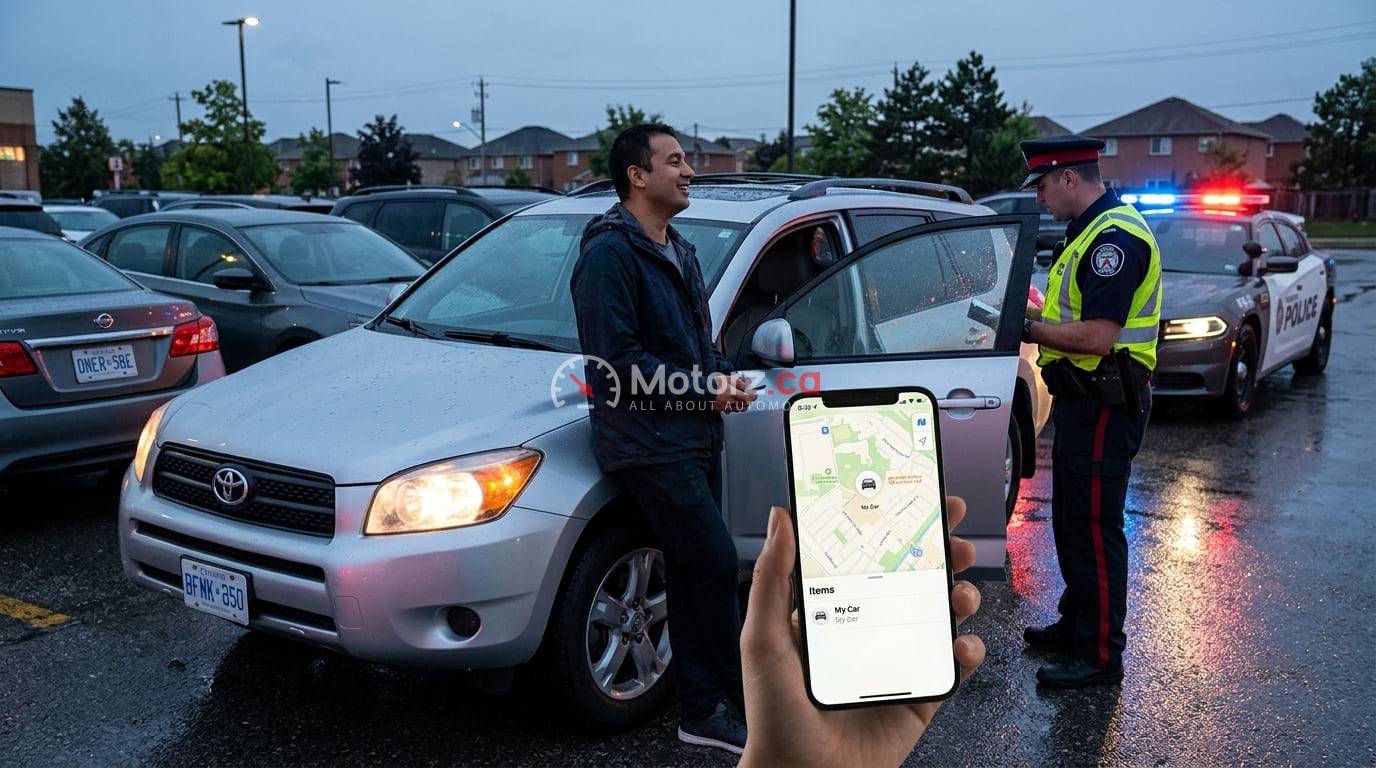
You park your Stolen Vehicle Recovery in the GTA, lock the doors, and head to bed. The next morning, you look outside only to find an empty patch of concrete where your car used to be. For residents across Mississauga, Brampton, and the broader Greater Toronto Area (GTA), this nightmare is becoming all too common. Peel Region has seen a massive surge in sophisticated auto thefts, leaving drivers searching for fast, budget-friendly ways to track and protect their investments.
It seems like an easy, logical solution: buy a twenty-nine dollar Apple Air Tag, hide it in the glovebox or beneath a seat, and use the Find My network to track down your car if it disappears.
But do Apple Air Tags actually work for stolen vehicle recovery in Peel Region? While there are real-world stories of GTA residents tracking their stolen vehicles across continents using these tiny silver discs, relying on them as your primary line of defense is a high-stakes gamble. Air Tags were designed to find lost keys and misplaced backpacks—not to outsmart professional, organized auto theft syndicates.
How Apple Stolen Vehicle Recovery in the GTA
To understand why Air Tags are a double-edged sword for vehicle tracking, you have to look at how they communicate with the world.
Unlike a traditional GPS tracker, an Air Tag does not have a built-in cellular connection or a global positioning satellite antenna. It is completely dependent on Apple’s Find My network.
Your AirTag emits a constant, encrypted Bluetooth signal. Whenever any stranger carrying an iPhone, iPad, or Apple Watch walks or drives within roughly fifty feet of your AirTag, their device detects that Bluetooth signature. The stranger’s device automatically and silently uploads your tracker’s location coordinates to Apple’s iCloud network, allowing you to see your car’s location on a map in real time.
Because the GTA has an incredibly dense population with millions of active iPhone users, an AirTag hidden inside a car will ping frequently as long as it is driving down the standard regional highways like the 401 or the 403. This massive network density is precisely what tempts drivers to use AirTags as a cheap alternative to premium tracking services.
The Fatal Flaw: Anti-Stalking Protections Alert the Thieves
While the Find My network is incredibly powerful, Apple built a critical feature into the AirTag that actively works against vehicle recovery: unwanted tracking alerts.
To prevent bad actors from slipping AirTags into people’s coats or purses to stalk them, Apple’s iOS software automatically detects when an unknown AirTag is traveling with someone over a period of time.
If a thief steals your car in Brampton and heads down the highway toward a shipping yard, their iPhone (or Android device running tracking detection apps) will push a notification directly to their screen saying: “AirTag Found Moving With You”.
The Clock is Ticking
The moment the thief receives that notification alert, your element of surprise is gone. The thief can use the “Play Sound” feature on their phone to force your hidden AirTag to emit a high-pitched chirping sound. They will tear through your cabin, find the disc, and toss it out the window onto the shoulder of the road, leaving you tracking a useless piece of plastic while your car drives away.
Real-World Limitations in the Peel Region Context
If you are parking your car in Mississauga or Brampton, there are specific geographic and logistical factors that limit how helpful an AirTag will be once a theft occurs.
The Proximity to Major Rail Yards and Intermodal Hubs
Peel Region is situated right next to massive transportation corridors and major intermodal rail hubs, including the CPKC railway yard in Vaughan. Organized crime rings do not joyride stolen cars around the block; they immediately drive them into deep steel shipping containers or hidden chop shops.
Once your vehicle is sealed inside a thick, heavy steel container, the AirTag’s short-range Bluetooth signal cannot penetrate the metal walls. Unless an active iPhone user stands right next to the open doors of that specific shipping container, your AirTag will stop updating entirely, showing its last known location on the side of a rail track.
The Port of Montreal Fast Track
A shocking percentage of luxury vehicles stolen out of Mississauga and Brampton are loaded onto transport trucks or trains and sent directly down to the Port of Montreal. From there, they are loaded onto massive cargo ships destined for markets in Europe, West Africa, or the Middle East.
If your AirTag manages to survive the trip to the port, it will go completely dark as it crosses the Atlantic Ocean, because there are no random iPhone users walking past your cargo container in the middle of the sea.
Modifying an AirTag for Vehicle Security: The “Speaker-Ectomy”
Because the chirping speaker is what gives away an AirTag’s hiding spot to a thief, a popular counter-tactic has emerged within the automotive community: physically removing the speaker.
Using a small plastic pry tool or a thin utility knife, owners carefully open the internal plastic casing of the AirTag, lift up the tiny magnetic coil board, and remove the small speaker element entirely.
Does a Silent Air Tag Work Better?
While modifying the device stops it from chirping, it does not stop the digital notification from hitting the thief’s phone screen. The thief will still know there is a tracker hidden somewhere in the vehicle. However, disabling the speaker forces them to waste valuable time digging through your car to find it, increasing the chances that they might panic and abandon the vehicle entirely.
Police Response: Will Peel Regional Police Chase an AirTag Signal?
A common point of confusion for GTA drivers is assuming that showing a real-time Air Tag map to the police means officers will immediately rush out to kick down doors and retrieve the car.
Peel Regional Police and other local law enforcement forces face strict legal boundaries and resource constraints when dealing with consumer tracking data:
Probable Cause and Warrants: An Air Tag ping showing your car is inside a specific private residential garage is often not legally sufficient on its own for police to obtain a search warrant. Because consumer Bluetooth tracking accuracy can bounce or lag, entering a private property without a warrant violates constitutional rights, meaning officers must gather secondary corroborating evidence first.
Safety Context: Tracking a stolen car yourself can lead to dangerous situations. Organized auto theft groups are professional criminals who may carry weapons. Peel Police strongly advise residents never to track down or confront thieves on their own based on Air Tag coordinates.
The Container Dilemma: If your Air Tag pings from a massive stack of thousands of identical shipping containers at a rail yard, police cannot legally or logistically force the transit authority to unstack and pry open every single container based on a consumer Bluetooth signal alone unless the signal matches specific manifests.
Best Hiding Locations for an Air Tag in a Vehicle
If you still choose to use an Air Tag as a supplemental backup tracking device, hiding it in the obvious spots—like the center console, glove box, or door pockets—is pointless. Thieves check these areas first. You must think creatively to hide the device where it can still emit radio waves but remains incredibly difficult to physically extract:
Deep Inside Trunk Linings: Peel back the carpet panels on the side of your trunk and tuck the Air Tag near the wheel well insulation.
Behind the Interior Cabin Air Filter: Drop the glove box assembly forward, remove the cabin air filter door, and attach the tracker to the non-moving framing structure inside the dash assembly.
Underneath Exterior Trim Panels: Place the Air Tag inside a heavy-duty, waterproof magnetic case and snap it underneath the rear plastic bumper fascia or inside the plastic lining of the fuel filler door cavity.
Sewn Into Seat Cushions: Use a small seam ripper to open an unnoticeable bottom edge of a rear seat cushion pocket, slide the disc deep inside the foam padding, and stitch it closed.
Comparing Consumer Trackers to Professional GPS Systems
To see where Air Tags fall short compared to true automotive protection, it helps to analyze how they stack up against dedicated commercial security hardware across key performance vectors:
The Verdict: Use AirTags as a Backup, Not a Shield
So, do Apple AirTags work for stolen vehicle recovery in Peel Region?
The short answer is yes, but only as a low-cost, secondary backup system. AirTags can give you an early heads-up or catch a lazy, amateur thief who doesn’t check for tracking notifications. They are better than having no tracking system at all, but they are highly vulnerable to being found and discarded by professional crime syndicates.
If you own a vehicle that tops the local most-stolen lists (such as a Honda CR-V, Ford F-150, Lexus RX, or Toyota Highlander), do not rely on a consumer luggage tracker to protect your asset. Instead, combine your hidden AirTag with professional security measures, such as a CAN-bus engine immobilizer (like IGLA or Ghost), an OBD-II port lock, or a high-grade cellular GPS tracking system.