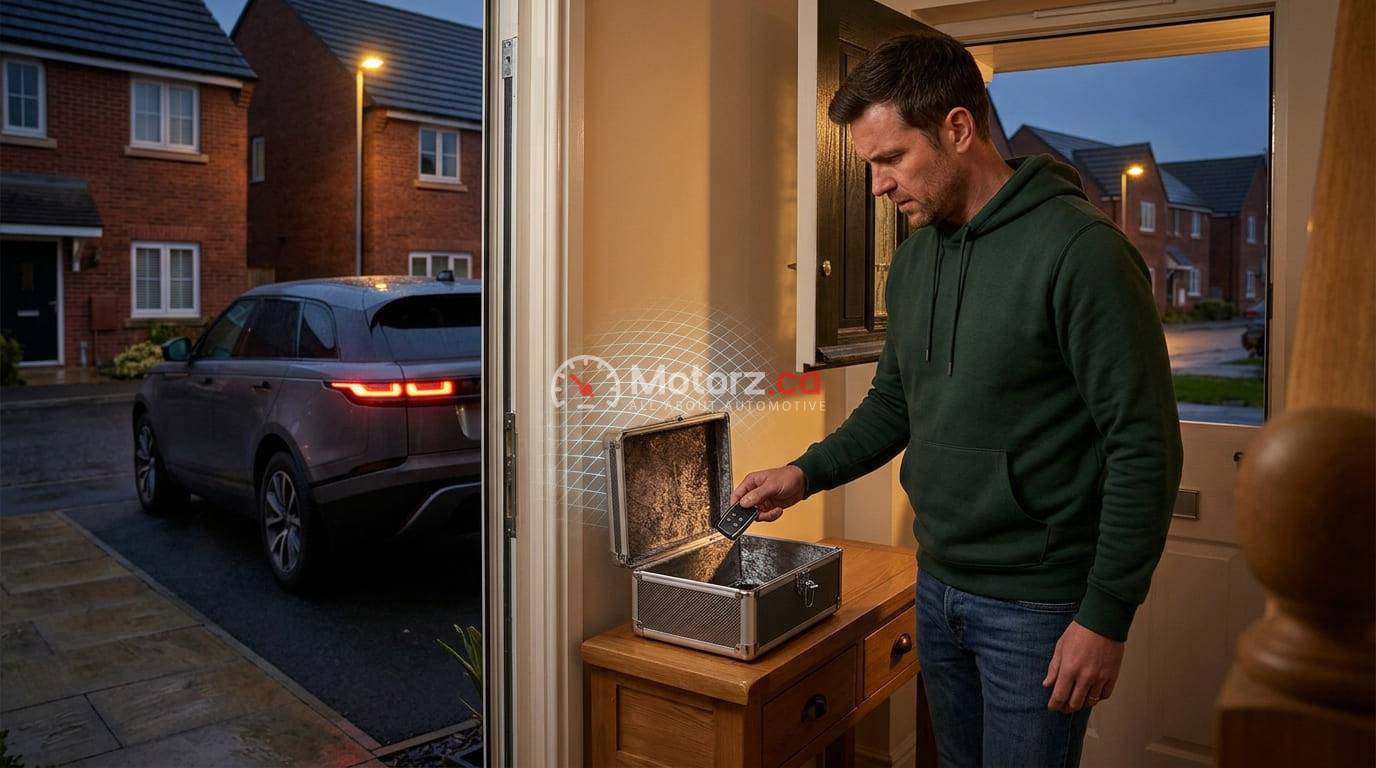
This is relay theft, a high-tech method of vehicle conversion that has turned Peel Region into a hotspot for organized auto crime. If you own a modern vehicle with a push-to-start ignition in Brampton, your vehicle is a potential target.
The good news? You do not need a degree in cybersecurity to secure your car. By understanding how these thieves exploit your keyless entry system, you can implement simple, layered defenses to ensure your vehicle stays exactly where you parked it.
Understanding Relay Theft: How Thieves Steal Cars Without a Key
To defeat an enemy, Brampton Guide to Stopping Relay Theft. Relay theft—often referred to as a “relay attack”—specifically targets vehicles that use a passive keyless entry system.
The Anatomy of a 30-Second Relay Attack
Your keyless key fob is constantly whispering. It emits a low-power wireless signal that looks for your car. When you get close enough to the vehicle and touch the door handle, the car sends out a signal of its own to validate the key. If the digital handshakes match, the doors unlock.
Thieves exploit this wireless conversation using two relatively cheap electronic devices: an amplifier and a transmitter.
Thief A (The Recruiter): Stands close to your front door, garage, or ground-floor window carrying an amplifier. This device intercepts the weak signal sleeping inside your house from your key fob sitting on the kitchen counter or entry table.
Thief B (The Driver): Stands right next to your car door with a transmitter.
The Bridge: Thief A amplifies your fob’s signal and beams it across the yard to Thief B’s transmitter. The transmitter mimics your actual key fob, tricking the car into thinking you are standing right next to it with the key in your hand.
The car unlocks, the push-to-start button is pressed, and the engine fires up. Once the engine is running, the thieves do not need the key anymore to keep driving; they can drive it straight to a shipping container or chop shop.
Why Brampton Has Formed the Epicenter of Auto Theft
Brampton, alongside Mississauga and the broader Greater Toronto Area (GTA), has experienced a significant surge in auto thefts over recent years. Several geographic and infrastructure factors make our neighborhoods prime targets:
Proximity to Major Transport Hubs: Brampton sits adjacent to major shipping corridors, rail yards, and is a straight shot down the highway to the Port of Montreal, where stolen vehicles are rapidly packed into containers destined for overseas markets.
High Density of Premium Vehicles: Our booming suburban developments feature multi-car driveways populated with highly sought-after SUVs, trucks, and luxury sedans.
Open Driveway Culture: Unlike older urban centers with tight alleyways or secure underground parking, most Brampton homes feature wide, open driveways that provide thieves with easy, unobstructed access to vehicles.
Physical vs. Digital Security: Why You Need a Layered Defense
Many homeowners believe that a single security measure—like installing a security camera—is enough to deter thieves. Unfortunately, professional auto criminals view cameras merely as a way to document their work. They wear masks, operate in the dark, and are gone before you receive a push notification on your smartphone.
To truly protect your vehicle, you must adopt a layered defense strategy. If a thief bypasses your digital security, they should run directly into a physical barrier that takes too much time or noise to overcome. Thieves want a clean, quiet, and fast exit. If you make your vehicle look like a chore to steal, they will move on to an easier target down the street.
Digital Defense: Blocking the Wireless Signal
Because relay theft relies entirely on intercepting radio frequencies, your first line of defense is cutting off that wireless communication entirely when you are at home.
The Power of Faraday Bags and Boxes
The absolute cheapest and most effective digital shield you can buy is a Faraday bag or a Faraday box. These pouches are lined with a special metallic mesh (usually copper or nickel) that creates an electromagnetic shield.
How it works: When you drop your key fob into a Faraday bag, it blocks all incoming and outgoing radio frequencies. The amplifier outside your house can no longer detect or clone your key’s signal.
When using Faraday protection, keep these rules in mind:
Test it immediately: Put your key fob inside the bag, walk up to your vehicle, and try to open the door. If the door remains locked, the bag is doing its job.
Protect the spare: Do not just protect your primary key. Your spare key fob sitting in a drawer emits the exact same signal and must be stored in a Faraday box as well.
Check for wear and tear: Over time, bending and dropping a Faraday bag can degrade the metallic lining. Replace them every year or two to maintain total signal blockage.
Disabling Keyless Entry via Key Fob Settings
Did you know that many modern vehicles allow you to temporarily turn off the key fob’s wireless signal manually?
For example, on many Toyota and Lexus models, you can hold down the “Lock” button while simultaneously pressing the “Unlock” button twice. The LED indicator on the fob will flash a few times, signaling that the battery-saving mode is active and the wireless transmission is deactivated. Pressing any button on the fob instantly turns it back on when you walk out to your car in the morning. Check your vehicle’s owner manual to see if your manufacturer offers a similar hidden feature.
Turning Off Proximity Sensors in Vehicle Menus
If your vehicle settings allow it, you can navigate through your infotainment system panel to completely disable the proximity unlocking feature. This changes your car back to an “active” keyless system, meaning you must physically press the unlock button on your key fob to get into the car. This completely eliminates the vulnerability that relay attacks exploit.
Mechanical Barriers: Old-School Security That Works
If a thief manages to clone your key signal using a sophisticated relay device, physical barriers act as your secondary wall. These old-school mechanical devices force thieves to break out noisy power tools, destroying the stealth aspect of their operation.
Steering Wheel Locks
Devices like “The Club” might seem antiquated in our digital world, but they remain highly effective visual deterrents. When a thief looks through your window and sees a brightly colored steel bar locked across your steering wheel, they know they cannot drive the vehicle without spending precious minutes cutting through the wheel with a cordless angle grinder.
Brake and Pedal Locks
A pedal lock clamps directly onto your brake or clutch pedal, preventing it from being depressed. Because push-to-start vehicles require you to step on the brake pedal before the engine will fire up, a pedal lock adds an extra layer of structural frustration for an intruder.
Wheel Clamps
If you are leaving your vehicle parked in your driveway while traveling out of Pearson Airport for a couple of weeks, a heavy-duty wheel clamp or “boot” is an excellent investment. It physically anchors the wheel to the ground, making it impossible to roll the vehicle backward down your driveway without creating a massive amount of noise and attention.
Advanced Electronic Protections: Aftermarket Solutions
For owners of high-target vehicles, relying solely on Faraday bags might not feel secure enough. Advanced aftermarket electronics offer deep system-level protection that stops thieves even if they have bypassed everything else.
Aftermarket Immobilizers
An aftermarket immobilizer operates entirely independently of your factory security system. Devices like the Ghost Immobilizer are integrated directly into your vehicle’s digital network.
Even if a thief clones your key, unlocks the door, and sits in the driver’s seat, the engine will not start until a specific, hidden sequence of factory buttons is pressed on your steering wheel, dashboard, or door panels. Without entering this secret PIN code, the car remains completely dead.
OBD Port Locks
When thieves break into a car without using a relay attack, they often target the On-Board Diagnostics (OBD) port. This is the plug located under your dashboard that mechanics use to diagnose engine issues.
Using specialized hand-held computers, a thief can plug into your OBD port and program a blank key fob to match your car in under a minute. Installing a physical steel lock over your OBD port prevents unauthorized access to your vehicle’s computer brain.
Driveway Strategies for Brampton Homeowners
Your driveway layout and parking habits play a massive role in whether your home is targeted by auto theft rings.
The Art of Strategic Parking
If your household owns multiple vehicles, always park your lower-target, less valuable, or older vehicles at the very end of the driveway, blocking your high-target vehicle close to the garage.
If you own an expensive SUV that thieves want to export, and it is physically pinned against your house by a ten-year-old sedan with a manual transmission, the thieves cannot easily pull off a quick midnight extraction.
Security Lighting and Motion Activation
Thieves love working in pitch-black conditions where their faces are hidden by shadows. Installing high-output, motion-activated LED floodlights directly above your driveway eliminates this advantage. The moment someone steps onto your property, the sudden burst of bright white light strips away their anonymity and forces them to work in plain view of your neighbors.
Perimeter Protection: Driveway Bollards
In response to the auto theft epidemic across Peel Region, an increasing number of Brampton homeowners are installing residential driveway bollards. These are heavy-duty, retractable steel posts anchored deep into the concrete of your driveway.
When you park your car at night, you lift the bollards into place and lock them. Even if a thief starts your engine, they cannot drive the vehicle past the steel barriers without destroying the front end of the car, rendering it worthless for resale.
What to Do If Your Car Is Target Number One: A Quick Action Checklist
If you wake up and discover that your vehicle has been targeted or stolen, acting immediately improves the chances of recovery before the vehicle can be loaded into a shipping container.
Secure Your Safety
Never confront auto thieves directly. Organized vehicle theft groups are often sophisticated and may carry weapons. Your property is replaceable; your life is not. Document what you can from a safe distance inside your home.
Call Peel Regional Police Immediately
Contact the police non-emergency line or 911 if the crime is actively occurring. Provide them with your vehicle’s year, make, model, license plate number, and any unique distinguishing features (dents, roof racks, aftermarket rims).
Activate Your Tracking System
If your vehicle features a factory tracking app (like Toyota Safety Connect, OnStar, or Lexus Enform) or an aftermarket tracker like an Air Tag or SmartTag, open the application and track the real-time location. Pass this data directly to the police dispatcher. Do not attempt to track down the stolen vehicle yourself.
Contact Your Insurance Provider
Report the theft to your auto insurance company right away to initiate the claims process for a rental vehicle and property loss. Provide them with the police report number as soon as it is generated.
Securing Your Peace of Mind
The rise of relay theft across Brampton neighborhoods can make vehicle ownership feel incredibly stressful. However, by understanding that auto thieves rely entirely on speed, silence, and wireless signals, you can take back control.
Implementing a simple nightly routine—dropping your keys into a reliable Faraday box, locking a visible steering wheel club into place, and parking strategically—creates a fortress that standard relay thieves simply cannot break through without throwing away their anonymity.
Protect your investment tonight so you can rest easy knowing your car will still be sitting in your driveway tomorrow morning.