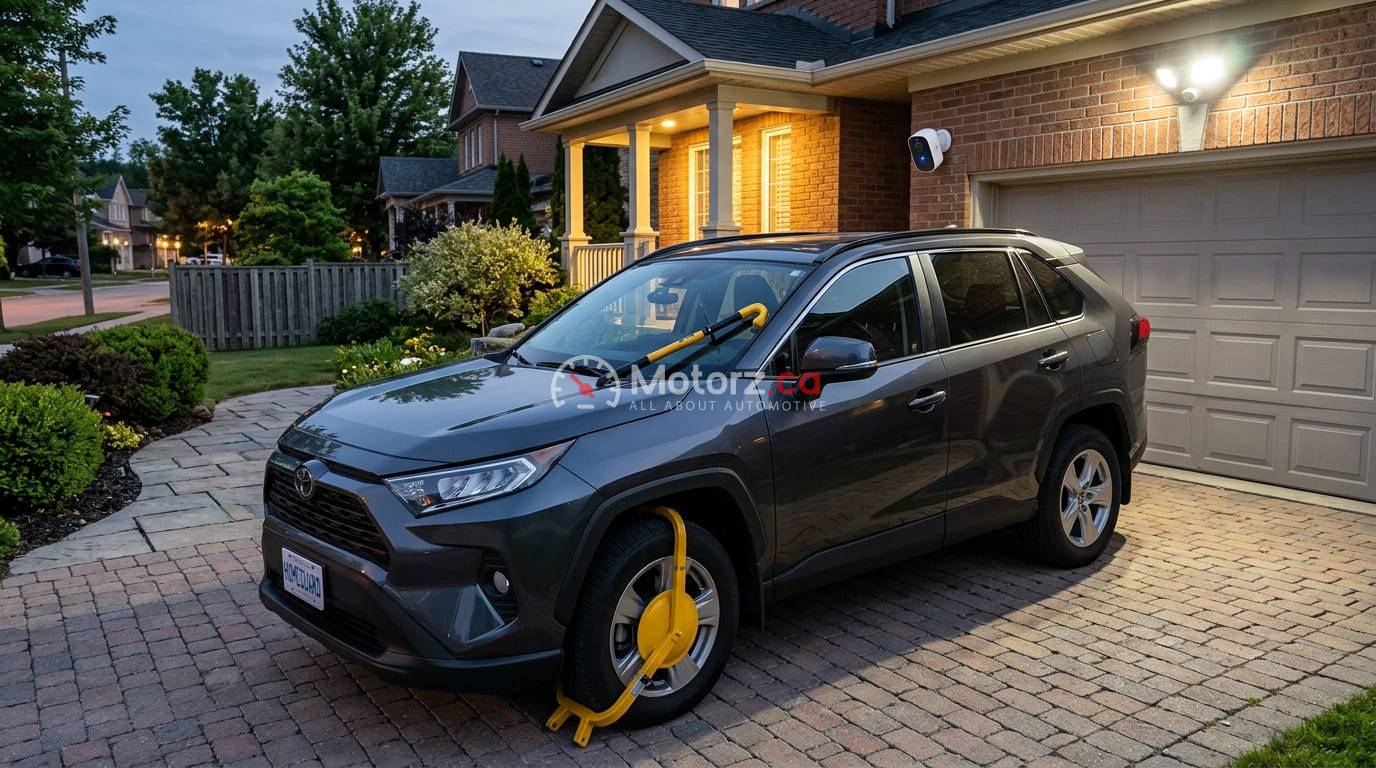
For generations, parking your car in your own Vehicle Against Auto Thieves felt like crossing the finish line of a long day. It was your property, your safe haven, and a completely reasonable place to leave your second most valuable asset overnight.
Today, that sense of security has been fundamentally upended. Across suburban neighborhoods, driveways have transformed into the primary hunting grounds for highly organized, technically sophisticated auto theft rings.
The mechanics of stealing a car have undergone a radical digital evolution. Gone are the days when car thieves relied strictly on a coat hanger, a slim jim, or a smashed window in a dark alleyway. Modern vehicle thieves dress like delivery drivers, operate in broad daylight or under the cover of midnight, and carry specialized electronic equipment that can bypass a factory-grade security system in under 60 seconds—all without making a sound or breaking a single pane of glass.
If you own a modern vehicle, particularly a highly sought-after Sport Utility Vehicle (SUV) or pickup truck, relying solely on your car’s factory security system is no longer enough. To protect your property and safeguard your insurance premiums, you need to turn your driveway into a hard target.
This comprehensive guide breaks down the exact tactics modern thieves use to exploit suburban properties, outlines a multi-layered security framework you can implement right now, and explores how securing your perimeter can help neutralize the threat of auto theft.
The Modern Vehicle Against Auto Thieves: Understanding the Threat
To build an effective defense strategy for your home, you must first understand the operational mechanics of your adversary. Modern auto theft is rarely a crime of opportunity committed by rogue joyriders; it is a highly structured, corporate-style pipeline managed by transnational criminal syndicates.
The Suburban Driveway as a Logistics Hub
Criminal networks view suburban neighborhoods as decentralized Auto Thieves warehouses. The layouts of these communities—characterized by quiet, predictable streets, dark cul-de-sacs, and multi-car driveways running right up to the front doors of residential properties—provide an ideal operational environment for thieves.
Thieves often deploy scouts or “spotters” to cruise through neighborhoods during afternoon hours or use rented vehicles to log the locations of specific high-demand makes and models. They note down your daily routines, your lighting setups, and whether your vehicles are parked in a way that makes for a fast, unobstructed escape.
Once a target vehicle is selected, an extraction team is dispatched, typically between the hours of midnight and 5:00 AM. Their goal is absolute speed and silence. If a vehicle takes longer than two minutes to breach and start, or if it requires creating loud structural noise, a well-trained thief will abort the attempt and move down the street to an easier target.
Why Factory Security Is No Longer Enough
Vehicle manufacturers have made incredible leaps in convenience, offering features like push-to-start ignitions, proximity unlocking, companion smartphone apps, and cloud-connected diagnostics. However, this shift toward digitization has inadvertently shifted the security landscape from physical mechanics to wireless software networks.
Car companies build vehicles to comply with regional minimum safety and anti-theft standards, but they often prioritize manufacturing efficiency and consumer convenience over absolute defense. Because automotive software systems are largely standardized across entire vehicle lineups, a security vulnerability discovered in one model can frequently be used to exploit hundreds of thousands of vehicles across the country.
Once a digital exploit is discovered by underground hacking forums, it is packaged into user-friendly, handheld hardware devices and sold to field thieves on the black market. This democratization of high-tech hacking tools means that low-level street criminals now possess the technical capability to easily override multi-thousand-pound machines protected by standard factory immobilizers.
Technical Vulnerabilities: How Thieves Steal Cars in Under 60 Seconds
Defending your driveway requires a clear understanding of the specific technological exploits that modern car thieves deploy. By identifying how your car’s digital handshake can be manipulated, you can implement precise, target-hardening countermeasures.
Relay Attacks (Fob Amplification)
The relay attack remains one of the most common and successful methods for stealing vehicles equipped with keyless entry and push-to-start systems. It directly exploits the convenience of proximity key fobs.
The Vulnerability: Your vehicle’s key fob constantly emits a low-power, short-range radio signal. When you walk up to your car with the fob in your pocket, the vehicle detects this signal, verifies the cryptographic digital handshake, and unlocks the doors. When you sit inside, it verifies the signal again to let you start the engine.
The Exploit: When you park your car at night and walk inside your house, you likely place your keys on a hook near the front door, on a kitchen counter, or in a jacket pocket in the foyer. The key fob continues to broadcast its quiet passive signal through the walls of your house.
The Execution: A team of two thieves approaches your property. Thief A carries an amplification antenna and walks up to your front door, garage door, or front window, waving the device close to the exterior walls to intercept the faint signal coming from your indoor key fob. Once captured, Thief A’s device amplifies the signal and transmits it across the driveway to Thief B, who stands next to your car holding a receiving unit. The car receives the amplified, authentic signal from Thief B’s box, assumes the owner is standing right there with the keys, and unlocks. Thief B hops inside, presses the start button, and drives away.
Once the engine is running, the thieves do not need the physical key fob to keep driving. The vehicle’s dashboard will display a warning stating “Key Fob Not Detected,” but the engine will run continuously until it is manually turned off or runs out of fuel. This allows the thieves to drive the vehicle directly to a shipping terminal, a shipping container, or a hidden chop shop safely out of range.
On-Board Diagnostic (OBD) Port Hacking
If a thief cannot perform a relay attack because your keys are stored securely, they will often pivot to a physical entry and electronic reprogramming strategy via the mandatory On-Board Diagnostic (OBD) port.
The Vulnerability: By environmental and transport regulations, every modern vehicle must include an accessible OBD port under the driver-side dashboard. This port allows licensed mechanics to plug in diagnostic computers to read engine trouble codes, perform emissions checks, and program replacement key fobs when owners lose their original sets.
The Exploit: The software architecture protecting the OBD port often lacks robust multi-factor authentication or cryptographic locks. If a tool can access the port, it can communicate directly with the vehicle’s central computer, known as the Electronic Control Unit (ECU) or Body Control Module (BCM).
The Execution: The thief gains physical entry into the cabin—either by using a specialized lockout tool to slide past the window weatherstripping, popping the physical door lock cylinder, or breaking a rear quarter-window pane. Once inside, they plug a handheld key-programming device into the OBD port. These devices can bypass the vehicle’s security protocols, wipe out the memory of existing authorized keys, and force the car to pair with a blank, unprogrammed electronic fob the thief brought with them. Within 30 to 45 seconds, the new key is authenticated, the steering column unlocks, the engine fires up, and the car is gone.
Controller Area Network (CAN) Bus Injection
As manufacturers tried to tighten OBD port security with software firewalls, organized crime networks adapted by targeting the physical communications infrastructure of the car itself through a process called CAN bus injection.
The Vulnerability: Modern vehicles are essentially rolling computers. Different modules—the engine, the brakes, the headlights, and the security systems—all talk to one another over a shared internal network pipeline called the Controller Area Network, or CAN bus. To save weight and manufacturing complexity, this communication network often operates on implicit trust: if a message is sent over the wires, every module assumes it is legitimate and executes the command.
The Exploit: Portions of this internal wiring network run close to the exterior skin of the vehicle to power peripheral components like smart LED headlight assemblies, radar sensors in the front grille, or electronic side mirrors.
The Execution: A thief approaches the front corner of your vehicle and pulls back the plastic wheel well liner, pops out a corner of the front bumper, or unclips a headlight housing. This exposes the clean wiring harness underneath. The thief plugs a specialized, disguised microchip device directly into the exposed wires by piercing the insulation. The device floods the vehicle’s internal network with rapid, fraudulent commands that mimic an official “smart key authorized” message. The central computer accepts the fake message, releases the electronic steering lock, disables the engine immobilizer, and unlocks the doors, allowing the thief to hop in and start the car without interacting with the key fob or the OBD port at all.
Layer One: Digital and Electronic Target Hardening
Defending against high-tech thefts requires deploying modern technical countermeasures. Your primary goal in this layer is to disrupt the electronic communication loops that thieves rely on to manipulate your vehicle’s computers.
Signal-Blocking Technologies
The simplest and most cost-effective defensive update you can make today is completely cutting off your key fobs from the outside world when they are inside your home.
Faraday Pouches: A Faraday pouch is a small sleeve or wallet lined with specialized, multi-layered metallic mesh fabrics (typically silver, copper, or nickel particles) that block electromagnetic fields. When your key fob is sealed inside a high-quality Faraday pouch, its passive radio frequency signals cannot escape, and external amplification devices cannot read them. This completely neutralizes the threat of a relay attack.
Faraday Boxes: For households with multiple vehicles, a dedicated Faraday box kept on a entryway table provides a central, secure repository for all family car keys, spare fobs, and smart home transponders.
Testing Your Shield: Do not assume your pouch or box is working automatically. Place your key fob inside the Faraday enclosure, walk right up to your vehicle’s door handle, and try to unlock the vehicle manually. If the door remains locked and the vehicle shows no response, your pouch is functioning correctly. Remember to replace pouches every one to two years, as the internal metallic lining can degrade, crack, or tear over time from repeated bending.
Secondary Aftermarket Immobilization Systems
If a thief manages to bypass your key fob entirely via CAN bus injection or OBD programming, your secondary line of digital defense must stop the car from physically moving under its own power.
PIN-Code Immobilizers: Systems like the Ghost II immobilizer are spliced directly into your vehicle’s internal CAN bus network. Once installed, the car will not allow the transmission to shift out of park, even if an authentic key is used or a new key is successfully programmed through the dashboard. To drive, the vehicle operator must enter a unique, customized sequence of button presses using the car’s existing steering wheel buttons, window switches, or climate control keys. Because this pin sequence is stored deep within the software layer and leaves no physical trace, a thief standing in your driveway cannot hotwire, bypass, or program around it.
Electronic Fuel or Starter Cut-Off Switches: A professional car audio or security specialist can install a hidden physical toggle switch that interrupts power to the vehicle’s primary fuel pump or starter solenoid. If the switch is toggled off, the engine will crank indefinitely but will never start, or it will refuse to turn over entirely. A thief racing against a countdown timer will not spend time hunting under carpet liners or dashboard trim panels to find a micro-switch.
Physical OBD Port Locks
To secure your diagnostic infrastructure against key programmers, you can install a physical barrier over the connector interface. An OBD port lock is a heavy-duty, reinforced metal cap or enclosure that clamps securely over the diagnostic plug and is locked in place using a unique, high-security mechanical key pattern.
Without the matching key, removing the block requires extensive grinding, cutting, or drilling directly beneath the steering column. This creates loud, unmistakable physical noise and risks severing the main dashboard wiring harness—a consequence that renders the vehicle useless and unsellable to a thief.
Layer Two: Mechanical and Physical Impediments
While digital security handles invisible electronic threats, physical and mechanical deterrents provide a strong visual defense. Visible barriers force thieves to calculate the time, noise, and physical effort required to steal your vehicle, often causing them to abandon your property in favor of a softer target down the road.
Heavy-Duty Steering Wheel Locks
Often dismissed as an old-school artifact from the 1980s and 1990s, heavy-duty mechanical steering wheel locks (such as modern iterations of “The Club” or the Disklok) have made an essential comeback in the modern anti-theft toolkit.
The Psychology of Visual Deterrence: When a thief walks up to your vehicle windows at night with an electronic scanning box, the very first thing they do is flash a quiet pocket light through the glass to look for physical obstacles. Seeing a bright yellow, heavy metal bar locked across the steering wheel immediately alters their risk assessment.
The Protection Mechanism: Even if a thief successfully executes a relay attack or programs a new key via the OBD port, they cannot physically steer the vehicle down the driveway. Attempting to drive with a steering wheel lock attached means the protruding metal arms will slam into your legs, the windshield, or the dashboard structure, making driving impossible.
Choosing the Right Model: Standard bar-style locks can sometimes be defeated by thieves using a portable hacksaw to slice through the soft, plastic-and-foam rim of the steering wheel itself, allowing them to slip the lock out of the gap. For high-risk vehicles, consider a full-coverage steering wheel lock like the Disklok. This heavy steel shell encloses the entire steering wheel. If an unauthorized user tries to turn it, the outer shell spins freely on a heavy internal bearing system, preventing any torque from reaching the steering column.
Driveway Security Bollards
For homeowners seeking the gold standard in physical asset protection, residential security bollards offer an unyielding, military-grade defensive layer.
How They Operate: Security bollards are heavy-duty steel posts installed vertically into the base of your driveway’s entrance. They are anchored deep into a reinforced concrete sub-base beneath your asphalt or stone pavers.
Retractable and Telescopic Designs: Modern residential bollards are designed to be user-friendly. When you need to drive your cars in or out of the property, you unlock the bollard using a secure key, slide it down vertically into its subterranean steel housing sleeve, and drive smoothly over the flush top plate. Once your vehicles are safely parked for the night, you lift the bollard back up until it clicks into its locked position.
Impact Resistance: High-quality telescopic bollards can withstand significant kinetic impacts from moving vehicles. Even if a thief starts your engine, they cannot drive the vehicle out of the driveway without ramming directly into a solid steel column anchored into the earth. This setup creates an absolute physical barrier that cannot be hacked, bypassed, or outsmarted by digital software tools.
Parking Strategies and Vehicle Interlocking
If you own multiple vehicles, you can use tactical parking configurations to create a physical block without spending any money on new security hardware.
Always park your lowest-risk, least-stolen vehicle (such as an older sedan, an electric vehicle, or a car with a manual transmission) at the very bottom of your driveway, closest to the street exit. Park your high-risk vehicle (such as a late-model SUV or pickup truck) at the top of the driveway, tucked tightly against your garage door or the brick wall of your home.
Ensure the lower-risk car is parked close enough to the high-risk vehicle’s bumper to eliminate any room for maneuvering. To steal your high-target vehicle, the thieves would first have to break into, hotwire, and move your lower-risk vehicle out into the street. This doubles their required time on-site, vastly increasing their chances of detection.
Layer Three: Environmental Design and Perimeter Defense
The third layer of defense focuses on the physical environment surrounding your vehicles. By applying the principles of Crime Prevention Through Environmental Design (CPTED), you can shape your property to naturally deter criminal activity, eliminate blind spots, and increase the perceived risk of immediate apprehension.
Smart Motion-Activated Lighting Systems
Thieves prefer to operate in complete darkness, where they can study your vehicle’s wiring or dashboard electronics without drawing the attention of neighbors or passing patrol cars. A dark, unlit driveway is an open invitation.
Eliminating Shadows with LED Floodlights: Install high-output, dual-head LED motion-activated floodlights directly above your parking areas, garage doors, and side walkways. Position the fixtures high up on your roofline or soffits so they cannot be reached, unplugged, or easily smashed by an intruder standing on a vehicle hood.
Setting the Sensitivity Correctly: Adjust the motion sensor’s detection field to trigger the moment a human foot steps over your property line, but calibrate the cross-zone sensitivity to avoid constant false triggers from blowing leaves or small neighborhood animals.
The Element of Surprise: A sudden blast of bright white light instantly shatters a thief’s focus. It signals to the intruder that their presence has broken a boundary line and alerts them that anyone looking out a window can now see their face and actions with perfect clarity.
High-Definition Perimeter Surveillance
Security cameras have evolved from passive, grainy recording boxes into proactive, intelligent monitoring systems capable of actively disrupting crimes before they happen.
To maximize the effectiveness of your security cameras, place a highly visible, eye-level camera near your parking zone alongside your hidden high-altitude units. When a scout notices a prominent camera lens pointed directly at their path, they immediately recognize that your property is actively monitored.
Perimeter Barriers and Landscape Defense
Clearly defining the physical boundaries of your property removes any excuse an intruder might have for lingering near your vehicles.
Install Driveway Gates: If your local property bylaws and driveway layout allow, installing a secure automated or manual driveway gate adds a vital perimeter layer. Even a waist-high decorative gate requires a thief to physically open a latch or breach a structural barrier before touching your vehicle, removing the ease of a quick getaway.
Maintain Clear Sightlines: Keep front hedges, ornamental trees, and perimeter bushes trimmed down to a maximum height of three feet. Avoid letting thick foliage grow directly around your parking bays or front porch. Dense greenery creates natural blind spots where a thief can crouch out of sight while hacking into a wheel well wire or working on a steering column lock.
Utilize Gravel Borders: Consider laying down loose decorative gravel along the edges of your driveway or directly beneath your vehicles. Walking across loose gravel creates distinct crunching sounds that are difficult to suppress, making it hard for a prowler to sneak up on your vehicle windows undetected.
The Insurance Perspective: How Security Protects Your Wallet
Securing your driveway is not just about keeping your vehicle where you parked it; it also plays a crucial role in managing your ongoing cost of vehicle ownership by keeping your auto insurance premiums stable.
The True Cost of a Total Loss Claim
Many drivers harbor a false sense of security based on a simple assumption: “If my car gets stolen, that’s what I pay insurance for. They will just buy me a new one.”
While comprehensive insurance coverage is designed to reimburse you for the actual cash value of a stolen vehicle, relying on a claim payout as your primary safety net ignores several frustrating real-world realities:
The Depreciation Gap: Unless you have a specific, paid endorsement on your policy that guarantees a limited-time replacement cost waiver, your insurer will settle the claim based on the vehicle’s depreciated actual cash value at the exact second it was stolen. This payout is often significantly lower than the money required to purchase an equivalent new vehicle in the current retail market.
The Long Waiting Period: Insurers do not hand over a settlement check the morning your car disappears. They typically enforce a mandatory waiting period of 30 to 45 days to allow law enforcement time to locate the vehicle. During this window, you must navigate the logistical headache of rental car limitations or out-of-pocket transportation costs.
Premium Escalation: Filing a major comprehensive claim for an unrecovered, high-value vehicle labels your profile as high-risk. When your policy comes up for its annual renewal, you may face steep premium increases, lose your clean-claims discounts, or find that certain carriers refuse to offer you comprehensive coverage entirely.
Securing Premium Discounts and Avoiding Surcharges
Proactively protecting your vehicle can yield immediate financial benefits on your monthly premiums. As auto theft claims costs rose across the country, many prominent insurance companies began penalizing owners of frequently stolen models by adding automated high-theft surcharges to their statements.
Many insurance providers will completely waive this surcharge or offer a recurring discount on your comprehensive premium if you provide proof of professional installation for an approved, high-grade anti-theft system.
Pro Tip: Before purchasing any aftermarket tracking system, immobilization device, or driveway bollard system, contact your auto insurance broker. Ask them specifically for their approved list of anti-theft devices (such as the Tag tracking system) and find out exactly what premium discounts you can unlock by installing them.