
Winter driving isn’t just about dealing with the cold; it is about managing a fundamental shift in how your vehicle interacts with the road. When the temperature drops and the pavement is covered in a treacherous mix of snow, slush, and invisible black ice, the physics of driving change instantly. Every year, thousands of accidents occur because drivers rely on habits developed for dry, sunny asphalt.
If you have ever felt that sickening sensation of your steering wheel going light or your brakes pulsing as you slide toward an intersection, you know that winter driving demands more than just caution—it requires a specific set of survival skills.
In this comprehensive guide, we are stripping away the fluff to focus on the three most critical winter driving pillars. These aren’t just “suggestions”; they are foundational techniques that could mean the difference between a close call and a catastrophic collision.
Master the Art of the “Threshold” and Anti-Lock Braking
The single most dangerous moment in winter driving is when you need to stop, and your tires decide they would rather slide. Understanding how to interact with your braking system on ice is the first life-saving skill you must master.
Understanding ABS vs. Manual Pumping
Most modern vehicles are equipped with an Anti-lock Braking System (ABS). In the old days, drivers were taught to “pump” the brakes to prevent them from locking up. Today, if your car has ABS, pumping the brakes is actually dangerous.
When you stomp on the pedal in an emergency, the ABS “pumps” the brakes for you—much faster than any human can—hundreds of times per second. You will feel a violent vibration in the pedal and hear a grinding noise. Do not let go. That sensation means the system is working to find grip where there is almost none.
The “Squeeze” Technique for Non-Emergency Stops
For everyday winter driving, you want to avoid triggering the ABS. The goal is “threshold braking.” Imagine there is a glass egg between your foot and the brake pedal. You want to apply firm, steady pressure—squeezing rather than stomping. This keeps the tire rotating just enough to maintain steering control while still slowing the vehicle down.
Steering While Braking
One of the greatest benefits of modern braking tech is the ability to steer while slowing down. In a slide, if you lock your wheels, you lose all steering capability. By using steady pressure, you allow the front tires to maintain enough “bite” to guide the car around an obstacle, even if you can’t come to a full stop in time.
Decode the Physics of Skids: Oversteer vs. Understeer
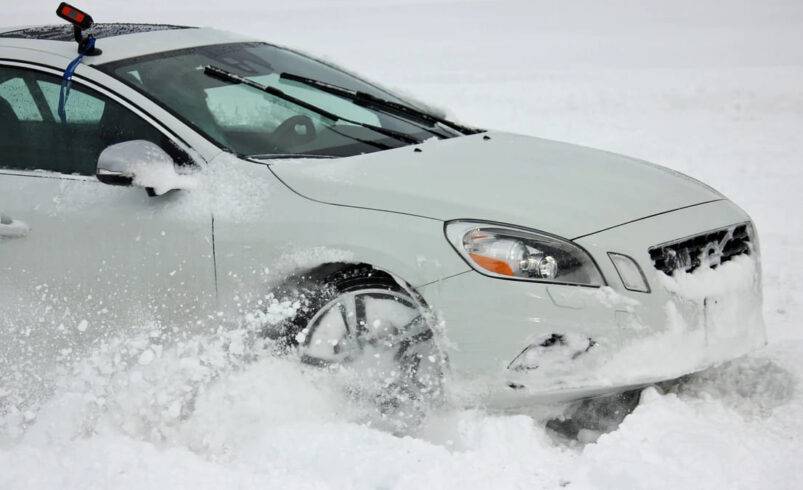
Most drivers panic when a car begins to slide, usually reacting by over-steering or slamming on the brakes. To save your life, you need to understand the two types of skids and how to “counter-steer” effectively.
Understeer: When the Car Won’t Turn
Understeer happens when you turn the steering wheel, but the car keeps going straight. This usually happens because you entered a corner too fast.
The Fix: Remove your foot from the gas immediately. Do not turn the wheel more into the corner; this actually makes the slide worse. Straighten the wheel slightly to let the tires regain grip, then gently steer back into the turn.
Oversteer: When the Rear End Fishtails
This is the classic “fishtail” where the back of the car tries to overtake the front. This is common in Rear-Wheel Drive (RWD) vehicles but can happen to anyone on black ice.
The Fix: This is where the phrase “steer into the skid” comes from. If the back of your car is sliding to the right, turn your steering wheel to the right. This aligns the front tires with the direction the back of the car is moving, helping the vehicle straighten out. Again, stay off the brakes, as locking the wheels will make the spin-out permanent.
Look Where You Want to Go
This sounds simple, but it is a psychological lifesaver. In a skid, humans tend to stare at the thing they are afraid of hitting—a tree, a guardrail, or another car. This is called “target fixation.” Instead, force your eyes to look down the open road where you want the car to be. Your hands will naturally follow your eyes.
Respect the “Invisible” Danger: Identifying Black Ice and Bridges
The most dangerous winter road isn’t the one covered in white snow; it is the one that looks perfectly clear. Black ice is a transparent coating of ice on the pavement that takes on the dark color of the asphalt, making it nearly impossible to see.
Why Bridges Freeze First
You have likely seen the signs: “Bridge freezes before road.” This isn’t just a suggestion. Because a bridge is suspended in the air, cold air flows both above and below the road surface. While the earth under a normal road acts as an insulator to keep the pavement slightly warmer, a bridge loses heat from all sides. A bridge can be a sheet of ice even when the rest of the highway is just wet.
Clues for Spotting Ice
Since you can’t always see black ice, you have to look for secondary clues:
The “Spray” Test: Look at the tires of the cars ahead of you. If the road is wet, the tires will kick up a mist or spray. If the road looks wet but there is no spray coming off the tires, you are likely driving on solid ice.
Steering Feel: If your steering suddenly feels “light” or effortless, your front tires have lost contact with the road.
The Temperature Gauge: Many modern cars have a “frost” warning that triggers when the outside temperature hits 37 degrees Fahrenheit (about 3 Celsius). Ice can form even above freezing temperatures if the pavement itself is cold enough.
Winter Survival Kit: The Gear That Saves Lives
Sometimes, despite your best driving, you might end up stuck in a ditch or stranded during a blizzard. In these moments, your driving skills matter less than your preparation. Every winter vehicle should carry:
A Solid Metal Shovel: Plastic shovels break when hitting packed ice or frozen snow banks.
Traction Mats or Sand: Even a bag of kitty litter can provide the grit needed to get a tire out of a slippery rut.
Extra Warmth: Pack a “mylar” space blanket and a heavy wool blanket. If your engine dies, the cabin of a car loses heat in minutes.
Portable Power: A dedicated jump-starter pack can be a literal lifesaver if your battery fails in sub-zero temperatures.
Common Winter Driving Myths Debunked
Myth: “I have All-Wheel Drive (AWD), so I’m safe.”
Reality: AWD helps you get going, but it does absolutely nothing to help you stop. In fact, AWD can give drivers a false sense of security, leading them to drive faster than conditions allow. Every vehicle on the road—whether it is a 4×4 Jeep or a tiny sedan—only has four patches of rubber touching the ice.
Myth: “I should deflate my tires for better traction.”
Reality: This is dangerous advice for modern radial tires. Deflating your tires can actually cause the tread to “bridge” or fold inward, reducing the contact patch and making the tire more prone to sliding. Stick to the manufacturer’s recommended PSI (usually found on the driver’s side door jamb).
Myth: “I can use hot water to clear my frozen windshield.”
Reality: Never do this. The extreme temperature difference can cause the glass to crack or completely shatter. Use a dedicated ice scraper and your car’s defroster.
Slow Down and Space Out
At the end of the day, no amount of technology or technique can overcome the laws of physics. The most important tip of all is to increase your following distance. On dry pavement, a three-second gap is standard. On snow or ice, you should increase that to eight or ten seconds.
Winter driving is a test of patience and precision. By mastering your braking, understanding how to handle a skid, and staying alert for invisible ice, you aren’t just driving—you are surviving. Stay safe, stay calm, and give the road the respect it deserves this season.