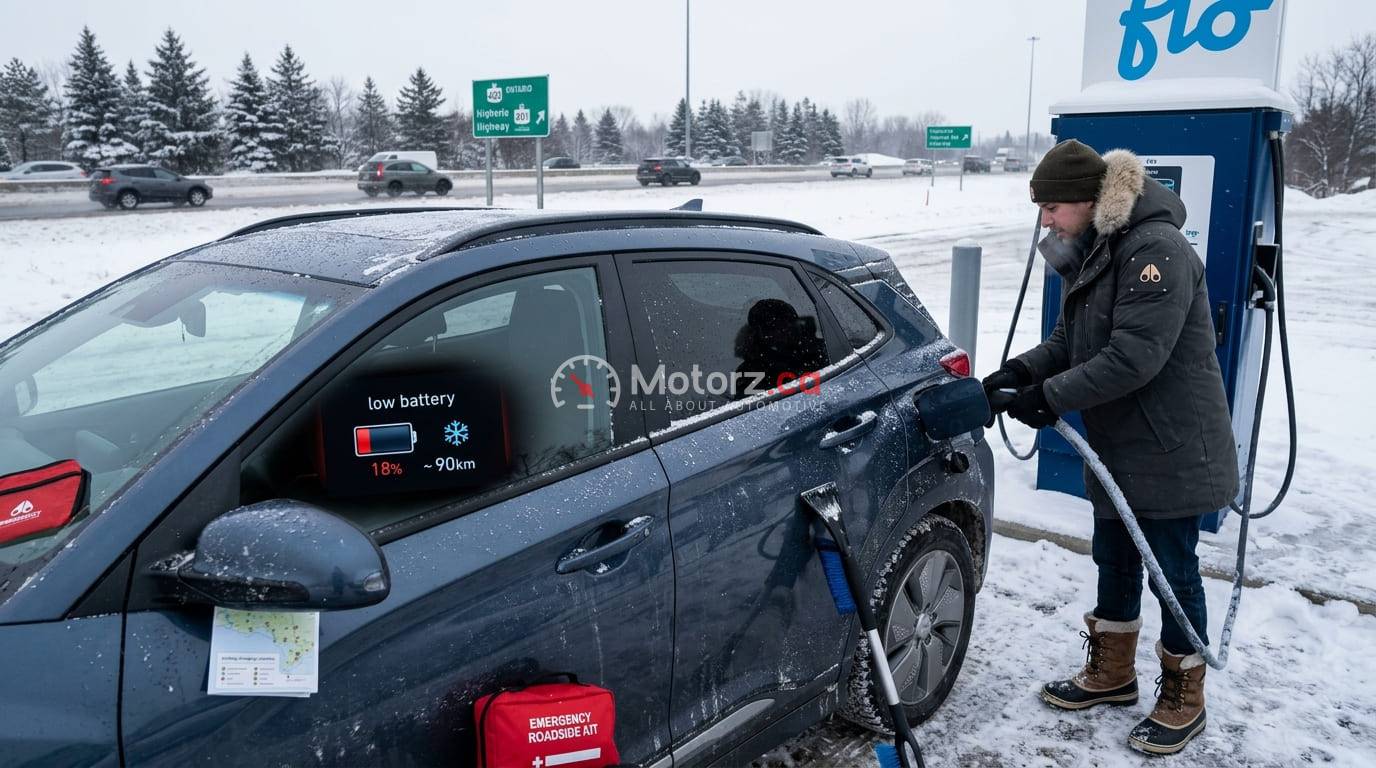
Every November, EV Winter Range Loss in Ontario. Commuters swap out their all-season tires, top up their winter washer fluid, and brace themselves for sub-zero mornings. But for a rapidly growing number of drivers, the arrival of freezing temperatures brings a relatively new psychological phenomenon: winter range anxiety.
The concern is well-founded. Anyone who has ever watched their smartphone battery plummet from 40 percent to dead while sitting in a hockey arena or waiting at a cold transit stop understands that lithium-ion chemistry behaves differently in freezing weather. When applied to a multi-ton electric vehicle navigating a snow squall on Highway 401, that chemical slowdown translates directly into fewer kilometers per charge.
Recent data from comprehensive real-world winter testing conducted by the Canadian Automobile Association (CAA) confirmed that electric vehicles covered between 14 percent and 39 percent less distance in Canadian winter conditions than their officially published ratings.
While a drop in efficiency is guaranteed, running out of power is not. By understanding the underlying physics of cold-weather battery performance and adapting your driving habits, you can accurately predict your winter range and navigate the coldest Ontario mornings with absolute confidence.
The Science: Why EV Winter Range Loss in Ontario
To master winter driving, it helps to understand why the EV Winter. The range drop in an EV during a cold snap comes down to two distinct issues: a chemical slowdown within the battery pack, and a massive thermal demand to keep the passenger cabin warm.
The Chemical Brake: Rising Internal Resistance
The lithium-ion batteries powering modern EVs rely on liquid or gel electrolytes to move lithium ions between the negative anode and the positive cathode. When the temperature drops, this liquid thickens, becoming highly viscous.
As ion movement slows down, the battery’s internal resistance rises. The vehicle’s computer recognizes this resistance and restricts how quickly energy can be pulled out of or pushed back into the cells. This does not cause permanent damage to your battery; the capacity has not vanished, it is simply temporarily inaccessible due to the cold. As soon as the battery pack warms up, its full capacity returns.
The Heating Dilemma: No More “Free” Energy
In a conventional gasoline-powered vehicle, the engine is remarkably inefficient, converting only about 20 to 30 percent of the fuel’s energy into movement. The remaining 70 percent is wasted as heat. In the winter, cars utilize this “waste heat” to warm the cabin for free.
Electric motors, by contrast, are incredibly efficient, converting over 80 percent of their energy directly into motion. Because they generate very little waste heat, an EV must actively consume battery power to keep you warm. Running a traditional resistive cabin heater can continuously draw between 3 kW and 7 kW of electricity. On a typical 60 kWh battery pack, running the heater full blast can drain 5 to 12 percent of your total capacity for every single hour you sit in traffic.
The Hard Numbers: How Popular EVs Perform in Canadian Winters
The impact of sub-zero temperatures varies significantly depending on the make and model of the vehicle. In early 2025, the CAA conducted a landmark road test, driving 14 popular EV models from Ottawa to Mont-Tremblant in real winter conditions with temperatures hovering between minus 7 and minus 15.
The findings highlighted a massive variance in how different engineering philosophies handle cold weather:
The Winter Champions: The Polestar 2 and the Chevrolet Silverado EV tied for the best performance, losing just 14 percent of their advertised range. The Polestar succeeded due to highly sophisticated thermal management, while the Silverado EV simply carries such a massive battery pack that its percentage losses remained relatively low.
The Average Performers: The Kia EV9 lost roughly 20 percent of its range, while the popular Tesla Model 3 and Kia Niro EV sat right in the middle of the pack with a 30 percent reduction.
The Cold Weather Struggle: The Ford F-150 Lightning suffered a 35 percent drop, the Hyundai IONIQ 5 lost 36 percent, and the Volvo XC40 Recharge experienced the highest range reduction at 39 percent below its official rating.
Slower Public Fast Charging
The cold weather penalty does not end when you pull up to a public charging station. Because a cold battery cannot safely accept high electrical currents, a Level 3 Direct Current Fast Charger (DCFC) will significantly throttle its delivery speeds to prevent lithium plating, which can permanently degrade the battery cells.
In the same CAA winter trials, vehicles plugged into fast chargers for 15 minutes added an average of only 100 kilometers of range. A Tesla Model 3 performed exceptionally well, adding 205 kilometers in 15 minutes, whereas the Kia Niro EV managed only 35 kilometers under identical frozen conditions.
Heat Pumps vs. Resistive Heaters: The Technology that Saves Your Range
If you are shopping for an EV in Ontario, the single most important technical feature to look for on the spec sheet is a heat pump.
Resistive Heating
Older or entry-level EVs use positive temperature coefficient (PTC) resistive heaters. These systems function like a household toaster, running high-voltage electricity through metal coils to generate direct heat. While effective at warming the air quickly, they consume a massive amount of battery power.
Heat Pump Technology
A heat pump operates like a refrigerator or air conditioner running in reverse. It utilizes a closed-loop refrigerant system to capture ambient heat from the outside air—even in temperatures well below freezing—and compresses it to warm the cabin.
According to seasonal vehicle data compiled by automotive research groups like Recurrent, an integrated heat pump can improve an EV’s winter efficiency by 10 to 15 percent compared to an identical vehicle using a resistive heater.
Pro Action Plan: 6 Steps to Maximize Winter Range in Ontario
You do not have to sit passively as the winter air reduces your dashboard range estimate. Implementing these six professional habits will drastically reduce your energy consumption on freezing mornings.
Precondition While Connected to the Grid
Preconditioning is the practice of warming both the passenger cabin and the vehicle’s battery pack before you start driving. Always configure this setting via your vehicle’s smartphone app while the car is still physically plugged into your home charger.
By preconditioning on grid power, your vehicle uses electricity from Ontario’s electrical grid to do the heavy lifting of bringing the cabin up to 21 degrees and warming the battery cells to their optimal operating zone. When you unplug and drive away, the car only needs a fraction of the energy to maintain that heat, preserving your precious battery capacity for actual road mileage.
Rely on Micro-Heating (Seats and Steering Wheel)
Heating the entire ambient air volume inside a large SUV cabin requires an immense amount of energy. Heating your body directly via conductive thermal elements is vastly more efficient.
On cold mornings, drop your main cabin climate control thermostat down to 18 or 19 degrees and turn your heated seats and heated steering wheel up to high. Heated seats typically draw less than 100 watts of power, compared to the thousands of watts consumed by the primary climate control blower. This simple shift can save you kilometers of driving range on longer commutes.
Clear Snow and Ice Completely
Leaving a heavy block of snow on your roof or hood does more than create a safety hazard for the drivers behind you; it severely compromises your range.
Weight: Carrying 50 pounds of packed snow forces the electric motor to work harder during stop-and-go city driving.
Aerodynamic Drag: EVs are precisely engineered to cut through the air with minimal resistance. A layer of crusty snow alters the vehicle’s aerodynamic profile, increasing wind resistance and energy consumption at highway speeds.
Maintain an Essential Power Buffer
During the summer, arriving at your destination or a public charger with 5 percent battery remaining is standard practice. In an Ontario winter, that is a dangerous gamble.
Many EVs reserve between 15 and 20 percent of their battery capacity specifically to run internal thermal management systems that keep the battery pack from freezing when parked. Always plan your winter road trips conservatively, aiming to arrive at your destination or next charging stop with a minimum buffer of 20 percent battery remaining.
Utilize Your Car’s Built-In Navigation for Fast Charging
If you need to use a public Level 3 fast charger during a winter trip, do not use your phone’s mapping app. Enter the fast-charging station directly into your vehicle’s native navigation system.
When a modern EV knows it is actively routing toward a high-powered DC fast charger, it will automatically begin aggressively warming the battery pack roughly 20 to 30 minutes before arrival. This ensures the battery hits its ideal thermal zone the moment you plug in, allowing you to bypass cold-throttling and achieve maximum charging speeds immediately.
Pay Attention to Winter Tire Rolling Resistance
Winter tires are non-negotiable for safe winter driving in Ontario. However, the deep treads and softer rubber compounds naturally increase rolling resistance compared to low-resistance summer tires.
When buying winter rubber for an EV, look for tires specifically engineered for electric platforms. These models feature specialized sidewall construction to support the extra weight of an EV battery while minimizing extra rolling resistance to preserve your range. Always check your tire pressures weekly during a cold snap; a drop in temperature causes tire pressures to fall, further increasing drag and sapping efficiency.
The Verdict: Can an EV Handle an Ontario Winter?
The unfiltered reality is that an Ontario winter will noticeably alter your EV driving experience. If your daily commute consists of driving 60 kilometers from Durham Region into downtown Toronto, the winter range drop is completely irrelevant. Even a 40 percent reduction on a modern EV with a 400-kilometer baseline leaves you with plenty of power to complete your round trip without ever visiting a public plug.
The challenge only emerges during extended long-distance winter travel—such as driving from Toronto to Ottawa during a January cold wave. These trips require a slight shift in mindset: you must plan for shorter highway stints, expect longer stops at public charging plazas, and actively manage your climate control settings.
An electric vehicle is fully capable of conquering Ontario’s harshest winter months. By trading range anxiety for tactical preparation—preconditioning your car, embracing your heated seats, and respecting the laws of battery chemistry—you can enjoy all the benefits of electric driving right through the heart of the Canadian winter.