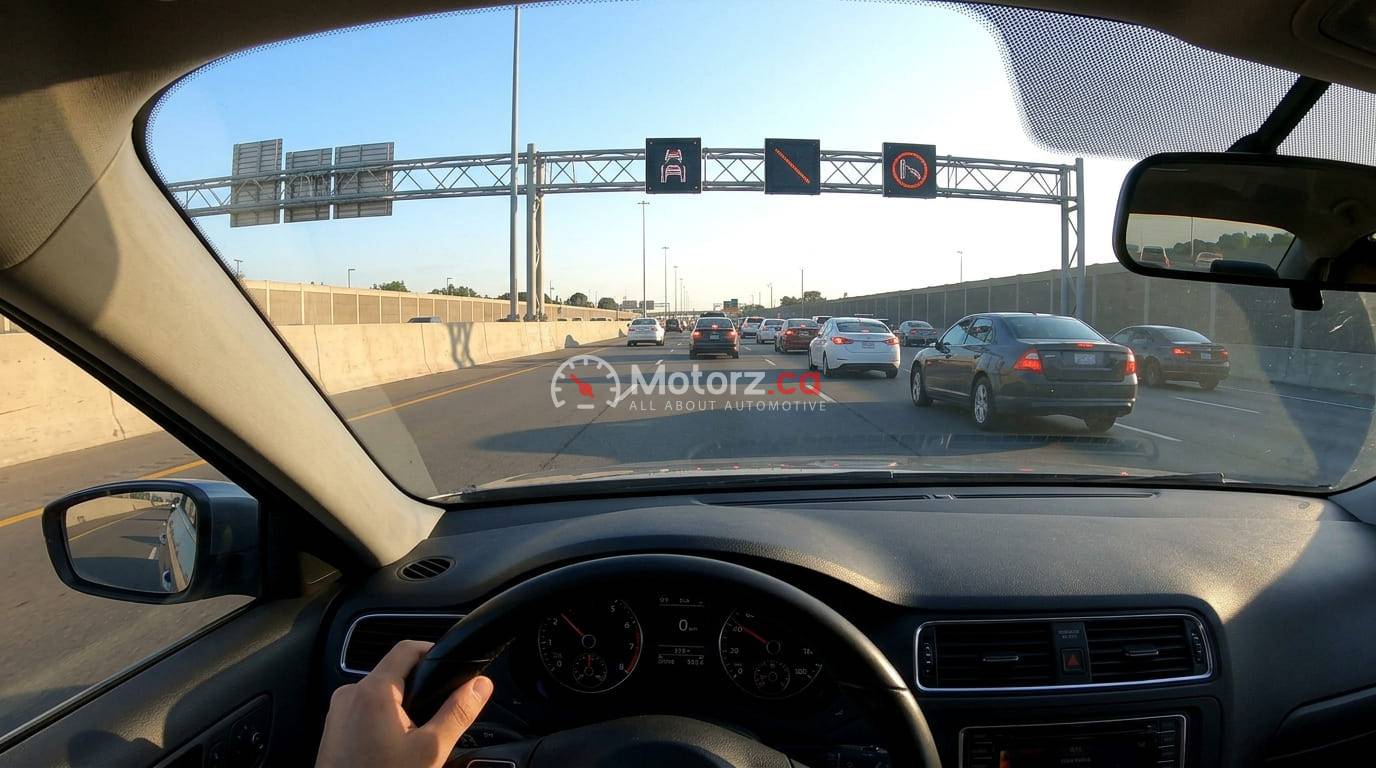
For residents of Driving Strategies, Highway 410 is far more than a asphalt corridor connecting Brampton to Mississauga and the wider Greater Toronto Area (GTA). It is a daily test of patience, focus, and survival.
Affectionately—and sometimes dynamicly—dubbed “The Four-Ten,” this crucial stretch of highway carries hundreds of thousands of commuters every day. It funnels traffic directly from the commercial and logistics hubs of Brampton into the massive stack interchanges of Highways 401 and 403.
If you drive this stretch during peak morning or evening rush hours, you already know the stakes. The corridor features a challenging combination of rapid speed fluctuations, dense commercial transport trucks, aggressive lane-merging, and unpredictable Ontario weather shifts.
A single lapse in concentration can quickly turn a routine drive into a stressful encounter, or worse, a visit to a regional Collision Reporting Centre.
Surviving your daily commute along this highway requires moving past passive driving habits. You need to develop an active, defensive driving framework tailored specifically to the unique layout and flow of the Peel Region corridor.
This comprehensive guide breaks down the structural trouble spots of the highway, identifies common driver behavior patterns, and provides actionable defensive driving techniques to help you arrive at your destination safely and without unnecessary stress.
Anatomy of a Driving Strategies: Mapping Highway 410’s Most Demanding Zones
Defensive driving begins with spatial awareness. To successfully navigate the Driving Strategies, you need to understand where the asphalt naturally creates conflict points. Because this freeway transitions quickly from dense suburban zones to major industrial junctions, certain segments demand elevated awareness.
The Northern Transition: Mayfield Road and Sandalwood Parkway
At its northernmost sector, the highway transitions from Highway 10’s undivided rural lanes in Caledon into a full, multi-lane 400-series highway infrastructure.
The Hazard: Commuters traveling southbound often accelerate rapidly as the road opens up, while northbound drivers frequently fail to slow down appropriately as the highway constricts into rural arterial lanes. This creates a volatile speed differential where cars traveling at widely varying speeds share the same space.
The Central Retail and Logistics Core: Queen Street, Centre Street, and Clark Boulevard
This central stretch serves as the main access artery for Brampton’s bustling downtown and industrial manufacturing sectors.
The Hazard: On-ramps and off-ramps throughout this segment are closely spaced. This design forces a high volume of vehicles to execute rapid lane changes simultaneously—drivers are decelerating to exit toward local commercial hubs while commercial logistics vans are accelerating onto the main highway lanes.
The Ultimate Junction: Steeles Avenue to the 401/403 Stack Interchange
The southern sector of the highway is its most demanding section. Here, the highway expands and splits into a massive collection of express lanes, collector lanes, and exit ramps directing traffic toward Toronto, Mississauga, or Pearson International Airport.
The Hazard: This area sees significant lane-weaving. Drivers unfamiliar with the lane configurations often realize too late that their lane is dropping or turning into a mandatory exit ramp. This realization frequently prompts sudden braking and unexpected, multi-lane corrections across live traffic.
Advanced Space Cushioning: The Key to Stop-and-Go Survival
The absolute foundation of defensive driving is maintaining a protective space cushion around your vehicle. In heavy traffic, vehicles tend to cluster together closely, which reduces your reaction time if a driver ahead brakes suddenly.
Implementing the Three-Second Rule (And Adjusting for Volume)
Under ideal, dry daytime conditions, always maintain a minimum three-second following distance behind the vehicle directly ahead of you.
To test your space cushion, select a fixed landmark along the shoulder, such as an overhead green highway sign or a light standard.
The moment the rear bumper of the leading car passes that point, begin counting: one-thousand-and-one, one-thousand-and-two, one-thousand-and-three.
If your front bumper crosses that same landmark before you finish the count, your following distance is too short.
Managing the Space Invasion Dilemma
A common frustration for drivers is that leaving a safe three-second gap often prompts aggressive drivers to slip into the open space. The standard reactive response is to tailgate the car ahead to block others out.
A defensive driver understands that this reaction compromises safety. If another vehicle cuts into your cushion, do not panic or tap your brakes aggressively. Simply ease off your accelerator for a few seconds, let them settle into the lane, and naturally rebuild your safe gap.
Safety Mindset: It is far better to lose five meters of lane position to an aggressive driver than to lose your stopping distance in stop-and-go traffic.
Escaping the Multi-Lane Pack
Avoid driving parallel to other passenger vehicles for extended distances. When vehicles travel side-by-side in adjacent lanes, they create a moving wall that eliminates your lateral escape routes if an object appears in the road or a driver veers into your lane.
Adjust your speed slightly to position your vehicle in the open spaces between clusters of traffic. This strategy gives you clear lanes on at least one side of your vehicle at all times.
High-Performance Vision: Scanning Beyond the Brake Lights
Most minor rear-end collisions happen because the driver is focusing entirely on the rear bumper of the vehicle immediately in front of them. Defensive driving requires expanding your visual field far down the road.
Developing a 15-to-20-Second Horizon Scan
Do not just monitor the car ahead of you. Look through their windshield, or look around their vehicle sides, to track traffic conditions 15 to 20 seconds down the highway.
By scanning the horizon, you can spot the puff of exhaust or the glint of red brake lights from vehicles four or five cars ahead. This early warning gives you vital extra seconds to ease off the accelerator and apply smooth, progressive braking long before the driver directly in front of you reacts.
Monitoring Heavy Commercial Vehicles and Blind Spots
The highway serves as an industrial shipping artery, meaning you will share the road with large transport trucks daily. These heavy vehicles require significantly longer distances to come to a complete stop compared to regular cars.
The Strategy: If you are traveling ahead of a transport truck, increase your front following distance. This precaution prevents you from having to slam on your brakes suddenly, which protects you from being rear-ended by the heavy vehicle behind you.
The No-Zone Rule: Avoid driving in a transport truck’s blind spots, which are located directly behind the trailer, along the sides of the cab, and immediately below the front windshield. If you cannot see the truck driver’s face in their side mirrors, they cannot see your vehicle. Pass these large commercial trucks efficiently and safely.
Masterful Merging: Navigating Entrance and Exit Ramps
Merging areas are some of the most dynamic zones on any 400-series highway. Poorly executed merges create sudden speed changes and disrupt the predictable flow of traffic.
The Accelerate-and-Match Protocol
The on-ramps along the highway are designed to give you enough space to bring your vehicle up to highway speed before entering the live lanes.
The Strategy: Use the full length of the acceleration lane to match the speed of the ongoing traffic. Attempting to merge onto a 100 km/h highway while traveling at 70 km/h forces oncoming vehicles to brake hard, creating a dangerous wave of deceleration through the lane behind you.
Early Selection and Managing Late Exits
When approaching your desired exit ramp, plan your lane transitions early. For example, if you need to exit at Steeles Avenue or Queen Street, you should be positioned in the right-hand collector lanes well before the ramp appears.
If traffic volume or a large truck prevents you from moving over safely in time, do not execute a sudden swipe across the gore paint or solid white lines. Accept the delay, continue down the highway to the next safe exit, and loop back via local regional roads.
Weatherproof Your Commute: Adapting to Ontario’s Extreme Seasons
Peel Region experiences a wide variety of weather conditions throughout the year. From blinding summer rainstorms that cause hydroplaning to black ice patches during mid-winter freeze-thaw cycles, weather conditions can change traction instantly.
Navigating Sudden Summer Rain and Hydroplaning
The initial 10 to 15 minutes of a sudden summer rainstorm are often the most hazardous. The falling water mixes with oil residues, grease, and rubber dust that have accumulated on the asphalt surface, creating a slick layer before the rain is heavy enough to wash it away.
The Strategy: Reduce your cruising speed below the 100 km/h limit, turn off your cruise control completely, and avoid sudden steering inputs. If your vehicle begins to hydroplane and feels disconnected from the road, do not slam on the brakes. Hold the steering wheel straight and ease your foot off the gas pedal to let the vehicle slow down naturally until the tires regain contact with the asphalt.
Winter Realities: Black Ice and Slush Management
Between December and March, the highway can present unique winter hazards. The elevated overpasses at key junctions like the 401 or Derry Road freeze much faster than standard ground-level asphalt because cold air flows beneath them.
The Strategy: Install high-quality winter tires by early November to ensure optimal rubber compliance when temperatures drop. Double your following distance to a minimum of six seconds on snowy or icy surfaces. If you see blowing snow accumulating across the lanes, look for the moisture sheen on the road surface to identify and avoid patches of black ice.
Managing the Mental Game: Road Rage and Distraction Mitigation
Defensive driving relies as much on your emotional state as it does on your physical inputs. The daily delays on GTA highways can test any driver’s patience, making active emotional management a vital safety skill.
Diffusing Aggressive Driver Encouters
If you encounter a driver who is tailgating, flashing their high beams, or weaving through lanes aggressively, do not attempt to block them or teach them a lesson. Tailgating is often a trigger for road rage incidents.
The Strategy: Signal early, move safely out of their way, and let them pass. Avoid making direct eye contact or gesturing, as these actions can escalate the situation. View aggressive drivers as a potential hazard to be distanced from your vehicle as quickly as possible.
Eliminating Cognitive Distractions
Traveling through stop-and-go traffic at low speeds can create a false sense of security, tempting drivers to check their smartphones or adjust navigation settings.
The Strategy: Put your phone on “Do Not Disturb While Driving” mode before you start your engine. A vehicle traveling at just 30 km/h covers more than eight meters per second. Looking down at a screen for a brief three-second text means your vehicle travels 24 meters completely unmonitored. Keep your focus entirely on the road ahead.
Real-World Defensive Driving Reference Matrix
To keep these strategies front of mind during your daily travels, use this quick-reference summary of how to adapt your driving approach across the different zones of the highway:
Safety is a Continuous Choice
Navigating Highway 410 safely does not require special driving skills; it requires consistency, patience, and a commitment to awareness. By learning to identify the highway’s natural bottlenecks, maintaining a protective space cushion around your vehicle, and managing your focus, you can protect yourself from daily hazards and make your commute more predictable.