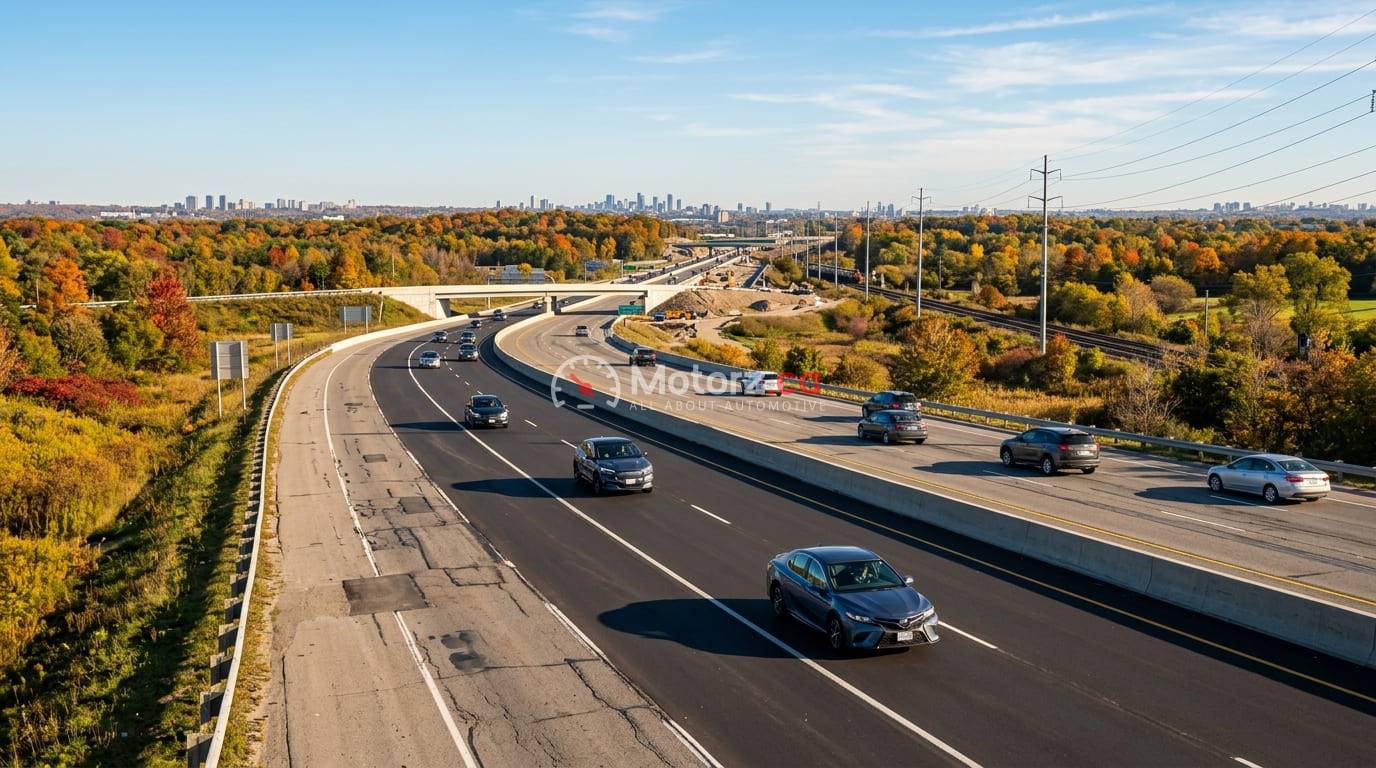
When Ontario motorists talk about Ontario’s Infrastructure Shapes, the conversation usually centers on the machine itself. We compare hybrid powertrains against conventional four-cylinder engines, double-check tire pressures, and debate the merits of low-viscosity synthetic oils.
However, there is a silent partner in your daily commute that wields massive control over your vehicle’s efficiency: the physical infrastructure of our province.
From the severe gridlock of the Greater Toronto and Hamilton Area (GTHA) to the profound frost heaves on rural routes in Northern Ontario, the physical state of our transportation networks shapes your fuel economy. This comprehensive guide breaks down the hidden mechanics of how Ontario’s roads dictate your vehicle’s energy consumption and maps out actionable steps you can take to reclaim control over your operational costs.
The Physics of Pavement: Ontario’s Infrastructure Shapes
To understand how infrastructure alters fuel economy, we must look at the physical interface where your vehicle meets the ground: the tire contact patch. The amount of energy required to roll a tire forward over a surface is known as rolling resistance. On a theoretically perfect, smooth concrete track, rolling resistance is minimized. On real-world Ontario roads, it climbs drastically.
The Pothole Penalty
Every spring, Ontario roadways undergo a destructive freeze-thaw cycle. Water seeps into the asphalt sub-layers, freezes and expands, then thaws, creating empty cavities beneath the surface. The weight of passing traffic collapses these pockets, creating a landscape of potholes, cracks, and jagged patches.
The 2026 CAA Worst Roads campaign highlights this systemic issue clearly. For the third time, Barton Street East in Hamilton secured the title of the Worst Road in Ontario, followed closely by Hurontario Street in Mississauga and Notre Dame Avenue in Greater Sudbury. Toronto corridors like Steeles Avenue East and Sheppard Avenue West also cracked the top ten list.
When your tire drops into a pothole or rolls across uneven, cracked asphalt, your vehicle’s suspension must compress and rebound to absorb the impact. This mechanical movement absorbs kinetic energy that was originally generated by your engine to move the vehicle forward. To maintain a constant speed over a heavily degraded surface, your engine must burn more fuel to offset this continuous energy loss.
Rutting and Water Pooling
On major freight corridors like Highway 410 or the Queen Elizabeth Way (QEW), heavy commercial truck traffic creates long, subtle ruts in the asphalt lanes over time. During Ontario’s frequent rainstorms, these ruts collect sheets of standing water, causing your tires to push through deep puddles rather than rolling cleanly over dry pavement.
Displacing this pooled water requires an immense amount of mechanical energy. Your engine must work significantly harder to cut through the liquid barrier, creating a dramatic drop in instantaneous fuel efficiency that lasts long after the rain stops falling.
The Traffic Crisis: The High Financial Cost of Gridlock
Traffic congestion across the GTHA is no longer just a source of daily frustration; it is a major economic burden. According to data compiled by the Canadian Centre for Economic Analysis (CANCEA) on behalf of the Residential and Civil Construction Alliance of Ontario (RCCAO), traffic gridlock costs Ontario’s economy over 12 billion units of currency annually in lost productivity alone. When broader social impacts are factored in, that number exceeds 50 billion.
The Thermal Inefficiency of Stop-and-Go Travel
Internal combustion engines are inherently inefficient at moving a vehicle from a complete, dead stop. An engine must burn a rich fuel-to-air mixture to generate the initial torque needed to overcome the inertia of a stationary, two-ton machine.
In heavy gridlock, this high-consumption launch phase is repeated hundreds of times over a single commute. The energy built up during acceleration is immediately converted into wasted heat energy by your brakes when the vehicle ahead stops again. This constant cycling destroys your vehicle’s average fuel economy ratings.
The Idling Drain
Idling is the ultimate efficiency killer because it reduces your fuel economy down to exactly zero kilometers per liter. Whether you are stuck behind a multi-vehicle collision on Highway 400 or waiting through multiple light cycles at a poorly timed intersection in Brampton, an idling engine continues to consume between 0.6 and 1.5 liters of fuel per hour depending on its displacement. If you spend 45 minutes of your daily commute idling in stationary traffic, you are effectively dumping fuel down the drain without advancing a single centimeter.
Geometric and Structural Bottlenecks across Ontario
The physical geometry and layout of Ontario’s highway systems create predictable, high-consumption choke points. These structural bottlenecks force traffic to slow down abruptly, triggering mass deceleration and acceleration cycles.
Poorly Planned Highway Merges and Lane Drops
One of the most notable architectural flaws in Ontario’s infrastructure is the sudden lane reduction or the short highway merging ramp. Consider where Highway 403 merges with the QEW in Oakville, or the lane configurations on the Lincoln M. Alexander Parkway in Hamilton.
When a highway lane drops abruptly without a sufficient taper distance, drivers are forced to slam on their brakes to merge safely. This creates a backward-traveling shockwave through the entire traffic column, slowing down vehicles kilometers behind the source.
Once past the bottleneck, every single driver accelerates back up to highway speeds simultaneously, causing a collective surge in regional fuel consumption.
The Lack of Dedicated Commercial Freight Arteries
Ontario relies heavily on its highway network to move commercial goods. Because major trade corridors like Highway 401 cut directly through dense passenger commuter zones in the GTA, light passenger vehicles must share tight pavement space with massive, heavy transport trucks.
A fully loaded commercial transport tractor-trailer requires significant time and space to accelerate up to highway cruising speed. When passenger cars cut closely in front of these large trucks, transport drivers must brake hard to maintain a safe stopping distance.
Accelerating a 40-ton commercial vehicle back up to speed burns an immense volume of diesel fuel, driving up transport costs that ultimately ripple into the consumer price of everyday goods across the province.
Active Infrastructure: Traffic Signals and Smart Transit Systems
Urban infrastructure relies heavily on automated traffic control systems to regulate vehicle flow. When these systems lack optimization, they create artificial stop-and-go patterns that degrade fuel economy.
Non-Synchronized Traffic Light Grids
Have you ever driven down a major municipal artery like Carling Avenue in Ottawa or Dundas Street in London and found yourself stopping at every single intersection, even when there is no cross-traffic? This occurs due to non-synchronized or rigid, time-based traffic signaling infrastructure.
Modern municipal infrastructure should utilize adaptive, smart traffic signals equipped with radar or pavement loop sensors that communicate dynamically with adjacent intersections.
When a city relies on outdated, fixed-timer lights, vehicles are repeatedly forced to drop from 50 kilometers per hour down to a complete stop, only for the light to turn green moments later. Synchronized corridors allow platoons of vehicles to travel at a steady speed, keeping engines running within their optimal efficiency windows.
Grade Separations and Railway Crossings
In many older industrial or growing suburban areas across Southwestern Ontario—such as Guelph, Kitchener, and parts of Thomasburg—railway tracks cut directly across major municipal roads at street level.
When a freight train passes, traffic grinds to a halt for ten to fifteen minutes. Hundreds of vehicles sit idling simultaneously, creating localized pockets of emissions and heavy fuel consumption.
Upgrading these intersections with structural grade separations—where the roadway passes cleanly over or under the rail tracks—completely eliminates these lengthy idles, smoothing out the flow of traffic and saving significant amounts of fuel.
Winter Infrastructure: Snow Removal and De-Icing Realities
Ontario winters place unique demands on our transportation infrastructure, and the provincial response directly influences how much fuel your vehicle consumes during the cold weather months.
Plowing Deficiencies and Slush Accumulation
When a heavy winter storm drops snow across regions like Barrie, Sudbury, or the Niagara peninsula, the speed and efficiency of municipal plowing operations matter immensely to your vehicle’s powertrain.
Driving through even two or three centimeters of unplowed snow or heavy, wet slush creates immense physical drag against your vehicle’s tires and lower chassis. The engine must generate extra horsepower simply to push through the heavy winter mixture, which can easily drop your cold-weather fuel economy by fifteen to twenty percent compared to driving on a clean, dry highway surface.
The Chemical Grip Factor
Ontario road crews utilize millions of tons of dry rock salt and liquid brine solutions every winter to melt ice accumulation on highways. While these chemicals are critical for safety, they have an indirect impact on vehicle aerodynamics.
As snow melts, it forms a sticky, salt-laden road spray that coats the exterior body panels of your vehicle. This thick layer of grime disrupts the smooth, aerodynamic airflow designed by the vehicle’s engineers.
At highway cruising speeds, a vehicle heavily coated in winter salt grime experiences increased wind resistance, requiring extra energy to cut through the air.
Structured Summary: Infrastructure Factors vs. Fuel Economy Impact
To see exactly how different infrastructure deficiencies compromise your vehicle’s efficiency, look at this structural breakdown of causes, effects, and the relative severity of the fuel penalty:
Practical Tips for Drivers to Fight Infrastructure Inefficiency
While you cannot personally repave Highway 401 or reprogram your city’s traffic light system overnight, you can adapt your driving habits to shield your wallet from the financial toll of deficient infrastructure.
Master the Art of Predictive Coasting
When navigating a poorly timed municipal road or a congested highway lane, look several hundred meters ahead rather than focusing solely on the bumper directly in front of you. If you see a red light or a cluster of brake lights forming in the distance, take your foot off the accelerator immediately and let your vehicle coast forward naturally.
By slowing down early, you often allow the bottleneck to clear or the light to turn green before you arrive. This technique helps you maintain forward momentum and avoids the high fuel penalty of accelerating from a complete stop.
Leverage GPS Routing with Real-Time Traffic Data
Never rely on habit for your daily commute across Ontario. Before leaving your driveway, activate a modern GPS navigation system that monitors real-time traffic speeds and construction blockages.
These smart mapping systems can route you around severe gridlock, closed lanes, or known bottleneck zones. Even if the alternative route covers a slightly longer total distance, traveling at a steady, consistent speed on open side roads burns significantly less fuel than sitting stationary in a highway gridlock zone.
Adjust Your Commute Window to Off-Peak Hours
If your employer offers flexible working hours or remote options, adjust your travel window to avoid peak rush hour traffic. Traveling along the QEW or Highway 401 at 6:15 AM rather than 8:00 AM completely transforms your driving experience.
By removing your vehicle from peak congestion periods, you cut your travel time in half and allow your engine to run in its optimal, high-gear highway efficiency window.
Optimize Your Lane Selection on Degraded Corridors
When driving on heavily worn industrial roads or freight-heavy highways, choose your lane strategically to minimize rolling resistance. Avoid riding directly inside the deep, worn ruts formed by heavy trucks in the right-hand lane, especially during rainstorms.
Position your vehicle on the smoothest sections of pavement available, and safely give a wide berth to known pothole fields along the edges of the roadway to protect both your fuel economy and your suspension components from costly mechanical damage.
Looking Forward: Smart Infrastructure Investments for Ontario
Long-term relief from infrastructure-induced fuel loss requires targeted, modern civil engineering solutions. Governments and planners across Ontario are exploring structural upgrades designed to get the province moving efficiently again.
The Implementation of Adaptive Traffic Control Systems
Major urban centers, including Toronto and York Region, are testing adaptive traffic signal technologies. These systems utilize artificial intelligence and advanced intersection sensors to track real-time traffic volumes across entire neighborhoods.
The system adjusts signal timing dynamically on the fly, extending green lights along busy transit corridors when a heavy volume of vehicles is detected. This technological upgrade reduces unnecessary stops, helping commuters save fuel across the network.
Transit-Oriented Development and High-Order Transit
The most effective way to optimize road infrastructure is to reduce the volume of single-occupant passenger cars competing for limited asphalt space. Major provincial investments in high-order transit—such as expanding Metrolinx GO Transit rail frequencies to fifteen-minute all-day service, building the Ontario Line subway, and deploying light rail systems in Waterloo and Mississauga—aim to provide drivers with viable alternatives.
Moving commuters onto efficient electric rail infrastructure frees up valuable road capacity for commercial freight vehicles and drivers who must use the roads, smoothing out traffic flow and reducing fuel consumption across the board.
Adapting to the Reality of the Road
Ontario’s infrastructure is a powerful force that actively shapes your vehicle’s fuel economy every single day. The potholes that break up our pavement, the bottlenecks that constrict our highways, and the traffic gridlock that tests our patience all carry a direct financial cost at the fuel pump.
While major civil infrastructure upgrades require years of political planning and capital investment, you do not have to be a passive consumer.
By understanding the physics of rolling resistance, adopting a predictive style of driving, utilizing real-time traffic routing tools, and keeping your vehicle away from peak congestion zones, you can successfully insulate your household budget from the hidden expenses of the road. In a province with demanding driving conditions, a smart, informed driver remains the ultimate efficiency tool.