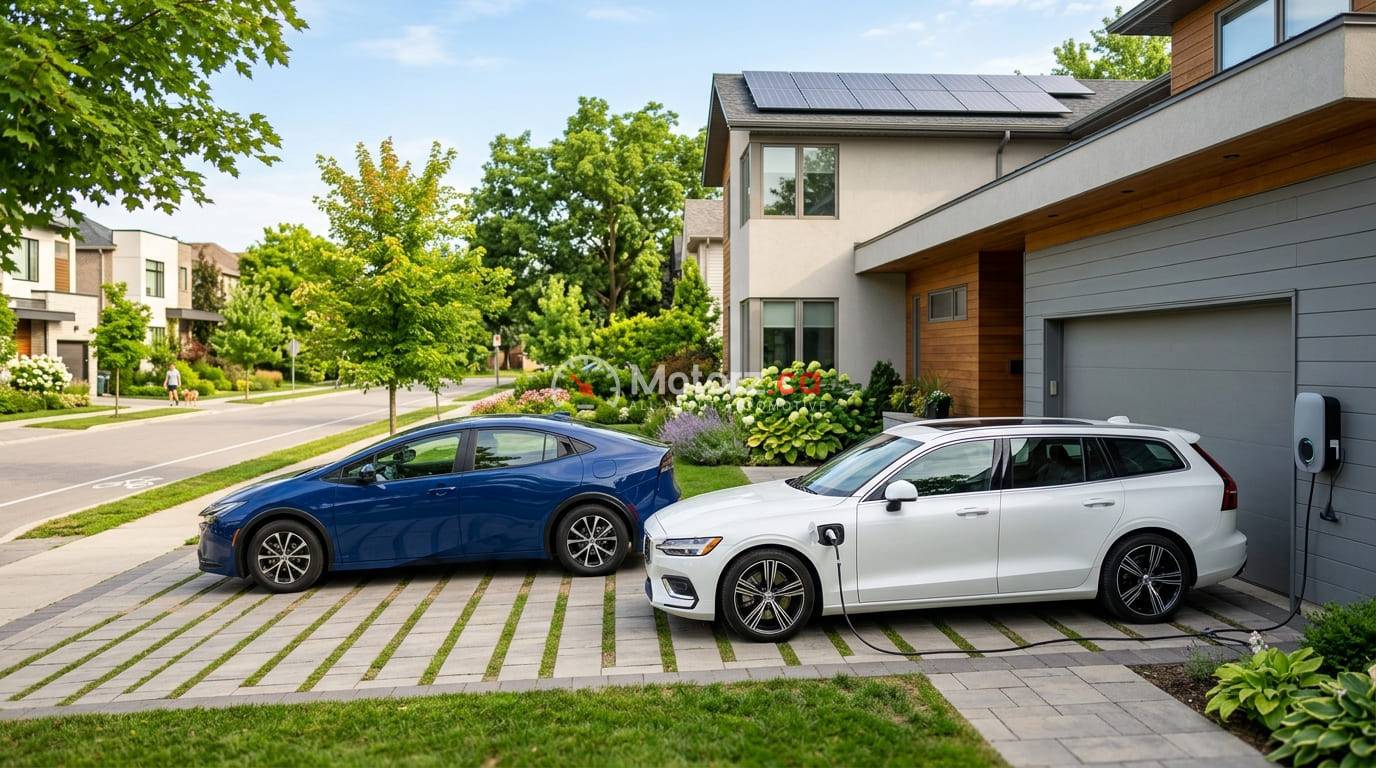
Rising fuel costs, a desire for Hybrid vs. Plug-In Hybrid, and evolving automotive technology are driving thousands of commuters in Brampton, Ontario to reconsider their reliance on traditional internal combustion engines. With major routes like Highway 410, Bovaird Drive, and Steeles Avenue gridlocked during rush hour, conventional gasoline vehicles waste significant amounts of energy idling in stop-and-go traffic.
If you are planning to transition toward electrified driving, you will find two primary options in the midsize and family vehicle market: traditional hybrids and Plug-In Hybrid Electric Vehicles (PHEVs). Both choices slash fuel bills and lower your carbon footprint, but they operate through completely different mechanical setups and require distinct daily habits.
This analytical guide contrasts standard hybrids with plug-in hybrids, focusing directly on the infrastructure, driving habits, and climate realities of living in Brampton.
The Hybrid vs. Plug-In Hybrid:
To choose the ideal powertrain, you must first understand how each vehicle processes power, manages its battery reserve, and uses gasoline.
Conventional Hybrids: The Set-It-and-Forget-In Option
A traditional hybrid vehicle, often called a self-charging hybrid, uses an internal combustion engine alongside a small electric motor and a compact battery pack.
How it charges: You never plug a traditional hybrid into an electrical outlet. The vehicle handles all battery replenishment on its own using a process called regenerative braking (capturing kinetic energy normally lost as heat when slowing down) and by routing excess energy from the gas engine to a generator.
How it drives: The electric motor manages low-speed crawling, pulling away from a stoplight, and maintaining steady speeds in parking lots. When you press down hard on the accelerator to merge onto a highway, the gasoline engine kicks in seamlessly to provide combined horsepower.
Plug-In Hybrids (PHEVs): The Dual-Identity Machine
A plug-in hybrid serves as a structural bridge between standard hybrids and full Battery Electric Vehicles (BEVs). It features a much larger battery pack and a more potent electric motor paired with a traditional gas engine.
How it charges: To maximize efficiency, you must physically plug the car into an external power source—either a standard home wall outlet or a public charging station.
How it drives: A PHEV operates as a purely electric vehicle for a set distance, generally between thirty-five and seventy kilometres on a single charge. Once that electric range is fully exhausted, the vehicle automatically reverts to functioning exactly like a standard conventional hybrid, using its gas engine and regenerative braking to keep driving without interruption.
Daily Commuting and Driving Profiles in Brampton
Your personal daily commute profile is the single most important factor determining whether a hybrid or a PHEV will deliver a better financial return.
The Short Urban Commute
If your daily routine consists of driving from the Springdale neighborhood down to the Brampton Innovation District downtown, or running local errands along Queen Street, your total daily travel distance might sit well under forty kilometres.
In this scenario, a plug-in hybrid is practically unbeatable. You can tackle your entire daily routine exclusively on electricity. If you charge the vehicle each night in your driveway, you can go weeks or even months without stopping at a gas station, saving massive amounts of money over the course of a year.
The Heavy GTA Highway Commute (Advantage: Hybrid)
Many Brampton residents endure long daily commutes down the 410, onto the 401 East toward Toronto, or via the 407 ETR across the Greater Toronto Area. If your one-way commute is sixty kilometres or longer, a PHEV will deplete its pure electric range within the first half of your morning drive.
For the remainder of your lengthy high-speed commute, you will be carrying the dead weight of a heavy, depleted battery pack while relying on the vehicle’s hybrid gas engine. A conventional hybrid shines in long-distance travel because it is optimized for consistent efficiency over hundreds of kilometres, features a lighter body weight, and often carries a lower initial purchase price, allowing you to recoup your investment faster through consistent fuel savings.
Infrastructure Realities: Charging at Home and on the Go
Choosing a plug-in hybrid means taking a hard look at your domestic living situation and your access to local charging stations.
The Home Charging Factor
Because a PHEV battery pack is much smaller than a pure electric vehicle’s battery, you can easily plug it into a standard 120-volt household wall outlet (Level 1 charging) in your garage or driveway. Leaving a PHEV plugged in overnight for roughly eight to twelve hours will generally net you a full charge by morning.
However, if you live in an apartment complex, a multi-generational townhome with shared parking spaces, or a rental property without external electrical outlets, keeping a PHEV charged becomes a persistent chore. If you cannot reliably charge a PHEV at home, a conventional hybrid is the superior, stress-free option.
Public Charging Options Across the City
Brampton continues to expand its public charging infrastructure. The city operates more than fifty public charging ports at civic buildings, including City Hall, the West Tower underground parking garage, and municipal recreation centres like the Cassie Campbell Community Centre and Susan Fennell Sportsplex.
Major shopping hubs like Bramalea City Centre and Shoppers World also offer accessible Level 2 charging stations, allowing you to top up your battery while shopping or catching a movie. While these public stations are highly convenient for a quick boost, relying solely on public infrastructure to power a PHEV is rarely cost-effective compared to cheap overnight residential electricity rates.
Facing the Canadian Winter: Climate Impact on Efficiency
The climate across southern Ontario presents distinct challenges for battery performance and overall vehicle efficiency.
How Cold Weather Shrinks PHEV Electric Range
Lithium-ion batteries rely on chemical reactions that slow down dramatically when ambient temperatures drop below freezing. During a typical January cold snap, a plug-in hybrid can lose thirty to fifty percent of its advertised electric driving range.
Furthermore, because electric motors do not generate significant waste heat, running the vehicle’s cabin heater and windshield defrosters requires immense amounts of energy. Many PHEVs will automatically fire up their internal combustion gasoline engine during sub-zero mornings simply to generate enough cabin heat to keep the windows clear, temporarily bypassing your ability to drive on pure electricity.
Why Hybrids Handle Severe Cold with Ease
Conventional hybrids also experience a drop in fuel efficiency during winter because the gasoline engine must run longer to reach its optimal operating temperature. However, because a traditional hybrid never promises a dedicated block of pure electric range, the cold weather impact feels far less disruptive to your daily driving habits. You simply drive the car normally, enjoying reliable heater performance from the gas engine while the electric motor continues to assist silently in the background whenever conditions allow.
Total Cost of Ownership: Purchase Price vs. Incentives
Upfront costs, long-term maintenance, and available government rebates play a massive role in determining your final vehicle choice.
Understanding Upfront Costs and Federal Rebates
As a general rule, a plug-in hybrid carries a higher manufacturer’s suggested retail price (MSRP) than an identical model equipped with a standard hybrid powertrain. This price delta pays for the larger battery pack and onboard charging equipment.
To help offset this initial price difference, the Canadian federal government offers a point-of-sale financial incentive through the Electric Vehicle Affordability Program (EVAP):
Plug-In Hybrids (PHEVs) with long-range electric capabilities can qualify for a rebate of up to 2,500.
Conventional Hybrids do not qualify for any federal or provincial EVAP incentives.
While Ontario does not offer a provincial rebate program for passenger electric vehicles, the federal EVAP rebate significantly helps bridge the upfront cost gap between a PHEV and a traditional hybrid.
Long-Term Maintenance Considerations
Many buyers worry that a plug-in hybrid introduces double the maintenance headaches because it combines complex battery tech with a traditional engine. In practice, both hybrids and PHEVs are remarkably reliable.
Because both systems use heavy regenerative braking to slow the car down, your mechanical brake pads and rotors experience far less physical friction, often lasting twice as long as pads on a standard gas-powered car.
PHEVs require regular oil changes, engine air filter replacements, and cooling system flushes just like any gas car. However, because the gas engine sits dormant during short city trips, the actual mechanical wear and tear on the engine pistons and valves accumulates at a much slower rate.
How to Determine Your Ideal Match
If you are standing in a local dealership showroom trying to pull the trigger on a new vehicle, follow this simple diagnostic checklist to ensure you buy the model that fits your lifestyle perfectly.
The Winner for the Brampton Commuter
There is no single correct answer, but there is an ideal choice for your specific lifestyle.
A Conventional Hybrid is the hands-down winner for residents who live in multi-family housing units without reliable overnight charging access, or for those who spend hours crushing long highway distances along the 401 or 407 every day. It offers hassle-free, highly efficient transportation with zero adjustments to your daily habits.
A Plug-In Hybrid (PHEV) is the absolute champion for suburban households with a driveway or garage who primarily travel within Peel Region for work, school carpools, and shopping. By utilizing a PHEV, you essentially get two distinct vehicles in one: a clean, quiet electric vehicle for your daily local routine, and a stress-free hybrid gas car ready to tackle long-distance Canadian road trips whenever you need it.