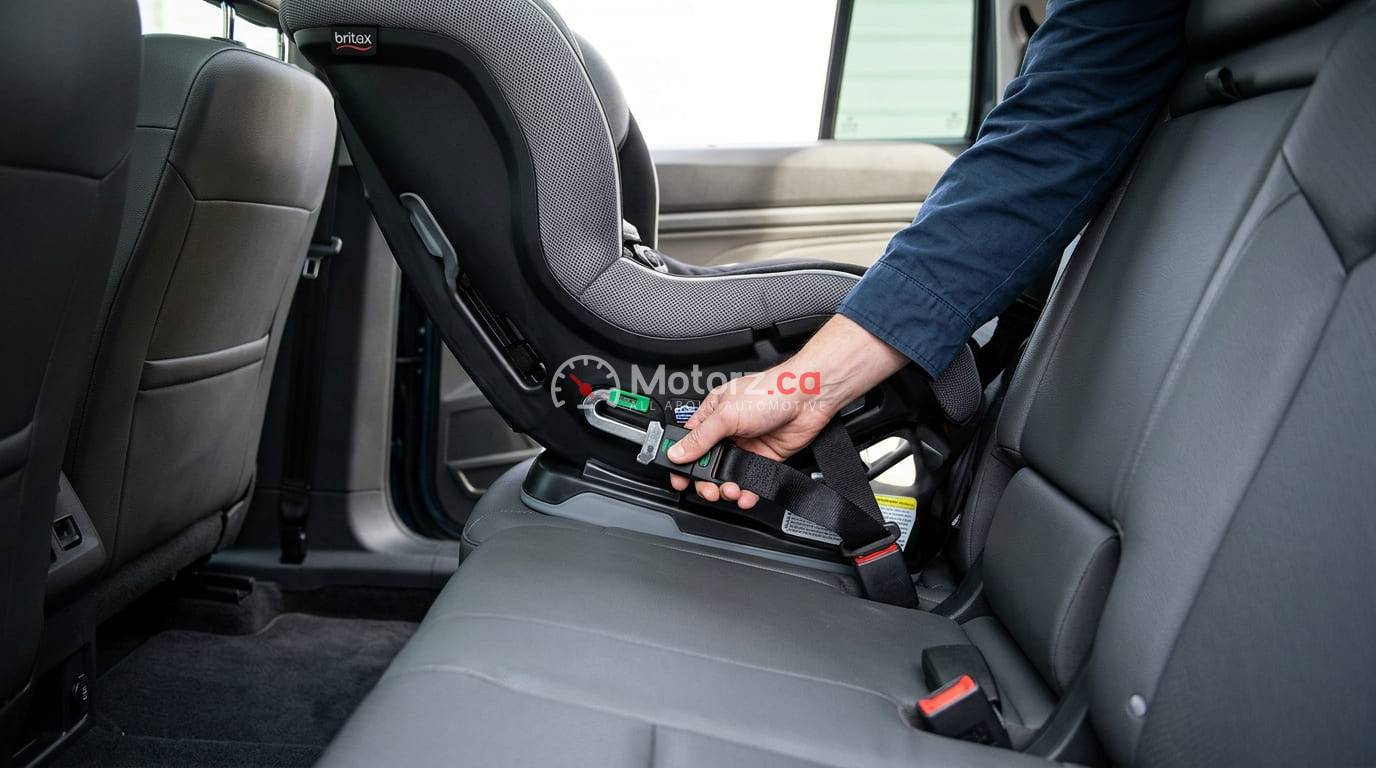
SUV Car Seat Installation Guide, is a distinct experience. Between navigating busy, multi-lane routes like Bovaird Drive and Steeles Avenue, handling high-stress merges onto Highway 410, and managing GTA winter weather, local parents face a lot on the road. When you throw the daily hustle of school drop-offs, weekend trips to the CAA Centre, and grocery runs into the mix, a modern Sport Utility Vehicle (SUV) becomes a core part of suburban family life.
SUVs provide a tall ride height, excellent visibility, and the security of all-wheel drive. Yet, a vehicle’s large size does not automatically guarantee safety for its smallest occupants. Studies consistently reveal that over 70% of child safety seats are installed incorrectly or used improperly.
In a modern SUV, a combination of deep-set seats, unique headrest angles, complex lower anchors, and wide configurations can create unexpected installation hurdles. This comprehensive safety guide will walk you through installing child car seats securely in a modern SUV, specifically tailored for families living in Brampton and the wider Peel Region.
Understanding SUV Car Seat Installation Guide Stages
Before installing a child restraint system, it is vital to know the legal requirements in Ontario. The Ministry of Transportation enforces distinct car seat regulations based on a child’s age, weight, and height.
Navigating these rules ensures your child is legally protected and positioned for maximum safety during everyday city driving.
Stage 1: Rear-Facing Seats for Infants
Under Ontario law, an infant must be secured in a rear-facing car seat from birth until they weigh at least 9 kilograms. However, car seat technicians and medical professionals highly recommend keeping your child rear-facing as long as possible, up to the maximum weight or height limit specified by your car seat manufacturer. Many modern convertible car seats allow children to remain rear-facing until they reach 18 to 22 kilograms.
In a collision, a rear-facing seat absorbs the crash forces across the entire shell of the seat, protecting the child’s fragile head, neck, and spinal cord from severe injury.
Stage 2: Forward-Facing Seats for Toddlers
Once your child outgrows their rear-facing seat by weight or height, they transition into a forward-facing car seat featuring a five-point harness. Ontario law requires children who weigh between 9 and 18 kilograms to be anchored in a forward-facing child seat.
The five-point harness keeps your toddler tightly secured against the seat structure, distributing impact energy across the strongest bones of the body: the shoulders and hips.
Stage 3: Booster Seats for Growing Kids
Children who weigh between 18 and 36 kilograms, are under the age of 8, and stand less than 145 centimeters tall must use a booster seat. A booster seat does not have its own harness system. Instead, it lifts your child up so that the vehicle’s standard adult lap and shoulder belts fit across their body properly.
Stage 4: The Adult Seatbelt Test
Your child is legally allowed to use a standard vehicle seatbelt alone once they turn 8 years old, reach a weight of 36 kilograms, or hit a height of 145 centimeters. However, height is the most critical metric. To safely transition out of a booster, the child must pass the five-step seatbelt test:
Their back rests flat against the SUV seatback while their knees bend comfortably over the edge of the seat cushion.
The shoulder belt crosses the middle of their chest and shoulder, never rubbing against their neck or face.
The lap belt sits low across the sturdy hip bones, not riding up onto the soft abdomen.
The child can maintain this proper posture for the entire duration of the drive.
Universal Anchorage Systems (UAS) vs. Vehicle Seatbelts
When installing a harnessed car seat in your SUV, you must choose between two primary securing methods: the Universal Anchorage Systems (UAS) or the vehicle’s built-in seatbelt. Both methods are equally safe, but they should never be used together at the same time unless explicitly permitted by both the car seat manufacturer and your vehicle owner’s manual.
Method A: The Universal Anchorage System (UAS)
UAS uses dedicated metal anchor bars built right into the crease of your SUV’s rear passenger seats. The car seat features corresponding lower connectors that clip or click directly onto these anchor bars.
UAS is highly popular because it makes installing a child seat quick and straightforward. However, UAS has a strict weight limit. In Canada, the combined weight of the child and the car seat cannot exceed 29.5 kilograms when using lower anchors. Once your child grows heavier, you must switch the installation over to the vehicle seatbelt system.
Method B: The Vehicle Seatbelt System
Using the SUV’s seatbelt is a highly reliable installation method that works for any child weight up to the maximum capacity of the car seat. To secure a child seat with a seatbelt, you must pull the shoulder strap all the way out to its full extension to switch the retractor into automatic locking mode.
As the belt feeds back into the wall, you will hear a clicking sound. This sound indicates the belt is locked solid and will not loosen up, ensuring the child restraint stays firmly pinned to the SUV seat frame.
Step-by-Step Rear-Facing SUV Installation
Rear-facing installations can be tricky in midsize and full-size SUVs because the vehicle seats often tilt backward for adult comfort, which can throw off the angle of an infant seat. Follow this sequence to secure a rear-facing base or convertible seat.
Step-by-Step Forward-Facing SUV Installation
When transitioning your child to a forward-facing seat, handling the top tether anchor becomes the most crucial safety factor. The top tether stops the top of the car seat from pivoting forward during a sudden stop, reducing potential head and neck movement significantly.
1. Position the Seat Flat Against the SUV Backrest
Place the child seat flush against the rear vehicle seat. If your SUV features adjustable rear backrests, ensure the seat is clicked into an upright, locked position. If the car seat frame cannot sit flat because of a protruding vehicle headrest, lift or remove the headrest entirely to achieve a tight, flush fit.
2. Lock the Lower Foundation (UAS or Seatbelt)
Thread your vehicle seatbelt through the forward-facing belt path, buckle it, and pull the belt fully out to activate the locking mechanism. Alternatively, hook the UAS connectors onto the built-in lower anchor bars. Press your knee down firmly into the center of the seat pan to compress the vehicle upholstery, and pull all remaining slack out of the anchor strap or seatbelt system.
3. Route and Secure the Top Tether Anchor
This is where many SUV installations miss the mark. Locate the designated top tether anchor point for that specific seating position. Clip the tether hook onto the anchor and pull the strap tight until all slack is gone.
Critical SUV Warning: In utility vehicles, the top tether anchor is never located on the roof or near the rear tailgate latch. It is typically found on the lower back of the rear seat upholstery, on the cargo floor, or on the back of the headrest frame. Check your SUV owner’s manual to ensure you are clipping onto a structural anchor bar, and not a flimsy plastic cargo net hook or cargo tie-down loop.
Common SUV Car Seat Installation Mistakes
Modern sport utility vehicles offer spacious cabin designs, but their versatile layouts can lead to specific installation errors if you are not careful.
1. Forgetting the Top Tether on Forward-Facing Seats
Failing to attach the top tether strap is one of the most frequent installation mistakes seen on Ontario roads. Without the top tether hooked up, a forward-facing car seat can tip forward violently during a hard braking event on busy local highways. This movement can cause a child’s head to strike the front vehicle seats, leading to preventable injuries. Always secure the top tether hook for every forward-facing installation.
2. Routing Straps Under or Around Adjustable SUV Headrests
Modern midsize and large crossover SUVs feature tall, adjustable rear headrests designed to prevent whiplash in adult passengers. However, these structures often interfere with the routing of a car seat’s top tether strap.
If the tether strap is routed loosely around the side of a wide headrest, it can easily slip off during a crash. Check your vehicle manual: some manufacturers require routing the top tether strap directly under the lifted headrest bars, while others instruct you to route it over the top.
3. Placing Child Seats in the “Borrowing” Center Position
Many parents prefer to install a child seat in the middle row position to keep their child as far away from side-impact crash zones as possible. While this is an excellent strategy, it can lead to a dangerous error known as anchor borrowing.
Most SUVs feature dedicated UAS lower anchor bars only for the two outer window seats. They rarely provide dedicated lower anchor pairs for the center position.
Parents often “borrow” the inner anchor bars from the left and right seats to secure a car seat in the middle. This is unsafe because the spacing is often too wide, which can cause the anchor bars to deform or fail under crash loads. If you want to use the middle seating position, secure the child car seat using the vehicle’s standard lap and shoulder seatbelt instead.
Managing Multi-Car Seat Layouts in Three-Row SUVs
If you have a growing family or run carpools around Peel Region, managing multiple child seats across a three-row SUV layout requires careful spatial planning.
Navigating the Third-Row Access Dilemma
Three-row SUVs like the Honda Pilot, Ford Explorer, or Toyota Highlander offer plenty of passenger capacity, but installing car seats can make getting to the third row difficult. If you install a rear-facing infant seat onto a second-row captain’s chair, that seat can no longer tilt or slide forward to let older children climb into the back.
To solve this, place your rear-facing seats on the smaller portion of a split-bench seat, or place your oldest independent children in the third row first before buckling younger infants into the middle row.
The Challenge of a 3-Across Installation
Trying to pack three child seats side by side across a single row is a puzzle familiar to many parents. Most standard infant and convertible car seats are quite wide, making a three-across configuration impossible in a compact or midsize SUV.
If you need to fit three kids across one row, you will need to purchase specialized slim car seats that measure 43 centimeters (17 inches) or less in width. When configuring a three-across setup, ensure that adjacent car seats do not touch or press hard against each other, as this pressure can interfere with how the seats perform during a collision.
Local Resources: Getting Expert Help in Brampton
Even if you follow every step in your manuals, getting an expert second opinion provides invaluable peace of mind before you hit the road.
Professional Car Seat Inspection Services
You do not have to handle child passenger safety completely on your own. There are certified professionals across Ontario trained to inspect your work and teach you proper techniques:
St. John Ambulance (Peel Dufferin Branch): Located nearby in Mississauga, this branch occasionally hosts dedicated child car seat workshops. Rather than doing the installation for you, their trained safety volunteers coach you through the entire process so you can install your seats with confidence.
CPSAC Certified Technicians: The Child Passenger Safety Association of Canada (CPSAC) maintains a comprehensive national registry of independent certified technicians. You can use their online locator tool to find a local technician right here in Brampton who can meet you for a personalized, one-on-one safety check.
Car Seat Safety Checklist for Busy Parents
Before you shift your SUV into drive and head out onto the busy streets of Brampton, take thirty seconds to complete this rapid visual safety check:
The 1-Inch Movement Check: Grab the car seat frame right at the belt path and give it a firm shake. Does it slide more than 2.5 centimeters (1 inch) side to side or front to back? If yes, tighten the belts.
The Harness Pinch Test: Buckle your child into their five-point harness and slide the plastic chest clip up so it sits level with their armpits. Try to pinch the fabric webbing of the harness strap at the child’s collarbone between your thumb and forefinger. If you can pinch a fold of the strap, the harness is too loose. Tighten it down until your fingers slide smoothly off the flat webbing.
The Winter Coat Rule: Never buckle a child into a harnessed car seat while they are wearing a thick, puffy winter coat or snowsuit. In a collision, the force of the crash instantly compresses the fluffy coat padding, leaving the harness loose and creating a risk of ejection. Instead, dress your child in warm, thin layers like fleece sweaters, buckle them snugly into the harness, and tuck their heavy winter coat over the top of the secured straps like a blanket.
The Expiry Date Verification: Plastic degradation from seasonal temperature swings can weaken a car seat over time. Check the manufacturer stamp on the back or bottom of your car seat shell to ensure the product has not passed its official expiration date.