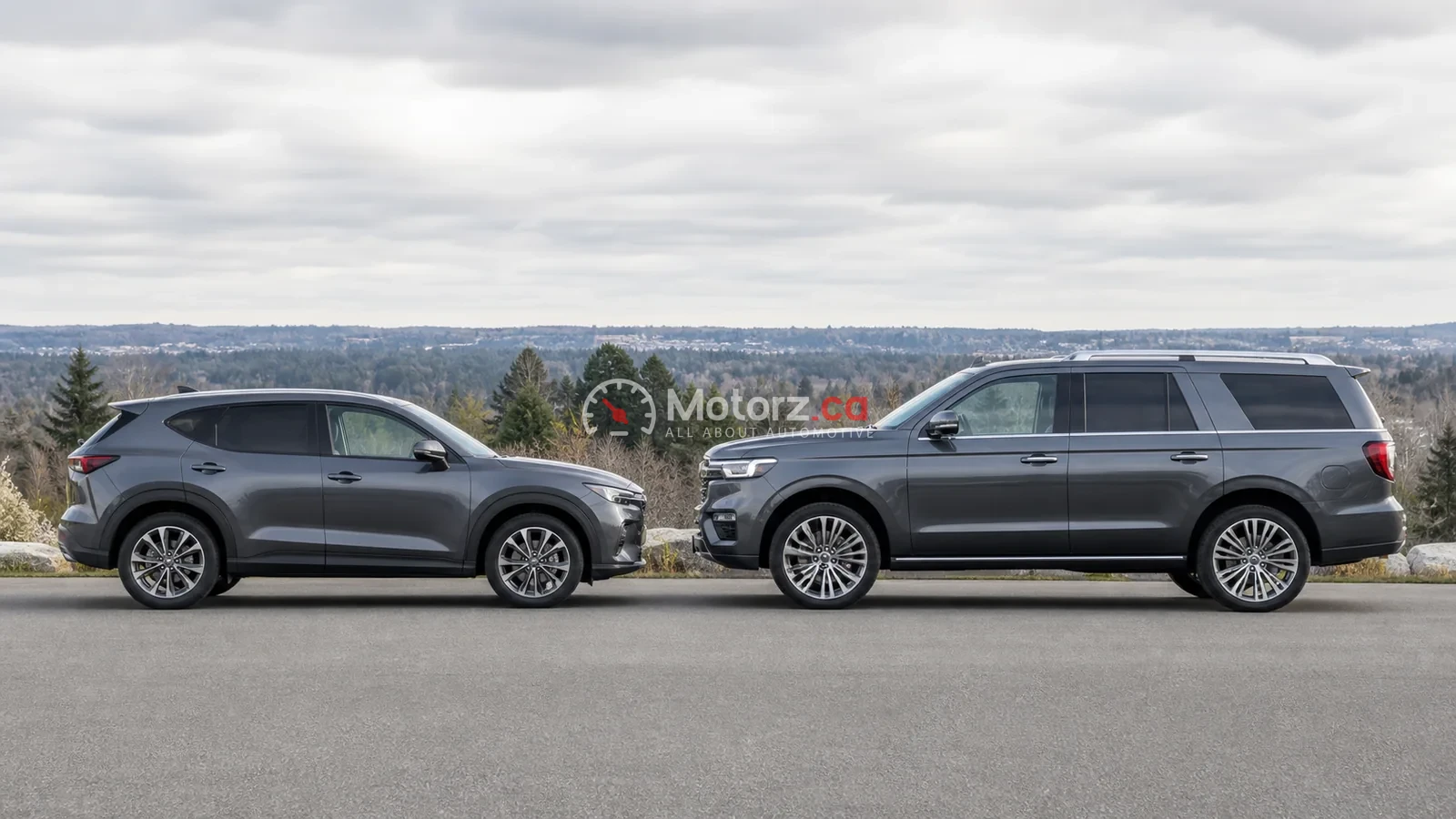
The words SUV and crossover are used inconsistently. A better comparison starts with space, payload, towing, roads, parking and operating costs.
The direct answer
Choose the specific vehicle that meets your passenger, cargo, towing, road and parking needs rather than assuming every “SUV” is rugged or every “crossover” is efficient. Many modern models blur the labels. Compare published specifications, fuel-consumption ratings, tires, ground clearance and actual usable space trim by trim.
Why the labels are confusing
Crossover commonly describes a utility-shaped vehicle based on car-like unibody construction, while SUV has historically included more truck-like designs. Marketing usage is not consistent, and manufacturers may use either term for vehicles with similar construction and capability. The badge therefore tells you less than the specification sheet.
Do not infer crash protection, off-road ability or towing capacity from the category name. Those characteristics depend on the particular vehicle, configuration, equipment and rating.
Start with passengers and cargo
Count the people who travel regularly, not the maximum number on an occasional trip. Check rear-seat access, headroom and legroom in person. A third row may reduce cargo space when raised, and a sloping roof can make a large published cargo figure less useful for tall items.
Bring measurements for strollers, mobility devices, sports gear, pet carriers or work equipment. Published cargo volumes are helpful for comparison but do not show every obstruction, loading height or seat-folding step.
Treat towing and payload as separate limits
If towing matters, use the manufacturer’s rating for the exact model year, powertrain, drivetrain and equipment. A brochure’s maximum may require a towing package or apply only to one configuration. Payload includes occupants, luggage, accessories and trailer tongue weight; it is not interchangeable with the trailer rating.
Motorz.ca does not calculate a safe towing setup for an individual vehicle. Confirm the owner’s manual, certification labels, hitch and trailer requirements with the manufacturer or a qualified professional.
Think about Canadian roads and winter
Ground clearance can help on deep snow or rough access roads, but it does not create traction by itself. Tires, speed, visibility and driver decisions remain central. All-wheel drive can help a vehicle accelerate in some low-traction conditions; it does not shorten braking distance on its own.
Drivers who stay mainly on plowed urban roads may value a lower step-in height, tighter turning circle and easier parking more than maximum clearance. Rural or recreational users should identify the actual surfaces, grades and seasonal access they face instead of buying for an imagined extreme.
Compare operating costs
Vehicle size, mass, shape, engine, drivetrain and tires all affect energy use. Natural Resources Canada’s fuel-consumption ratings allow consistent model comparisons, but real results vary with temperature, traffic, speed and load. Larger tires may also cost more to replace, and insurance should be quoted for the exact model.
A smaller crossover is not automatically the cheapest choice, and a larger SUV is not automatically wasteful relative to every alternative. Compare vehicles that can genuinely do the required job. Motorz.ca’s guide to using less fuel in Canadian driving explains how ratings and real-world conditions differ.
Use this decision order
- Define regular passengers, cargo and accessibility needs.
- Measure parking and garage constraints.
- Identify real towing, payload and road requirements.
- Compare exact trims and required equipment.
- Price insurance, tires and expected energy use.
- Test seating, sightlines, controls and loading access.
The best outcome may be a hatchback, wagon, minivan, pickup or car rather than either label. The Office of Consumer Affairs similarly recommends beginning with distance, road conditions and cargo before selecting a vehicle type. For a broader purchase framework, see how Canadian buyers can choose between new and used.
Compare safety and access model by model
Body style alone does not establish crash protection. Review recognized crash-test information and safety equipment for the exact model year and trim. A taller seating position may improve one driver’s sightline while another finds the step-in height or wide body difficult. Test normal turns, lane positioning and parking without attempting emergency manoeuvres.
Door opening, sill height and cargo-floor shape can matter more than a headline volume. Consider whether regular passengers can enter comfortably, whether a mobility device or stroller loads without awkward lifting, and whether a roof carrier would be reachable and clear the garage.
Match the vehicle to a real profile
An urban commuter with underground parking and no towing requirement may prioritize a compact footprint. A family carrying bulky equipment may value square cargo space and wide doors. A rural driver on unpaved access roads may care more about clearance, tire availability and spare-wheel provision.
These are decision patterns, not universal recommendations. A minivan can offer easier third-row access, a wagon can combine cargo room with a lower floor, and a pickup may fit true bed or payload needs. Keeping alternatives open prevents a marketing category from making the choice.
Compare the turning circle, exterior dimensions and parking experience as well as the cabin. A vehicle that fits on paper can feel cumbersome in an older garage or dense neighbourhood. Choosing the smallest footprint without testing rear-seat and cargo needs can also force an early replacement. The useful size is the smallest one that comfortably handles the recurring job.
Transmission behaviour is another trim-level difference worth understanding before a test drive; see what normal CVT operation can feel like.
Sources
- Office of Consumer Affairs: Buying or leasing a vehicle
- Natural Resources Canada: Tips for buying a fuel-efficient vehicle
- Government of Canada Open Data: Fuel-consumption ratings
Updated August 2026: Rewritten as a decision guide. Unsupported body-style safety and capability claims were removed.