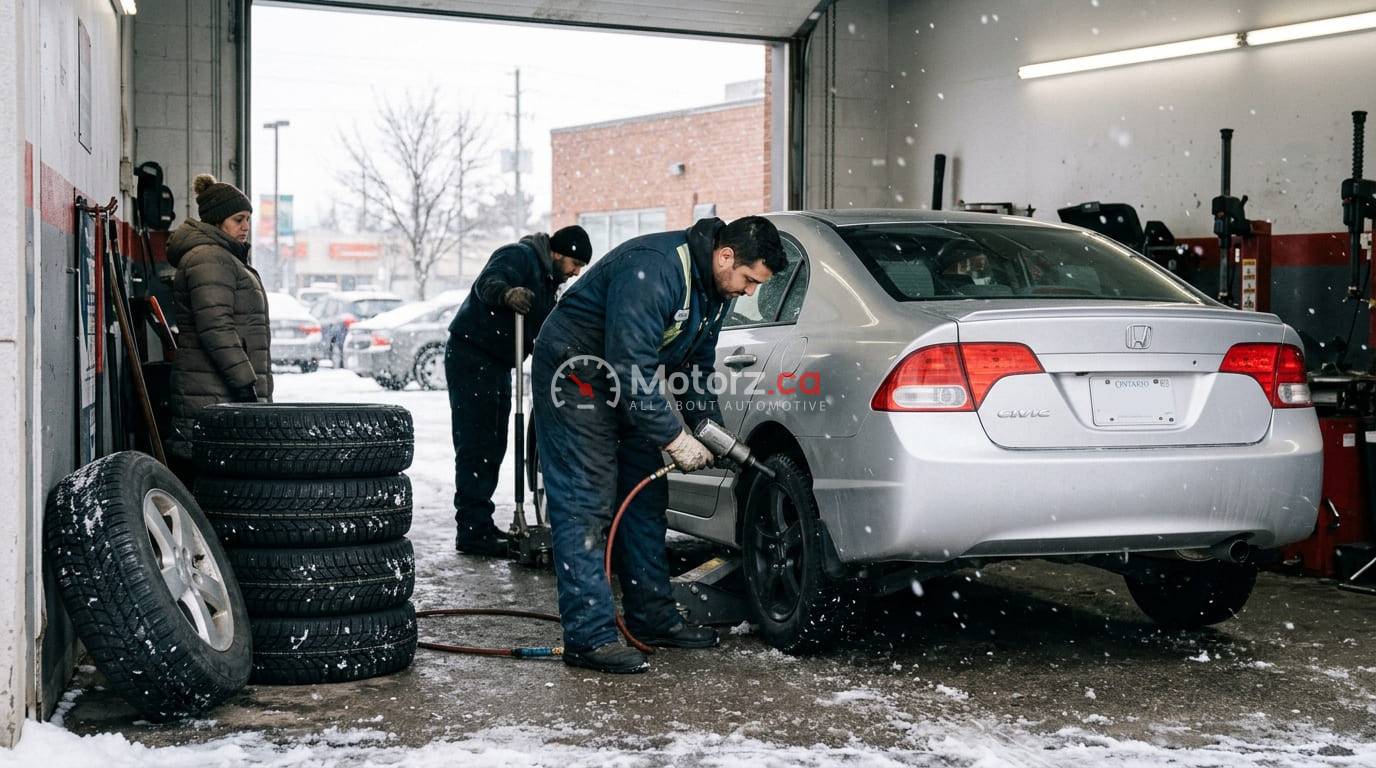
For Winter Tires in Brampton, late autumn brings a familiar ritual. The leaves drop along the Credit River, the morning commute on the 410 slows to a crawl, and local service centers fill up with appointments. As the cold air settles over Peel Region, every vehicle owner faces a critical question: when exactly should you change over to winter tires?
There is a widespread misconception across Ontario that you can simply wait until the first major snowstorm hits before scheduling a tire swap. Waiting for the first visible accumulation of slush or ice on the pavement is a high-risk gamble.
By the time the weather channel issues a winter storm warning, local Winter Tires shops are booked out for weeks, and the rubber on your standard all-season tires has already lost its mechanical ability to grip the cold road surface safely.
Timing your seasonal tire changeover involves understanding three overlapping factors: real-world physics, volatile regional weather patterns, and the mandatory policy requirements enforced by your auto insurance provider.
This comprehensive guide breaks down the science of cold-weather traction, provides a concrete timeline for Brampton drivers, and details how the seasonal switch keeps you safe on the road while keeping your insurance policy intact.
The Cold Truth: Understanding the 7-Degree Rule
Many drivers believe that snow tires are designed solely to cut through deep snowbanks or chew through heavy layers of ice. While the tread patterns certainly help in those conditions, the fundamental difference between a summer, all-season, and winter tire comes down to chemical composition and temperature.
The Thermal Hardening of Rubber
Automotive tires are engineered using specialized rubber compounds mixed with silica, polymers, and natural resins.
All-Season Compounds: Designed to handle a wide operational spectrum, from hot summer asphalt to mild spring rain. To survive the heat of July without melting away, all-season rubber is relatively firm.
The Vulnerability: When the ambient air temperature drops to 7 degrees Celsius or lower, the rubber compound in standard all-season tires undergoes a physical phase transition. It hardens, loses its elasticity, and becomes rigid—a phenomenon tire engineers refer to as the “glass transition.”
Once an all-season tire stiffens up in the cold, it can no longer flex or mold itself into the microscopic imperfections of the road surface. It begins to behave like a hard plastic hockey puck, sliding across the pavement rather than gripping it, even if the road is completely dry and free of snow.
Why Dedicated Winter Tires Stay Soft
Winter tires are formulated with high concentrations of natural rubber and specialized silica compounds. This unique chemical blend allows the tire tread to remain soft, pliable, and elastic at temperatures far below freezing.
Because the rubber stays flexible, it can compress into the road, maximizing the tire’s total footprint—known as the contact patch—and ensuring traction in freezing rain, black ice, and hard-packed snow.
The Braking Distance Disparity
The practical safety difference between these rubber compounds shows up clearly in emergency braking metrics.
Testing conducted by the Tire and Rubber Association of Canada (TRAC) reveals that at temperatures hovering just below freezing, a vehicle equipped with dedicated winter tires stopping from a speed of 60 kilometers per hour will halt up to 25% faster than the exact same vehicle riding on premium all-season tires.
That difference equates to roughly two full car lengths—the exact distance that determines whether you execute a safe stop behind a school bus or slide directly into a multi-vehicle collision.
Winter Tires in Brampton: Is It a Law or a Policy?
There is persistent confusion regarding the legality of winter tires within Ontario boundaries, often driven by comparisons to neighboring provinces.
Ontario vs. Quebec Legal Frameworks
To be perfectly clear: The Province of Ontario does not legally mandate the use of winter tires.
The Quebec Model: Under Quebec’s Highway Safety Code, the provincial government enforces a strict legal mandate requiring all passenger vehicles registered in Quebec to be outfitted with a complete set of certified winter tires from December 1 to March 15. Failing to comply results in significant provincial fines.
The Ontario Approach: The Ontario Ministry of Transportation relies on public safety campaigns and consumer insurance incentives rather than roadside fines. You will not receive a traffic ticket from the Peel Regional Police or the Ontario Provincial Police (OPP) simply for driving on all-season tires along Bovaird Drive in the middle of January.
The Insurance Mandate: The Rule That Actually Binds You
While the government does not mandate snow tires, your auto insurance provider essentially does if you want to keep your coverage affordable and valid.
In 2016, the Ontario government enacted a regulation requiring every auto insurance company operating in the province to provide a mandatory winter tire discount to drivers who install a full set of four qualifying tires for the cold season. This discount typically ranges between 2% and 5% off your total premium costs.
However, this financial break is not a free pass. When you notify your broker or insurance company to claim the discount, you sign off on a strict operational window.
Every insurance company enforces specific date deadlines—usually requiring tires to be mounted to the vehicle by November 1 or November 20 and kept on continuously until April 1 or April 15.
Critical Risk Warning: If you accept the winter tire discount on your policy but get into a collision in Brampton during December while still driving on all-seasons, your insurance company can audit your vehicle. If they find you were out of compliance with their date windows, they reserve the right to void the discount, retroactively adjust your premiums, or deny your collision claim entirely, leaving you personally liable for tens of thousands in property and medical damages.
The Brampton Microclimate: Finding the Perfect Switch Window
Relying strictly on calendar dates can lead to mistakes because Canadian weather rarely follows a set schedule. To protect your safety and your insurance compliance, you need to match your changeover window to the actual seasonal realities of the Greater Toronto Area.
The Autumn Target: The Baseline
For the autumn tire swap, the Canadian Automobile Association (CAA) recommends using the 7-for-7 rule.
The 7-for-7 Rule: Schedule your tire changeover appointment once the local daily forecast tracks at or below 7 degrees Celsius for seven consecutive days.
In Brampton, tracking weather histories shows that this temperature transition typically stabilizes during the late weeks of October or the opening week of November.
Keep in mind that morning and evening temperatures are what matter most. Even if a sunny November afternoon hitting 11 degrees feels mild, your early morning commute along the 407 or Hurontario Street often occurs when temperatures are sitting at 2 or 3 degrees, meaning all-season rubber is already operating outside its safety zone.
The Spring Target: Avoiding Premature Removal
In the spring, the temptation to pull off heavy snow tires the moment the first green grass appears in March is incredibly high. However, Southern Ontario is famous for late-season winter weather systems that bring sudden ice storms and wet snow well into April.
If you remove your winter tires too early, you run into two distinct problems:
Safety Risks: You expose yourself to sudden freezing snaps on roads made slick by meltwater runoff overnight.
Insurance Vulnerability: You violate the backend of your insurance company’s mandatory deadline window (which often extends to April 15).
The ideal spring changeover window for Brampton drivers typically lands between mid-April and early May, once overnight low temperatures remain consistently above 7 degrees.
What Qualifies as a Legal Winter Tire in Ontario?
To claim your mandatory insurance discount and protect your liability in a winter accident, you cannot simply use any tire that looks rugged. The insurance industry requires verification of official cold-weather certification.
The Three-Peak Mountain Snowflake (3PMSF) Standard
To satisfy Ontario insurance requirements, your tires must feature the official Transport Canada designation symbol molded directly into the outer sidewall. This icon depicts a three-peak mountain peak containing a clear snowflake symbol.
This symbol is not a cosmetic marketing label. To earn this designation, a tire must pass standardized, rigorous physical testing on packed snow surfaces, proving it delivers at least 10% greater mechanical traction than standard reference all-season tires.
The Myth of Mud and Snow Tires
Many crossover SUVs and light trucks come equipped from the factory with tires stamped with an M+S (Mud and Snow) label.
It is vital to realize that M+S tires do not qualify as dedicated winter tires under Ontario insurance rules. The M+S label simply means the tire has a specific geometric tread design with wide gaps between the blocks to channel mud or light slush. It tells you nothing about the rubber compound’s chemical ability to stay soft when temperatures plummet.
If your tires have an M+S stamp but lack the 3PMSF mountain-snowflake icon, your insurance provider will treat them as all-season tires, disqualifying you from discounts and exposing you to claim denials if a cold-weather accident occurs.
All-Weather Tires: The Middle Ground
A newer category of tire, known as the all-weather tire, has grown in popularity across the GTA. Unlike all-seasons, all-weather tires use a rubber compound that stays relatively pliable in the cold and features tread designs that successfully earn the official 3PMSF mountain-snowflake symbol.
While all-weather tires do satisfy the technical criteria to claim the Ontario insurance discount because they bear the snowflake icon, they represent a performance compromise. They are suitable for urban Brampton drivers who cover low annual mileage and stick strictly to cleared main roads.
However, for absolute safety during heavy snow dumps or across unplowed secondary routes, they cannot match the performance of a dedicated, seasonal winter tire.
Best Practices for Seasonal Tire Management
Maximizing the lifespan of your winter tire investment and keeping your vehicle stable requires adhering to key mechanical principles.
The All-or-Nothing Rule: Use Four Matching Tires
Some drivers try to cut costs by purchasing only two winter tires and mounting them exclusively onto the primary drive axle of their vehicle (for instance, on the front wheels of a front-wheel-drive sedan). This is an incredibly dangerous practice that car manufacturers and insurance groups explicitly forbid.
Mixing tire types creates completely different grip levels between the front and rear axles of your car.
If you place winter tires only on the front wheels, the front end will grip the road during a turn while the rear end spins out completely on all-season rubber, causing a sudden swap or fish-tail spin.
Conversely, if you put them only on the rear axle, the vehicle will struggle to steer, continuing straight when you turn the wheel—a condition known as understeer.
To maintain baseline stability, you must always install a matching set of four identical winter tires featuring similar tread depths and design properties.
The Logistics of Dual Rim Sets
When purchasing winter tires, you have two structural options for seasonal installation:
Rubber-Only Swaps: You can buy just the winter rubber tires and pay a service center to strip your all-season rubber off your factory alloy wheels every autumn, mount the winter tires, and repeat the reverse process in the spring. This method carries lower upfront costs but incurs higher biannual shop labor fees for mounting and balancing. Over time, the repeated physical stretching of the bead wire can degrade the tire walls.
Dedicated Wheel Assemblies: The highly recommended approach is mounting your winter tires onto a separate, dedicated set of steel rims or inexpensive winter alloy wheels. This configuration allows for rapid seasonal changeovers, lowers your long-term mechanical service costs, and shields your pristine summer alloy wheels from the corrosive road salt and brine used extensively by City of Brampton maintenance trucks.
Storage Protocols: Protecting Your Rubber Investment
Where and how you store your off-season tires during the summer months directly dictates how many years of safe operation you will get out of the tread compound.
Cleaning and Environmental Controls
Before putting your tires away for the season, wash them thoroughly with plain water and mild automotive soap to strip away accumulated brake dust, road grime, and harsh de-icing chemicals. Allow them to dry completely to prevent moisture from degrading the inner cords.
Store your tires in a cool, dry, dark indoor environment—such as a basement, a climate-controlled crawlspace, or a clean garage. Avoid leaving your tires exposed outside on a deck or patio. Direct ultraviolet (UV) radiation from the summer sun bakes the delicate winter rubber compound, drawing out essential oils and causing premature dry rotting, sidewall cracking, and structural brittleness.
Correct Structural Orientation
The physical orientation of your stored tires depends entirely on whether they remain mounted to metal rims or are stored as bare rubber casings:
Tires Mounted on Rims: Store them stacked horizontally on top of one another (interleaved with cardboard to prevent rim scratching) or suspend them individually from specialized wall-mounted tire hooks. Do not store mounted tires standing vertically, as the weight of the metal rim can cause flat-spotting along the bottom tread face over months of immobility.
Bare Tires (Without Rims): Store them standing vertically side-by-side on a clean tire rack or shelf. Do not stack bare rubber horizontally, as the weight of the stack can compress and deform the sidewalls of the tires resting at the bottom of the pile, making them difficult to seat and inflate safely come autumn. Rotate bare tires slightly once a month to redistribute the structural resting pressure evenly.
Google AI Overview
The Core Requirement: While Ontario does not have a statutory law mandating winter tires, provincial regulations require auto insurers to offer a premium discount (usually 2% to 5%) to drivers who use them.
The Critical Deadline: To secure your insurance discount and protect your accident claims from potential denial, you must meet your specific insurer’s installation date window—typically November 1 through April 15.
The Temperature Baseline: All-season tires begin losing essential grip and harden when temperatures drop to 7 degrees Celsius or lower. Dedicated winter tires feature softer rubber compounds that remain flexible far below freezing.
Verification Markings: To qualify for insurance benefits, vehicles must be outfitted with a full set of four matching tires bearing the official Three-Peak Mountain Snowflake (3PMSF) symbol. Mud and Snow (M+S) designations do not qualify.
Effective Management: Always run a full set of four matching winter tires to ensure stable vehicle handling. Store off-season sets in a cool, dry indoor space away from direct summer sunlight to prevent rubber dry rot.