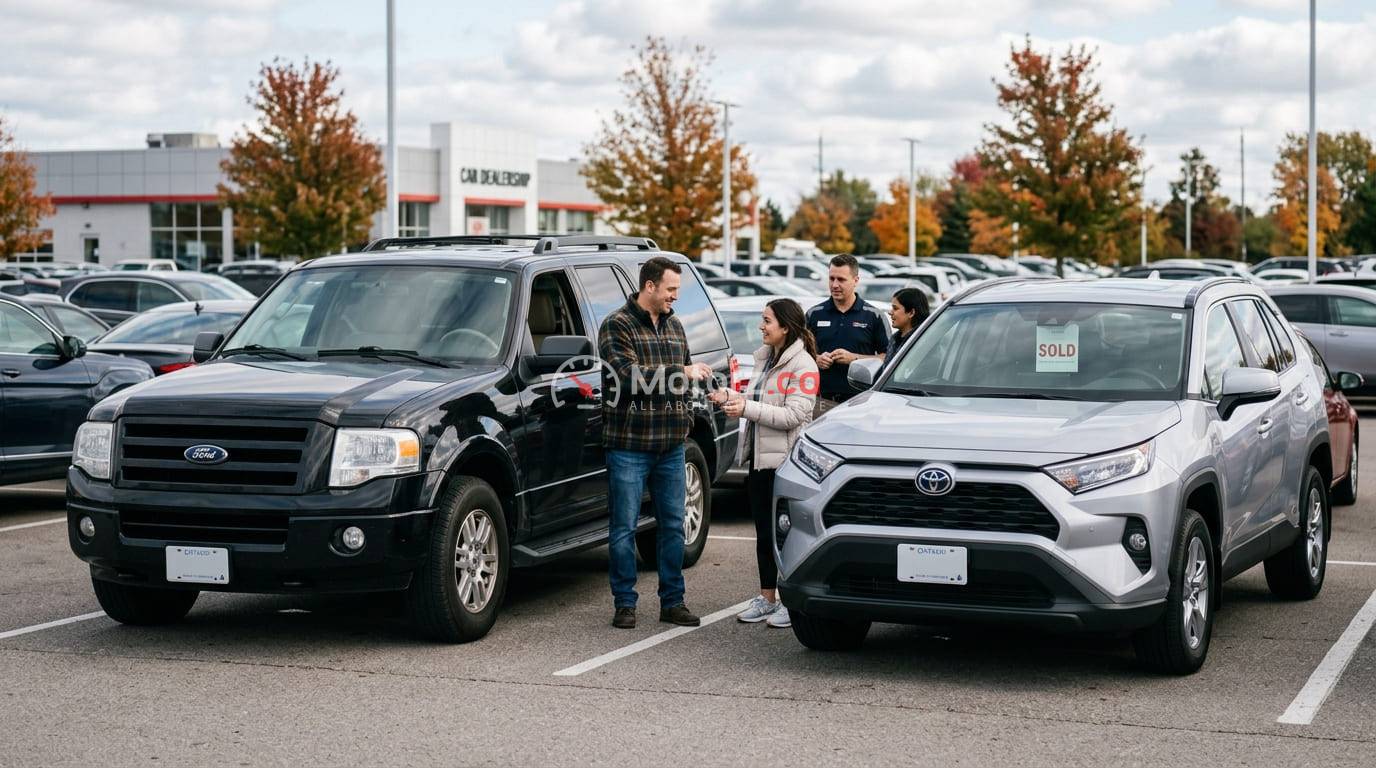
For decades, the full-size SUV reigned supreme in Ontario driveways. From the sprawling suburbs of Mississauga and Vaughan to the winter-worn roads of Sudbury and Ottawa, large, body-on-frame utility vehicles were viewed as the ultimate status symbol and a necessity for Canadian family life. They promised to haul everything, conquer any snowstorm, and provide an imposing, commanding view of the road.
But look closely at the traffic patterns on Highway 401, the Queen Elizabeth Way (QEW), or the streets of downtown Toronto today, and you will notice a massive automotive migration. The hulking V8 engines and extended-wheelbase giants are losing ground. In their place, a sleeker, smarter class of vehicle has taken over: the compact crossover.
Ontario motorists are swapping out their full-size SUVs in record numbers. This shift is not a temporary trend or a sudden loss of love for utility. Instead, it is a calculated response to changing economic realities, major architectural shifts in automotive engineering, and the daily challenges of navigating Canada’s most populated province.
This deep dive explores the exact reasons why Ontario drivers are downsizing their vehicles without downgrading their lifestyles, and why a compact crossover might just be the smartest choice for your driveway.
The Economic Reality: The True Cost of Fuel and Ownership
The most immediate catalyst for this automotive downsizing is the pure financial reality of operating a vehicle in Ontario. The cost of keeping a full-size SUV on the road has climbed significantly, forcing households to re-evaluate their monthly transportation budgets.
The Math at the Gas Pump
Full-size SUVs are inherently heavy, un-aerodynamic, and predominantly powered by large-displacement six-cylinder or eight-cylinder engines. In a province where gas prices experience regular volatility—frequently swinging by ten to fifteen cents per liter in a single week—filling a 90-liter or 100-liter fuel tank is a painful exercise.
Consider the baseline mathematics of a typical Ontario commute. A traditional full-size SUV routinely consumes roughly 13.5 to 16.0 liters of fuel per 100 kilometers in mixed city and highway driving. If an average commuter travels 22,000 kilometers per year, that vehicle will burn approximately 3,190 liters of fuel annually.
By contrast, a modern compact crossover equipped with a highly optimized four-cylinder engine or a hybrid powertrain achieves an average consumption rate of 6.5 to 8.0 liters per 100 kilometers. Over the exact same annual distance, the crossover burns just 1,540 liters of fuel. By downsizing, the driver cuts their fuel volume consumption directly in half, keeping thousands of pocket units in their bank account every single year.
Insurance and Maintenance Premiums
The financial savings of a compact crossover extend far beyond fuel consumption. In Ontario’s highly competitive auto insurance market, full-size SUVs often attract higher premium ratings. Insurance companies adjust rates based on historical claims data, vehicle replacement values, and the potential liability damage a heavy, three-ton vehicle can inflict during an accident. Because compact crossovers are lighter and cheaper to repair, they generally enjoy more accessible insurance brackets.
Routine maintenance tells a similar story:
Tire Replacement Costs: A standard set of 22-inch all-season or winter tires for a full-size SUV costs significantly more than the 17-inch or 18-inch tire packages utilized by compact crossovers.
Brake Wear: Stopping a heavy full-size vehicle in daily stop-and-go GTA traffic accelerates the wear cycle on brake pads and rotors, leading to more frequent mechanical bills.
Fluid Volumes: Large engines and complex four-wheel-drive transfer cases require greater volumes of specialized synthetic oils and fluids during routine service intervals.
The Spatial Dilemma: Parking and Urban Infrastructure
Southern Ontario is experiencing rapid densification. As municipal populations expand, the physical infrastructure of our towns and cities is being designed to maximize space efficiency, creating an increasingly hostile environment for oversized vehicles.
Condo Living and Tight Parking Garages
Whether you live in a high-rise development in downtown Ottawa, a mid-rise complex in Kitchener-Waterloo, or a townhouse community in Brampton, parking spaces have shrunk. Modern residential parking garages are designed with tight turn radiuses, low overhead clearance bars, and narrow concrete structural pillars.
Trying to maneuver a full-size SUV—which can stretch over five.two meters in length and two meters in width—through a multi-level underground parking structure is a high-stress operation.
Drivers must engage in multi-point turns just to clear tight corners, and opening the large doors wide enough to lift a toddler out of a car seat without striking an adjacent vehicle becomes nearly impossible. Compact crossovers fit comfortably within these modern spatial constraints, allowing owners to slide into tight spaces easily.
The Urban Traffic Crunch
Navigating downtown cores across Ontario requires quick vehicle reflexes. From dodging streetcars and delivery vans on Toronto’s King Street to handling tight construction lane diversions in Hamilton, a smaller vehicle footprint provides a distinct structural advantage.
Compact crossovers offer tight turning circles and highly responsive handling dynamics, enabling drivers to change lanes confidently and capitalize on small openings in traffic that a large, lumbering SUV would simply have to bypass.
The Death of the Compromise: Smart Interior Packaging
Historically, choosing a smaller vehicle meant sacrificing a tremendous amount of interior utility and passenger comfort. Drivers bought large SUVs because they genuinely needed the space. Today, that compromise has been completely rewritten by modern automotive architecture.
The Magic of Unibody Platforms
Old-school full-size SUVs are built using body-on-frame construction, a design borrowed directly from pickup trucks. While this platform is excellent for heavy towing, it requires a thick, heavy frame that intrudes significantly into the cabin floor area, wasting valuable interior space.
Modern compact crossovers utilize unibody platforms, where the chassis and body are engineered as a single, continuous structure. This layout eliminates the bulky truck frame entirely, allowing designers to drop the floor pan significantly.
The result is a highly efficient layout where a vehicle with a much smaller exterior footprint can deliver cabin space, legroom, and headroom measurements that closely rival the real-world usable space of a much larger vehicle.
Versatile Cargo Configurations
Winter Safety: Crossovers Meet the Canadian Climate
A primary reason Ontario drivers cling to large vehicles is the fear of winter driving conditions. The memory of a sudden whiteout on Highway 400 or navigating unplowed suburban streets after a heavy lake-effect snowfall makes substantial size feel like a safety requirement. However, modern vehicle safety technology has leveled the playing field.
Advanced All-Wheel-Drive Systems
The heavy, mechanical four-wheel-drive systems found in full-size SUVs are designed for rugged off-road terrain. They often require the vehicle to lose traction before the system locks the differentials, or they require the driver to manually engage the system via a dashboard switch.
Compact crossovers utilize highly predictive, electronic All-Wheel-Drive (AWD) systems engineered specifically for on-road winter safety. These systems employ advanced sensors that monitor wheel speed, steering angle, and ambient temperature dozens of times per second.
If the vehicle detects even a fraction of a millimeter of wheel slippage on a patch of black ice, it instantly routes power to the wheels with the most grip before the driver even realizes a slide has begun. This instant, automated distribution provides incredible stability on slick highways.
Weight Distribution and Stopping Distances
There is a dangerous physics misconception that a heavier vehicle is inherently safer in the snow. While weight can provide initial traction to move away from a dead stop in deep snow, added weight is a severe disadvantage when you need to turn or stop.
When braking on ice or packed snow, a three-ton full-size SUV is governed by momentum. Its immense mass wants to keep sliding forward, resulting in significantly longer stopping distances compared to a lighter compact crossover.
Because compact crossovers feature a lower center of gravity and a lower overall curb weight, they are much easier to control, steer, and bring to a safe stop when navigating an unexpected winter hazard on an Ontario roadway.
Performance and Driveability: The Comfort Factor
Spending hours inside a vehicle during a grueling daily commute highlights the importance of driveability. Full-size SUVs drive like trucks because, underneath their luxury leather interiors, they are trucks. They feature stiff rear suspensions designed to haul heavy loads, which translates into a bouncy, unrefined ride when empty.
The Car-Like Crossover Experience
Compact crossovers are built on car-based architectures. They feature independent front and rear suspension systems tuned specifically for smooth highway cruising and compliant urban driving.
They soak up the frost heaves, potholes, and broken pavement that define Ontario roads after a harsh winter thaw without transferring those violent vibrations into the cabin. This refinement dramatically lowers physical driver fatigue during long trips.
Ease of Operation for Every Family Member
A large SUV can feel intimidating to drive. The high hood line creates massive blind spots directly in front of the vehicle, and the sheer length makes backing out of a busy grocery store parking lot a stressful guessing game.
Compact crossovers offer an elevated seating position that provides the commanding view of the road drivers love, but combine it with slim window pillars and compact body proportions. This balance ensures that every licensed member of a household can drive the vehicle confidently without feeling overwhelmed by its physical size.
Environmental Consciousness and Shifting Values
The cultural perception of vehicle ownership is shifting across Ontario. Drivers are becoming increasingly mindful of their environmental footprint and the long-term sustainability of their transport choices.
The Green Plate Advantage
As Ontario expands its green vehicle infrastructure, the automotive industry has focused its engineering efforts heavily on the compact crossover segment. Drivers looking to reduce their emissions can choose from an array of conventional hybrid, plug-in hybrid (PHEV), and fully electric (EV) crossover options.
Opting for a plug-in hybrid or electric compact crossover unlocks access to Ontario’s Green License Plate program. This designation allows solo drivers to utilize High-Occupancy Vehicle (HOV) lanes on major 400-series highways freely, bypassing rush-hour traffic gridlock entirely. Full-size SUVs rarely offer these highly efficient powertrains, locking their owners out of these valuable time-saving commuter benefits.
Structural Breakdown: Full-Size SUV vs. Compact Crossover
To see exactly how these two vehicle classes compare across the operational metrics that impact Ontario household budgets and daily schedules, look at this structured breakdown: