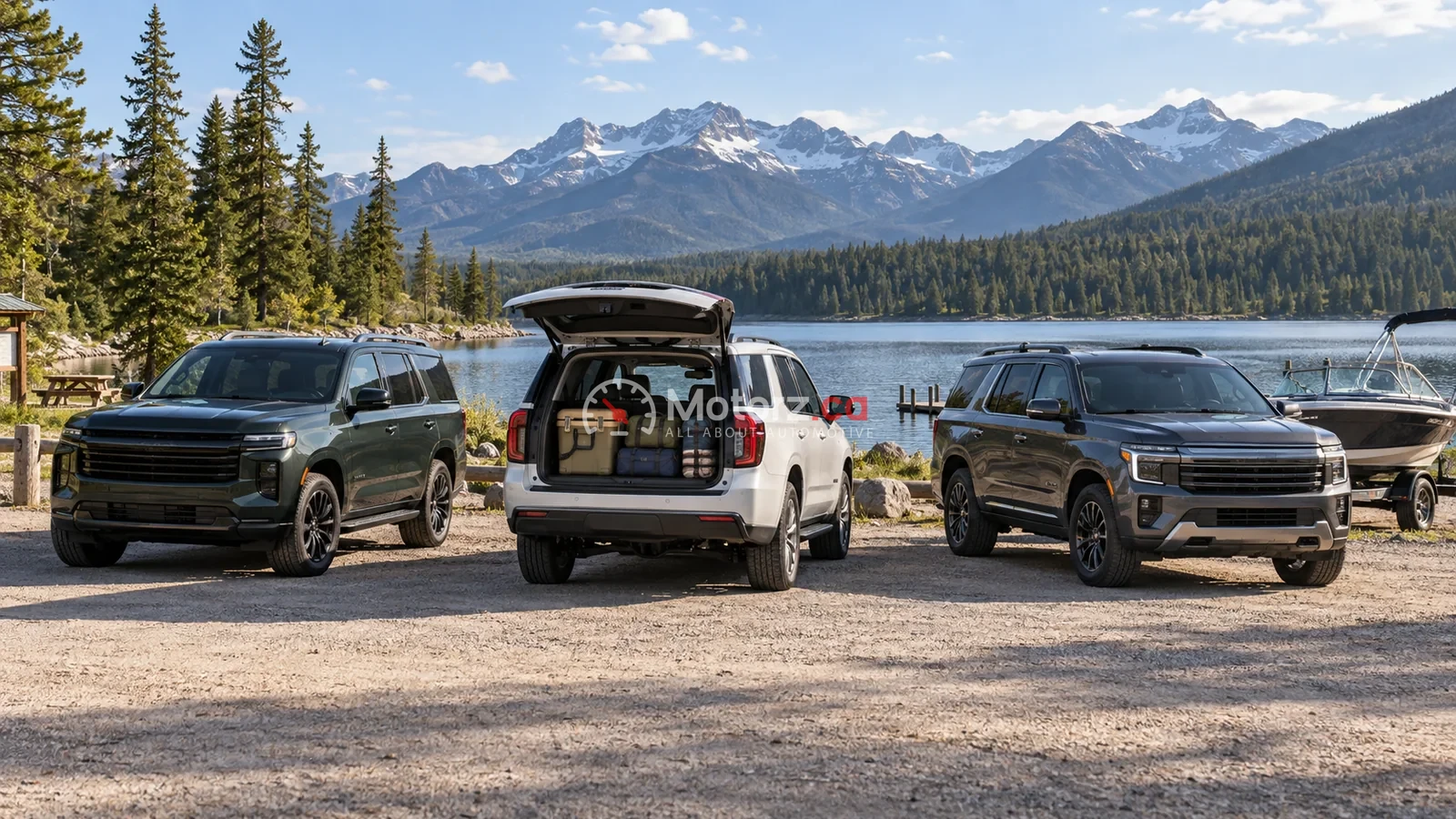
Canada’s best large SUV depends on whether the priority is maximum trailer rating, cargo behind three rows, hybrid efficiency, off-road hardware or purchase price.
How these large SUVs were selected
2026 Canadian large-SUV comparison
| Model | Seats | Powertrain highlight | Published max towing | Best fit |
|---|---|---|---|---|
| Ford Expedition / MAX | Up to 8 | 3.5L EcoBoost V6; high-output version available | Up to 9,600 lb (standard wheelbase 4×4, properly equipped) | Towing and MAX cargo behind row three |
| Chevrolet Tahoe | Up to 9 | 5.3L or 6.2L V8; available 3.0L diesel | Up to 8,400 lb | Powertrain choice and flexible seating |
| Toyota Sequoia | 7 or 8 | 437-hp i-FORCE MAX twin-turbo hybrid | Approximately 9,000 lb; exact grade varies | Standard hybrid torque and 4WD |
| Nissan Armada | 7 or 8 | 3.5L twin-turbo V6, 425 hp on referenced SL | Up to 8,500 lb | Strong standard output and third-row packaging |
Best for maximum towing: Ford Expedition
Ford publishes up to 9,600 lb for the 2026 Expedition 4×4 with the required heavy-duty tow equipment. The Expedition MAX gives up some maximum rating but adds substantially more cargo room behind the third row. Payload, hitch hardware, axle ratio and passenger load remain decisive.
Best for powertrain choice: Chevrolet Tahoe
The Tahoe offers V8 and available diesel choices and seating for up to nine in certain configurations. Chevrolet publishes up to 3,474 L of maximum cargo volume and up to 8,400 lb towing. Buyers should compare actual third-row/cargo configuration rather than maximum cargo with seats folded.
Best standard hybrid: Toyota Sequoia
Every 2026 Sequoia uses Toyota’s i-FORCE MAX hybrid system, rated at 437 hp. Toyota’s Canadian specifications list 12.6/10.5/11.7 L/100 km city/highway/combined and towing around 9,000 lb depending on grade. Its battery placement and third-row arrangement deserve an in-person cargo check.
Best standard-output value check: Nissan Armada
The 2026 Armada SL listing shows a 425-hp twin-turbo V6, eight seats and 8,500 lb maximum towing. The lineup’s available suspension and PRO-4X equipment broaden the use cases, but trim price and wheel/tire choices change comfort and operating cost. Shoppers comparing an SUV with a pickup can also consult the truck shortlist for Canadian buying decisions. Use the Canadian gasoline-price driving-cost model to explore fuel assumptions without treating its sample as a personal cost guarantee.
How to choose a full-size SUV
- Measure occupied cargo: bring the stroller, cooler or mobility equipment you actually use.
- Calculate payload first: passengers, tongue weight and accessories all count.
- Price winter tires: large wheel sizes can make replacement sets expensive.
- Compare fuel in litres per 100 km: small differences become meaningful at full-size-SUV consumption levels.
- Check garage and parking dimensions: standard and extended wheelbases behave differently in cities.
For smaller options, see the consolidated small-SUV guide. For trail-focused hardware, compare our off-road trucks and SUVs. Use the car-buying hub for financing and transaction guidance.
Frequently asked questions
Which large SUV tows the most in this comparison?
The 2026 Ford Expedition has the highest manufacturer-published maximum here at up to 9,600 lb for a properly equipped standard-wheelbase 4×4. That figure is not universal across trims and can be limited by payload, passengers and equipment.
Is a large SUV the same as a three-row crossover?
No. Large/full-size SUVs in this guide use truck-oriented proportions and are selected for heavy towing, substantial cargo and three-row packaging. Many unibody three-row crossovers are easier to park and more efficient but do not serve the same maximum-capability intent.
Sources
- Ford Canada — 2026 Expedition
- Chevrolet Canada — 2026 Tahoe
- Toyota Canada — 2026 Sequoia specifications
- Nissan Canada — 2026 Armada specifications
Editorial disclosure: Motorz.ca did not road-test the vehicles or tires in this guide. Recommendations are editorial analysis of current Canadian manufacturer, government and industry information.