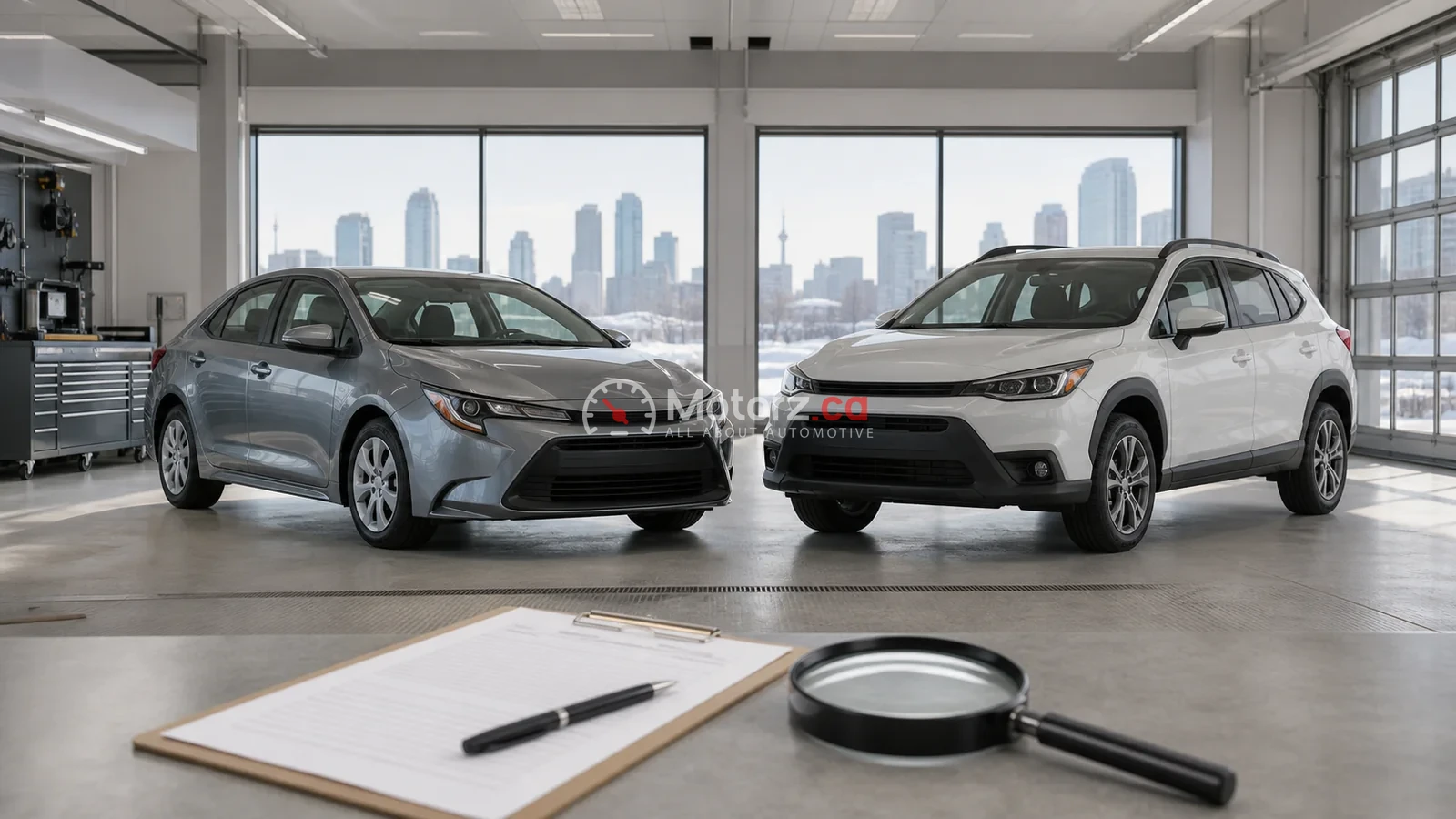
Direct answer: The best used car is not one universal model. In Canada, the strongest buy is usually a common vehicle with a documented service history, a clean lien and collision record, affordable local parts, and a pre-purchase inspection that matches how you will use it. A well-kept mainstream compact car or small SUV is often a safer value than a neglected “reliability favourite.”
This guide gives Canadian shoppers a repeatable way to build a shortlist and verify an individual vehicle. It does not promise that every example of a named model will be reliable.
How we define a strong used-car buy
- Condition and history: maintenance records, collision history, recall status and evidence of winter or corrosion exposure.
- Ownership cost: fuel, insurance, tires, scheduled service and parts availability—not purchase price alone.
- Practical fit: passenger space, cargo capacity, winter needs, parking and annual kilometres.
- Resale resilience: broad Canadian demand and a configuration that is easy to service.
- Verification: an independent inspection and province-specific paperwork before money changes hands.
A practical Canadian shortlist by need
| Need | Examples worth comparing | Why they make a sensible starting point | What to inspect closely |
|---|---|---|---|
| Low-cost commuting | Toyota Corolla, Honda Civic, Mazda3 | Common parts and service knowledge; efficient sizes; broad used inventory. | Service records, rust, collision repairs, CVT/automatic operation and tire condition. |
| Small-car practicality | Toyota Corolla Hatchback, Honda Fit, Kia Forte5 | Useful cargo space without SUV running costs. | Rear-cargo water entry, suspension wear and model-specific recall completion. |
| Compact-SUV versatility | Toyota RAV4, Honda CR-V, Mazda CX-5 | Useful cargo and winter-friendly configurations; wide Canadian availability. | AWD service, underbody corrosion, brakes, wheel bearings and uneven tires. |
| Hybrid efficiency | Toyota Prius, Corolla Hybrid, RAV4 Hybrid | Low published fuel use and established hybrid availability. | Hybrid-system warning lights, battery cooling intake, service history and warranty status. |
| Winter-oriented wagon/SUV | Subaru Impreza, Crosstrek, Forester | Available all-wheel drive and practical body styles. | Oil leaks, wheel bearings, CVT behaviour, matching tires and corrosion. |
These are shopping starting points, not rankings. Year, powertrain and maintenance history can matter more than the badge. Check the exact VIN for recalls and obtain insurance quotes before committing.
The seven-step buying process
1. Set an all-in budget
Reserve money for tax, registration, insurance, immediate maintenance and a second set of tires where needed. A lower asking price can become expensive if brakes, tires and fluids are due.
2. Verify the seller and paperwork
Confirm that the seller’s identity matches the ownership documents. In Ontario, review the Used Vehicle Information Package where required. Requirements differ by province, so consult the responsible provincial registry.
3. Check for liens
A lien can remain attached to a vehicle even after it changes hands. The Financial Consumer Agency of Canada recommends checking the vehicle history and provincial or territorial personal-property registry. Do not treat a seller’s verbal assurance as proof.
4. Check collision and registration history
A history report can reveal reported collisions, branding and registration information, but it is not a complete mechanical diagnosis. Compare the report with invoices, panel gaps, paint consistency and the inspection.
5. Check recalls by VIN
Use Transport Canada’s recall resources and the manufacturer’s VIN lookup where available. Ask for documentation showing that open recall work has been completed.
6. Arrange an independent pre-purchase inspection
Choose a qualified repair facility that is independent of the seller. Ask for the underbody, brakes, steering, suspension, tires, fluid leaks, diagnostic warning lights and corrosion-prone areas to be checked. A provincial safety certificate only confirms minimum standards at the time of inspection; Ontario explicitly says it is not a warranty.
7. Test the vehicle in your real conditions
Start it cold if possible, use city and highway speeds, test climate controls and every key, and listen over rough pavement. Confirm that driver seating, child seats, cargo and winter visibility work for your household.
Canadian winter and corrosion checks
- Look underneath for structural corrosion, fresh undercoating hiding damage, damaged lift points and seized fasteners.
- Confirm all four tires match in size and have suitable remaining tread; mismatched tires can be especially problematic on AWD vehicles.
- Test the battery, heater, defrosters, heated equipment and washer system.
- Ask where the vehicle lived and whether it received regular rust protection; geography is context, not proof of condition.
Red flags that justify walking away
- The seller will not permit an independent inspection or VIN check.
- Ownership names, VIN labels or history records do not match.
- Warning lights fail to illuminate during startup or remain on after starting.
- Freshly cleared diagnostic codes, unexplained fluid leaks or strong masking odours.
- Pressure to pay a deposit before reviewing records and inspection results.
Bottom line
Buy the condition, records and inspection—not the reputation alone. Start with common models that fit your needs, then let VIN-specific evidence decide which individual vehicle earns your money.
Related Motorz.ca guides
- What a vehicle-history report can—and cannot—tell you
- New or used car: how Canadian buyers can decide
- Used-car buying checklist
Disclosure: Motorz.ca did not test the vehicles, parts or retailers discussed in this guide. The comparisons use published Canadian information and stated policies.
Vehicle history also includes theft and recovery records where available. Our Canada auto-theft data explainer shows what national trends can—and cannot—tell an individual buyer.
Sources
Motorz.ca reviewed the following primary and official sources. Specifications, prices and policies can change; verify current details before acting.
- Transport Canada — vehicle recalls
- Financial Consumer Agency of Canada — risks of car liens
- Ontario — Used Vehicle Information Package
- Ontario — Safety Standards Certificate
- ICBC — inspecting a used vehicle
If fuel cost is the main filter, compare our focused guide to fuel-efficient used cars in Canada. Read the focused Motorz.ca guide.
nCompare these recommendations with Motorz.ca’s 20-listing Canadian used-car asking-price basket.