


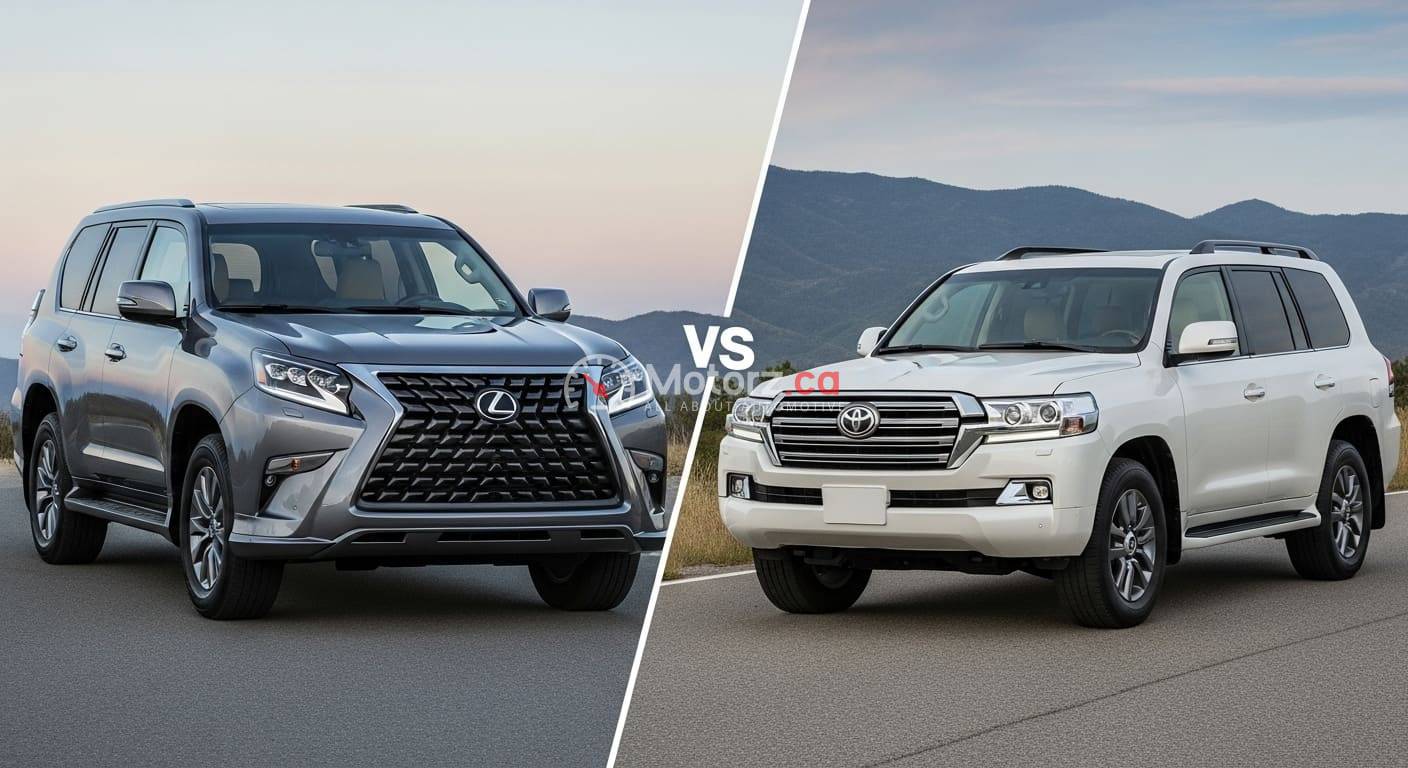

The Lexus GX 550 vs. Toyota Land Cruiser world is abuzz with the return of two titans, reimagined for the modern era: the all-new Lexus GX 550 and the reborn Toyota Land Cruiser. These two SUVs, built upon the shared, rugged foundation of the TNGA-F body-on-frame platform, represent two sides of the same adventurous coin. One leans heavily into upscale refinement and potent performance (the Lexus GX 550), while the other reclaims its heritage as a capable, no-nonsense off-road machine with a hybrid twist (the Toyota Land Cruiser).
For the savvy buyer Lexus GX 550 vs. Toyota Land Cruiser for a true utility vehicle that can handle the daily commute, the school run, and the toughest trails, the choice has never been more compelling—or complicated. This in-depth comparison pits luxury against legend, dissecting everything from horsepower and torque to interior opulence and sheer off-road prowess.
The Shared Platform, Divergent Goals
While siblings under the Toyota Motor Lexus GX 550 vs. Toyota Land Cruiser umbrella, the GX 550 and Land Cruiser were developed with distinctly separate missions. Understanding this fundamental difference is key to making the right purchasing decision.
Lexus GX 550 vs. Toyota Land Cruiser New-Era Luxury Utility
Lexus has completely reinvented the Lexus GX 550 vs. Toyota Land Cruiser, shedding the rounded, aging shell of its predecessor for a bold, boxy, and unapologetically rugged aesthetic. The new GX 550 is a deliberate attempt to capture the growing “Overland Luxury” market. It retains the rugged, body-on-frame construction essential for serious off-roading, but swaddles its occupants in the comfort, technology, and premium materials expected of the Lexus brand. It is an elevated execution of a traditional SUV design, providing the best of both worlds: genuine capability and uncompromising comfort. Key terms to note here are Overland Luxury and premium materials.
The Toyota Land Cruiser: Return to the Off-Road Icon
The return of the Land Cruiser to North America marks a significant shift. Smaller than its predecessor and adopting a new hybrid powertrain, the 2024 Land Cruiser (known globally as the Land Cruiser Prado or Series 250) re-focuses on its heritage. It aims for a more attainable price point and superior off-road capability right out of the box, with a nod to its classic, no-frills, utilitarian roots. The Land Cruiser is all about pure function, durability, and conquering any terrain, making it a true off-road legend.
Power and Performance: V6 Twin-Turbo vs. Hybrid I-Force Max
The most significant difference between these two Lexus GX 550 vs. Toyota Land Cruiser lies beneath the bonnet, where they employ completely different powertrains that define their performance characteristics.
Lexus GX 550 Engine Specs
The GX 550 is powered by a robust twin-turbocharged 3.4-liter V6 engine, paired with a 10-speed automatic transmission. This traditional gasoline powertrain is engineered for smooth, potent power delivery, which translates directly into Lexus GX 550 vs. Toyota Land Cruiser towing and quicker acceleration.
Engine: 3.4L Twin-Turbo V6
Horsepower: 349 hp
Torque: 479 lb-ft
Transmission: 10-speed Automatic
0-60 mph (approx): 6.2 – 6.5 seconds
This engine’s high torque output at low RPMs makes it an Lexus GX 550 vs. Toyota Land Cruiser choice for towing and high-speed highway driving, giving the GX a decided performance edge on pavement.
Toyota Land Cruiser Engine Specs
The Land Cruiser embraces the future with Toyota’s I-Force Max hybrid system, a departure from the V8s of old. This system uses a turbocharged 2.4-liter four-cylinder engine mated to an electric motor and an 8-speed automatic transmission. The focus here is on low-end torque and enhanced fuel efficiency.
Engine: 2.4L Turbo I-Force Max Hybrid
Horsepower: 326 hp
Torque: 465 lb-ft
Transmission: 8-speed Automatic
0-60 mph (approx): 7.7 seconds
While slightly less powerful than the Lexus GX 550 vs. Toyota Land Cruiser, the hybrid system delivers instant electric torque, which is invaluable for controlled off-road maneuvers like crawling over obstacles. Critically, the Land Cruiser boasts significantly better EPA-estimated fuel economy.
Off-Road Prowess and Capability
Both vehicles are built to tackle difficult terrain, but they approach it with slightly different engineering philosophies, catering to distinct off-road enthusiast Lexus GX 550 vs. Toyota Land Cruiser. Both feature full-time four-wheel drive and low-range gearing.
Towing and Utility
The Lexus GX 550 is the clear winner for those whose utility needs extend to pulling heavy loads.
Lexus GX 550 Max Towing: Up to 9,096 pounds (on specific trims like the Overtrail).
Toyota Land Cruiser Max Towing: 6,000 pounds.
The superior towing capacity of the GX is a Lexus GX 550 vs. Toyota Land Cruiser result of its non-hybrid V6 powertrain and 10-speed transmission, making it the better choice for hauling large trailers, boats, or campers.
Dedicated Off-Road Trims and Features
Both models offer specialized off-road trims packed with capability-enhancing features.
Lexus GX 550 Overtrail
The GX introduces the new Overtrail and Overtrail+ grades, which are engineered for serious backcountry exploration. These trims come standard with:
Electronic-Kinetic Dynamic Suspension System (E-KDSS)
Standard Electronic locking rear differential
33-inch All-Terrain Tires (on 18-inch wheels)
Increased ground clearance (up to 9.84 inches)
Multi-Terrain Select (MTS) and Crawl Control
The E-KDSS system is a luxury-level off-road technology, capable of electronically disconnecting the stabilizer bars for maximum wheel articulation on rough terrain, while instantly reconnecting them for stable on-road handling.
Toyota Land Cruiser Off-Road Focus
The Land Cruiser, especially the mid-level and First Edition trims, is equipped with a classic set of rugged tools:
Standard locking center and rear differential (on all but base 1958 trim)
Stabilizer bar disconnect mechanism (standard on mid- and upper trims)
Multi-Terrain Select (MTS) and Crawl Control
Ground Clearance: 8.3-8.7 inches
The Land Cruiser offers a simpler, proven off-road package. Its hybrid system allows for electric-only low-speed crawling, providing precise torque control that experienced off-roaders will appreciate.
Interior Design, Comfort, and Technology
Stepping inside is where the philosophical difference between the two SUVs becomes most apparent. The GX is a sanctuary of quiet luxury, while the Land Cruiser maintains a more functional, durable aesthetic.
Luxury and Materials: The Lexus Standard
The GX 550 interior elevates the experience to the luxury SUV segment.
Seating: Available in three-row (7-passenger) configurations on Premium and Luxury grades, and a two-row (5-passenger) layout on Overtrail trims. Heated and ventilated front and second-row seats are widely available, with high-end trims offering semi-aniline leather and even massage functions.
Infotainment: Dominated by a large, crisp 14-inch touchscreen display, running the latest Lexus Interface system with wireless Apple CarPlay and Android Auto.
Aesthetics: The cabin is characterized by high-quality stitching, wood trim options, and a focus on minimizing noise, vibration, and harshness (NVH), creating a quiet, sophisticated driving environment.
Utility and Durability: The Toyota Ethos
The Land Cruiser’s interior is more focused on enduring rough use, reflecting its legendary status as a world traveler.
Seating: Exclusively a two-row, 5-passenger SUV. Seating materials are durable, often cloth on the base trim and SofTex/leather on higher trims, prioritizing longevity and ease of cleaning over ultimate luxury.
Infotainment: A standard 8-inch screen on the base 1958 trim, upgrading to a 12.3-inch touchscreen on higher grades. While fully modern, the system is less feature-dense than the Lexus equivalent.
Practicality: The Land Cruiser emphasizes physical controls for climate and crucial off-road systems, which are easier to operate while wearing gloves or driving on bumpy trails. It also features a useful 2,400-watt AC inverter, perfect for powering camping equipment.
Size, Practicality, and Cargo Space
Although built on the same platform and sharing an identical 112.2-inch wheelbase, subtle design and packaging choices affect interior utility, especially regarding passenger and cargo space.
Seating Capacity and Dimensions
The Lexus GX offers greater seating flexibility, appealing more to larger families.
Lexus GX 550: Available 3-row seating (7 passengers). While the third row is snug, it provides emergency seating capacity that the Land Cruiser simply does not offer.
Toyota Land Cruiser: Dedicated 2-row seating (5 passengers). This decision was made to maximize the hybrid battery placement and rear cargo volume behind the second row.
Cargo Volume
Despite the three-row option, the Lexus GX boasts superior overall maximum cargo capacity.
Lexus GX 550 Max Cargo (behind 1st row): Up to 90.5 cubic feet (2-row Overtrail). The 3-row models still offer a respectable 76.9 cubic feet.
Toyota Land Cruiser Max Cargo (behind 1st row): 82.2 cubic feet.
The GX’s boxier shape translates to more usable vertical space, making it a surprisingly practical vehicle for both gear and grocery hauling.
Pricing, Trim Levels, and Value Proposition
The starting price is arguably the biggest differentiator, cementing the Land Cruiser as the value-oriented adventurer and the GX as the premium entry. Pricing is a crucial factor in the purchasing decision.
Toyota Land Cruiser Pricing
The new Land Cruiser aims for accessibility, with a starting price that significantly undercuts its luxury sibling.
Land Cruiser 1958: The entry-level, retro-styled trim focused on core capability.
Land Cruiser: Mid-range trim with better tech and features.
Land Cruiser First Edition: Limited-run, fully loaded off-road model.
The Land Cruiser’s lower starting point makes the high-capability, body-on-frame SUV accessible to a broader audience, emphasizing rugged Toyota reliability.
Lexus GX 550 Pricing
The GX 550 commands a higher price tag reflective of its premium positioning, superior performance, and luxury features.
Premium & Premium+: Focus on standard luxury and convenience.
Overtrail & Overtrail+: Dedicated 2-row off-road capability.
Luxury & Luxury+: Highest levels of refinement, comfort, and advanced technology.
While more expensive, the Lexus justifies its price with a superior engine, significantly higher towing capacity, and an interior experience that is miles ahead in terms of materials and refinement. The Lexus warranty is also longer than Toyota’s.