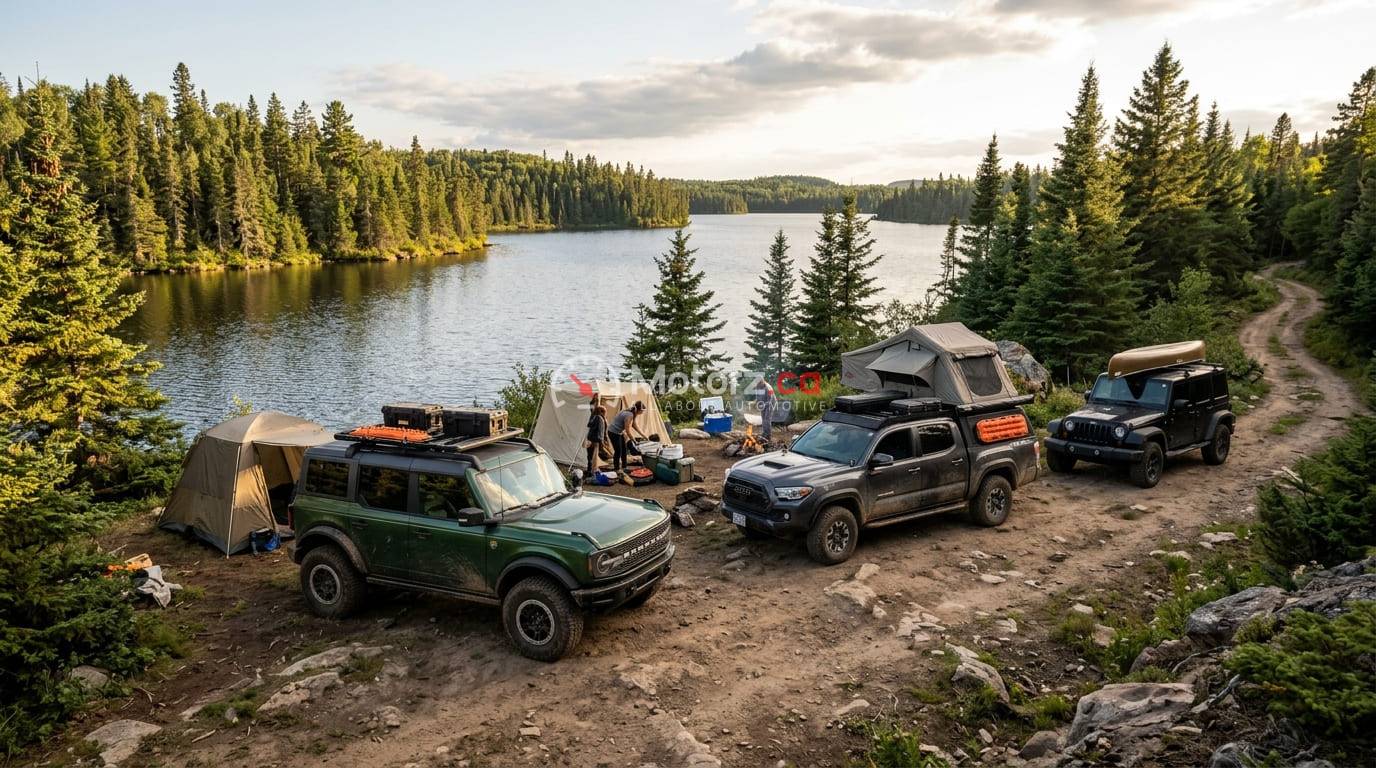
SUVs and Trucks for Northern Ontario, but it is also one of the most unforgiving environments in North America. Venturing past Algonquin, through the rugged Crown lands near Sudbury, or deep into the logging trails of Boreal forest surrounding Thunder Bay requires more than standard camping gear. It demands a highly capable, off-grid-ready vehicle.
The logging routes, washouts, and Canadian Shield topography of the North will quickly expose any vehicle lacking proper ground clearance, suspension articulation, or electrical architecture. If your goal is true self-sufficiency—where help could be hours or days away—your vehicle serves as your primary mobility tool, recovery station, and power grid.
This comprehensive guide highlights the absolute best SUVs and trucks engineered to handle off-grid camping in Northern Ontario, focusing on factory-built models that excel in payload capacity, advanced four-wheel-drive configurations, and overlanding utility.
What Makes a SUVs and Trucks for Northern Ontario for the Canadian Bush?
Before looking at specific models, it is essential to understand the unique challenges of Northern Ontario trail driving and what features are non-negotiable for a wilderness rig.
1. High Payload and Towing Capacity
Off-grid camping requires carrying heavy loads: extra fuel, structural camp setups, cooking equipment, recovery gear, and water filtration systems. Many midsize crossovers hit their maximum weight limits with just two passengers and a couple of coolers. True off-grid vehicles require a high payload rating to handle structural modifications like a heavy-duty bed rack and a hardshell rooftop tent without sagging or compromising handling.
2. Mechanical Locking Differentials
Slippery Canadian Shield rock faces, deep muskeg, and muddy logging tracks can leave standard all-wheel-drive systems spinning their tires in place. True four-wheel drive with low-range gearing and at least a locking rear differential is crucial. A mechanical locker forces both wheels on an axle to turn at the exact same speed, ensuring you maintain forward momentum even if one tire completely leaves the ground.
3. Factory Underbody Armor and Clearance
The crown of an unmaintained logging road can easily puncture an exposed oil pan or transmission case. Off-grid-ready vehicles feature robust steel or aluminum skid plates protecting vital powertrain components from sharp granite shelves and hidden stumps. Minimum ground clearance should sit around 9.5 inches or higher.
4. Advanced Electrical Architecture
Modern off-grid camping relies on reliable electrical auxiliary power. The best modern trucks and SUVs feature high-output alternators, built-in inverters, and dedicated bed power outlets. This allows you to run a 12-volt compressor refrigerator, charge drone batteries, or run tools directly from the vehicle without draining the starter battery.
Top Midsize Trucks for Agile Trail Exploration
Midsize pickups strike the perfect balance for Northern Ontario. They are narrow enough to squeeze through tightly overgrown logging trails without getting heavily pin-striped by brush, yet they offer real body-on-frame truck capability.
Toyota Tacoma Trailhunter
The Toyota Tacoma has long been a baseline for Canadian overlanders, but the Trailhunter trim is a factory-built masterpiece designed specifically for remote expeditions.
Drivetrain: i-FORCE MAX 2.4-litre Turbocharged Four-Cylinder Hybrid producing 326 horsepower and an impressive 465 lb-ft of torque.
Off-Grid Hardware: Old Man Emu (OME) position-sensitive forged Monotube shocks with remote reservoirs, an electronic locking rear differential, a high-clearance trail exhaust, and full underbody steel skid plates.
The Off-Grid Edge: The Trailhunter features a built-in high-output air compressor in the bed, which is incredibly useful for airing down tires for traction on soft muskeg and airing back up for the highway. It also boasts an integrated 2400-watt AC inverter with outlets in both the cabin and the truck bed to power heavy-duty camping appliances.
Chevrolet Colorado ZR2 / GMC Canyon AT4X
General Motors revolutionized the midsize off-road space by implementing premium racing suspension technology into mass-market trucks.
Drivetrain: High-Output 2.7-litre Turbocharged Engine yielding 310 horsepower and 430 lb-ft of torque.
Off-Grid Hardware: Multimatic DSSV (Dynamic Suspensions Spool Valve) dampers, front and rear electronic locking differentials, and 33-inch mud-terrain tires.
The Off-Grid Edge: The Multimatic suspension provides unparalleled control over jagged washboard roads, significantly reducing driver fatigue during long, bumpy drives through backcountry terrain. Having both front and rear lockers allows these trucks to crawl out of deep mud pits that would trap almost any other vehicle.
Elite Full-Size Trucks for Heavy Cargo and Long Expeditions
If your off-grid style involves extended multi-week trips, hauling heavy hard-sided campers, or bringing along watercraft, a full-size platform provides the payload cushion you desperately need.
Ford F-150 Tremor
While the F-150 Raptor is built for high-speed desert running, the Tremor is optimized for practical backcountry work, heavy hauling, and wilderness exploration.
Drivetrain: 3.5-litre EcoBoost V6 or the classic 5.0-litre Coyote V8.
Off-Grid Hardware: Upgraded twin-tube front and piggyback rear shocks, a Torsen limited-slip front differential, a locking rear differential, and 33-inch General Grabber all-terrain tires.
The Off-Grid Edge: Ford’s Pro Power Onboard system is a game-changer for off-grid survival. Available with a 2.0 kW or up to 7.2 kW output depending on the hybrid configuration, it turns your truck into a fully functional generator. You can run induction cooktops, power tools, and camp lighting for days on end without carrying noisy, smelly portable gas generators.
GMC Sierra 2500 HD AT4X AEV Edition
For those carrying heavy slide-in campers or pulling robust off-road trailers through remote areas, a heavy-duty truck is unmatched. The AEV (American Expedition Vehicles) edition elevates this platform to military-grade capability.
Drivetrain: 6.6-litre Duramax Turbo-Diesel pumping out 470 horsepower and 975 lb-ft of torque.
Off-Grid Hardware: Factory 1.5-inch suspension lift, Multimatic DSSV dampers, AEV stamped steel bumpers with front winch capability, and hot-stamped boron steel skid plates.
The Off-Grid Edge: Massive cargo capacity allows you to carry hundreds of liters of water and extra diesel fuel without exceeding gross vehicle weight ratings. The structural underbody protection ensures that even if you drag this massive truck over a granite ledge, your critical driveline components remain untouched.
Best Rugged, Enclosed SUVs for Bad Weather Comfort
Truck beds are fantastic for storage, but an enclosed SUV allows you to keep your gear completely dry, insulated, and climate-controlled. This is a massive advantage when facing down a massive storm front off Lake Superior.
Ford Bronco (with Sasquatch Package)
The Ford Bronco successfully revived heritage styling with modern, trail-shredding independent front suspension technology.
Drivetrain: 2.3-litre EcoBoost four-cylinder or a 2.7-litre Twin-Turbo V6.
Off-Grid Hardware: Position-sensitive Bilstein dampers, front and rear locking differentials, 35-inch Goodyear Territory mud-terrain tires, and an electronic front sway-bar disconnect.
The Off-Grid Edge: The Sasquatch package gives the Bronco a commanding 11.5 inches of ground clearance right off the showroom floor. The electronic sway-bar disconnect can be activated under load, allowing the front wheels to drop deeply into washouts and maintain contact with the ground for maximum traction.
Toyota 4Runner (TRD Pro or Trailhunter)
The Toyota 4Runner is a legendary icon of mechanical reliability. When you are deep in the remote wilderness without cellular service, knowing your vehicle will start every single time provides invaluable peace of mind.
Drivetrain: 2.4-litre Turbocharged i-FORCE engine paired with a rugged 8-speed automatic transmission.
Off-Grid Hardware: Multi-Terrain Select, Crawl Control (which acts as a low-speed off-road cruise control), an electronic locking rear differential, and specialized premium off-road shocks.
The Off-Grid Edge: Built on a shortened version of the fully boxed Tacoma and Tundra steel frame, the 4Runner offers immense structural durability. Its cavernous cargo area can easily accommodate modular drawer storage systems, dual-zone fridge sliders, and comprehensive emergency medical and recovery gear packs.
Comparing the Ultimate Off-Grid Vehicles
Selecting the right layout depends entirely on your style of exploration, gear requirements, and trail preferences. Use this data table to compare their foundational factory specifications.
Critical Off-Grid Modifications to Add Before Heading North
Even if you purchase a highly capable factory-built truck or SUV, a few strategic upgrades will ensure your safety and independence when camping off the grid.
1. Upgrade to Light Truck (LT) Rated All-Terrain Tires
Many factory vehicles—even off-road trims—ship with P-metric (passenger car) rated tires to boost fuel economy numbers for the showroom floor. These tires have thin, flexible sidewalls that can easily be sliced open by sharp, broken granite on northern backroads. Swap them out for heavy-duty, Light Truck (LT) rated tires with a 10-ply rating (Load Range E) to protect against flats.
2. Install a Dual-Battery System or Portable Power Station
Running a 12V portable fridge-freezer, charging camera gear, and running camp lights directly off your vehicle’s single starter battery can quickly leave you stranded with a dead engine. Install a secondary deep-cycle marine battery with an isolator switch, or carry a high-capacity lithium portable power station paired with portable solar panels.
3. Mount a Reliable Recovery Winch
If you camp solo, a winch is your ultimate insurance policy. If your vehicle gets high-centered on a boulder or bogs down in deep muskeg, a 10,000-lb winch spooled with synthetic line wrapped around a stout boreal tree can pull you out safely without requiring a secondary vehicle.
4. Carry a Satellite Communication Device
Cellular coverage drops off rapidly once you travel north of Highway 17 or Highway 11. A hardwired or portable satellite communicator lets you pull down real-time weather alerts, communicate with family back home, or trigger an emergency SOS rescue via search and rescue teams if a medical emergency occurs.
5. Invest in a Quality Vehicle Snorkel or Raised Breathers
Northern Ontario trails are notorious for deep, unpredictable water crossings and washouts. A snorkel or raised differential breather tubes protect your engine and drive axles from sucking in water, preventing catastrophic internal engine damage if you misjudge a deep puddle.
Essential Off-Grid Camping Checklist
Use this structured breakdown to ensure your vehicle is packed logically and safely before leaving the grid behind.
The Wilderness Awaits
The unmatched beauty of Northern Ontario—from the pristine shores of Lake Nipigon to the hidden crown land lakes of the boreal forest—is accessible to anyone willing to prepare properly. Choosing a vehicle engineered with robust structural foundations, a locking differential, and smart power management ensures that your off-grid camping trip remains an unforgettable adventure rather than a stressful survival scenario.
For a national market view, compare the leading pickup lines and the payload-first buying framework. Read the focused Motorz.ca guide.