

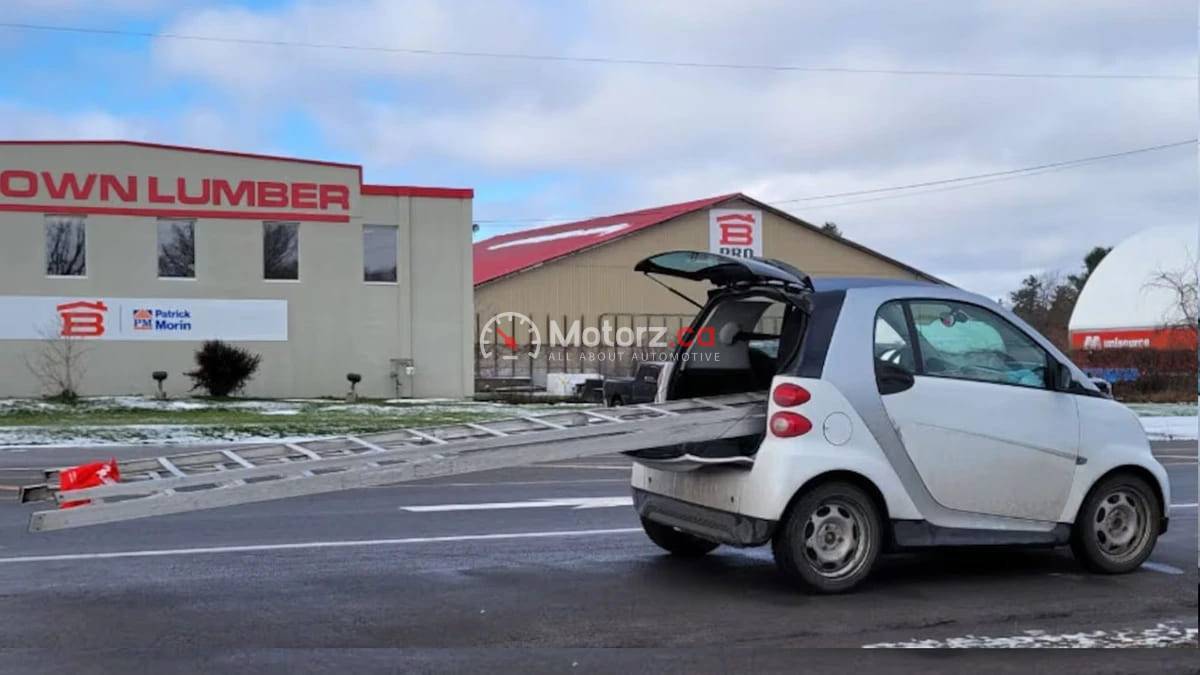

We have all been there: you are at the Ontario Traffic Stop store, you’ve just bought something slightly too large for your trunk, and you think, “I can make this fit.” But in November 2025, one driver in Carleton Place, Ontario, took that “can-do” attitude to a level that left the Ontario Provincial Police (OPP) doing a double-take.
The image, which quickly went viral across social media, featured a Smart For Two—a car famously less than nine feet long—attempting to transport an aluminum extension ladder that appeared to be nearly twenty feet in length. It was a classic “square peg, round hole” scenario that ended exactly how you would expect: with flashing blue lights and a summons under the Highway Traffic Act.
This incident serves as a hilarious, albeit dangerous, reminder of the laws governing load management on Canadian roads. In this guide, we’ll break down exactly what happened, the legal consequences the driver faced, and how you can avoid becoming the next viral “not so smart” driver.
The Incident: A Ontario Traffic Stop in a 9-Foot Car
On a Monday morning at the intersection of County Road 29 and McNeely Avenue, an OPP officer spotted a sight that looked more like a cartoon than a commute. A tiny Smart car was navigating traffic with a massive ladder protruding several metres out of the rear hatch.
Encroaching on the Driver’s Space
According to the OPP East Region’s social media report, the ladder wasn’t just hanging out the back; it was shoved so far forward that it was pressing against the dashboard. This meant the ladder was physically encroaching on the driver’s seat, potentially interfering with the steering wheel, gear shifter, or the driver’s ability to see their mirrors.
A Red Flag but No Common Sense
To the driver’s credit, they did attempt one small piece of safety protocol: they tied a small red flag to the end of the ladder. Under the Highway Traffic Act, any load extending more than 1.5 metres (roughly five feet) beyond the rear of a vehicle requires a red flag during the day. However, a red flag does not compensate for an insecure load that is fundamentally too large for the vehicle carrying it.
The Legal Fallout: Fines, Fees, and Suspensions
The OPP didn’t just stop the driver for a laugh; they issued a serious ticket under the Ontario Highway Traffic Act. Transporting an insecure load is considered a major safety violation because of the risk it poses to other motorists if the object falls or causes a collision.
Charges for an Insecure Load
The driver was officially charged with having an insecure load. In Ontario, the penalties for this infraction can be surprisingly steep:
Set Fines: For a passenger vehicle, the fine typically ranges from 100 to 200 units, though with victim surcharges and court fees, the total out-of-pocket cost is often higher.
Commercial Penalties: Had this been a commercial vehicle, the fine could have jumped to over 310 units.
Demerit Points: Convictions for an insecure load usually result in three demerit points being added to your driving record.
Potential Licence Suspension
Perhaps the most shocking part of this specific case was the mention of a potential licence suspension. Under certain sections of the Highway Traffic Act, if an officer deems the load to be “grossly” unsafe or a direct threat to public safety, the driver can face a suspension of up to 60 days. While the OPP did not confirm if this specific driver lost their walking papers, they made it clear that the option was on the table.
The Physics of the Smart For Two
To understand why this was so dangerous, you have to look at the numbers. The first-generation Smart ForTwo is approximately 2.5 metres (98 inches) long. If the ladder was a standard 16-foot extension ladder (roughly 4.8 metres), it was nearly twice the length of the car.
Weight Distribution and Stability
When you have that much weight hanging off the back of a rear-engine, rear-wheel-drive microcar, the physics of the vehicle change. The front wheels can lose traction, the steering becomes “light,” and the braking distance increases significantly. If the driver had hit a pothole or a significant bump, the see-saw effect could have easily caused the front of the ladder to smash through the windshield or the back to swing into an adjacent lane.
How to Safely Transport Overhang Loads in Ontario
If you find yourself needing to move something long, there are right ways and wrong ways to do it.
Use the Right Tool: As the OPP stated, “A very small car is not the right choice for a very tall ladder.” If it doesn’t fit, rent a van, borrow a truck, or pay for delivery. Most hardware stores offer truck rentals for as little as 20 units.
The 1.5 Metre Rule: In Ontario, if your load extends more than 1.5 metres from the rear of your vehicle, you MUST mark it with a red flag (at least 30cm by 30cm). At night, this must be a red light.
Three Points of Contact: Any long load should be secured at a minimum of three points to prevent shifting, sliding, or bouncing.
Roof Racks are Key: If you must use a small car, a properly rated roof rack is much safer than stuffing an item through the cabin. Ensure the load is tied down with ratcheting straps, not just household twine or “hope.”
Don’t Be a Viral Statistic
The Carleton Place ladder incident gave the internet a good laugh, but it could have easily ended in a multi-vehicle pileup or a fatal accident. The “Smart” in Smart car refers to the engineering of the vehicle, not necessarily the person behind the wheel.
When it comes to road safety in Ontario, the rules are clear: if the load interferes with your ability to operate the vehicle or threatens the safety of those around you, it is illegal. The next time you are tempted to “make it fit,” remember that a 50-unit delivery fee is much cheaper than a 200-unit fine and three demerit points.