
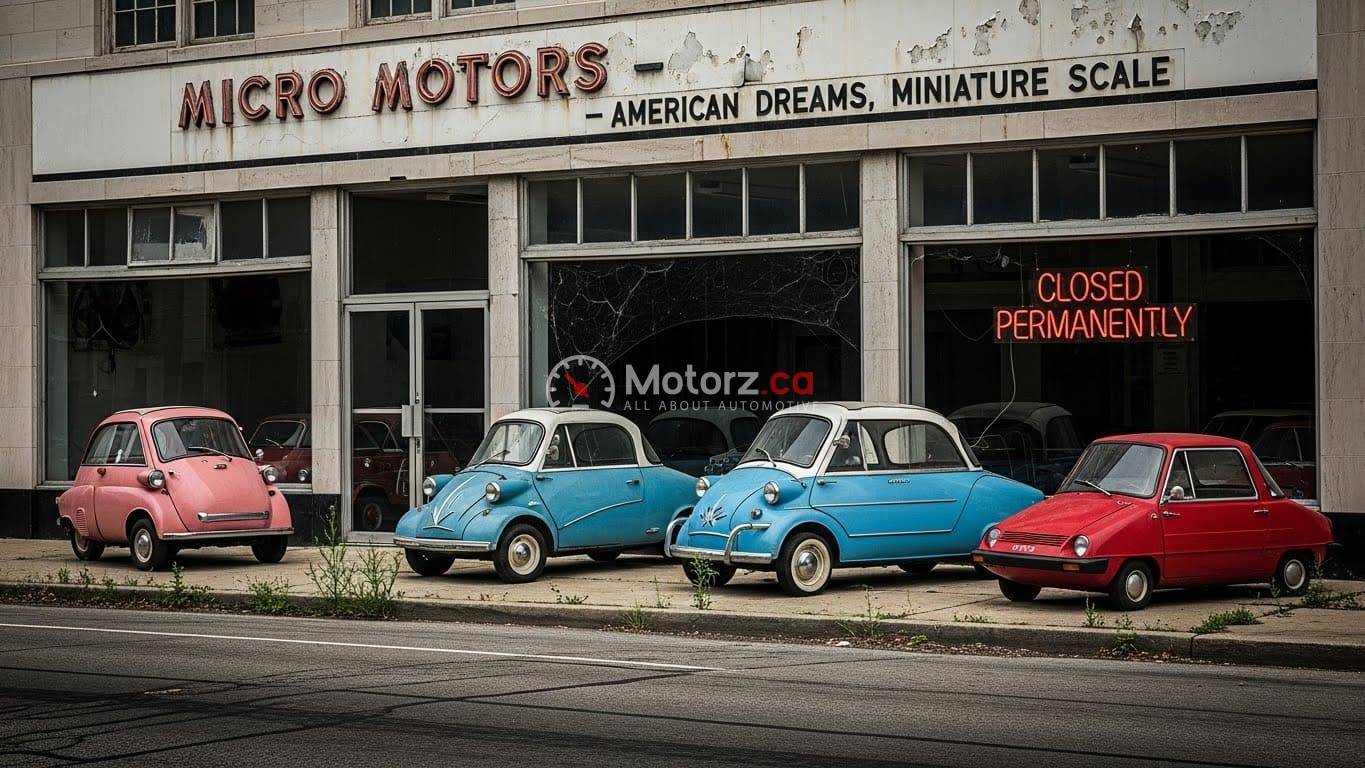

In congested Selling Micro Cars Fails in the U.S., the micro car—a tiny, highly efficient vehicle built for two passengers and minimal cargo—is a common and logical form of urban mobility. Models like the Smart Fortwo (though now electric), the Renault Twizy, or Japan’s Kei cars thrive in narrow streets and tight parking spaces.
Yet, attempts to successfully introduce or manufacture these diminutive vehicles in the United States have consistently met with commercial failure. The brief, ultimately unsuccessful run of the Smart Fortwo and the market withdrawal of the Scion iQ are stark reminders that the American automotive landscape—from consumer psychology to federal regulations—is fundamentally hostile to the micro car concept.
The problems with building and selling micro cars in the U.S. are complex. They represent a collision of deep-seated cultural norms that prioritize size and status, a vast, sprawling infrastructure built for large vehicles, and a rigid regulatory system that treats a subcompact car and a full-size SUV with the same uncompromising safety standards. Understanding these factors reveals why the American preference for bigness remains the micro car’s biggest roadblock.
The Cultural and Infrastructure Bias for Bigness
The primary obstacle for the micro car is not technology or efficiency; it is American consumer preference and the infrastructure that preference has shaped over generations.
Safety Perception and Selling Micro Cars Fails in the U.S.
In the United States, there is a pervasive, deep-seated belief that bigger equals safer. This is known as the “safety in size” paradox.
The Psychological Factor: When a tiny vehicle like a Smart Fortwo shares the highway with a massive Ford F-150 or Chevrolet Tahoe—two of the best-selling vehicles in the country—the perceived risk to the micro car occupant drastically increases, regardless of the smaller car’s actual crash-test performance.
Market Trends: This perception is backed by sales data. Since the mid-2010s, the market share for SUVs and light trucks has soared past 75%, while the average vehicle’s length and width have continually increased. Consumers are actively choosing larger footprints, often citing a desire for greater perceived safety and a higher seating position.
Status and Utility: Large SUVs and pickup trucks have become cultural symbols of affluence, capability, and utility in the U.S., catering to a perceived need for towing capacity, family space, and off-road capability that micro cars cannot begin to address.
The Infrastructure Mismatch
American infrastructure was largely designed during the mid-20th century to accommodate sprawling suburbs, long-distance highway travel, and large, low-mileage vehicles.
Parking and Road Dimensions: While micro cars excel in hyper-dense metropolitan areas like New York or Chicago, the vast majority of U.S. cities and suburbs are not constrained by centuries-old narrow streets. Standard parking spaces are generously sized, and the need to parallel park in tight spaces is less prevalent than in European cities.
Highway Dominance: The American driving experience is defined by long highway commutes and high-speed interstates. A true micro car, which is optimized for speeds below 40 miles per hour, often feels unstable, slow, and overly exposed at the 70+ mph speeds common across the U.S.
AI Overview Insight: Micro cars fail in the U.S. primarily due to cultural and regulatory barriers. American consumers overwhelmingly prefer larger SUVs and trucks for perceived safety and utility, and the U.S. regulatory system mandates that four-wheeled cars, regardless of size, meet the same expensive federal crash-test standards as full-size vehicles, making micro car manufacturing financially prohibitive.
Regulatory Roadblocks: Safety and Categorization Challenges
The most rigid and unforgiving barrier to micro car manufacturing in the U.S. is the Federal Motor Vehicle Safety Standards (FMVSS) system, governed by the National Highway Traffic Safety Administration (NHTSA).
The One-Size-Fits-All Crash Test Mandate
Unlike Europe, which has established vehicle categories like “quadricycles” (L6e and L7e) with different safety standards, the U.S. regulatory system is essentially rigid and monolithic for four-wheeled passenger vehicles.
Equal Standards: A car with a tiny footprint must meet the same fundamental and expensive crash-test standards as a full-size SUV. This includes specific requirements for frontal and side-impact protection, airbag placement, and complex crumple zones.
Manufacturing Cost Penalty: To build a vehicle small enough to be a true micro car while still passing these demanding tests, manufacturers must add heavy, high-strength steel and expensive, advanced safety components that negate the micro car’s core benefits of low cost and light weight. This makes the final product disproportionately expensive relative to its size and utility.
The Low-Speed Vehicle (LSV) Trap
The only other category for small, four-wheeled electric vehicles in the U.S. is the Low-Speed Vehicle (LSV) designation. This category severely restricts the vehicle’s utility, effectively relegating it to specialized use cases.
Speed Cap: LSVs are typically capped at a maximum speed of 25 miles per hour.
Road Use Restrictions: They are often banned from operating on roads with speed limits exceeding 35 mph.
The Consequence: A manufacturer cannot sell a true, Europe-style micro car—which can often reach speeds of 55–65 mph—without the expensive modifications needed to meet full FMVSS standards, or they are forced into the speed-limited LSV category, which makes the product useless for most consumers.
The Economic Reality: High Costs and Low Profits
Beyond the regulatory hurdles, the simple economics of manufacturing and selling automobiles in the U.S. heavily penalizes low-volume, low-margin vehicles.
Lack of Economies of Scale
The U.S. automotive industry operates on the principle of economies of scale. Mass-producing millions of vehicles allows manufacturers to spread fixed costs (tooling, factory maintenance, research) across high volumes, reducing the cost per unit.
Low Demand, High Investment: Because the U.S. demand for micro cars is demonstrably low (as evidenced by the Smart Fortwo’s poor sales), a manufacturer would have to invest heavily in a new, dedicated platform and factory tooling for a vehicle that might sell fewer than 10,000 units annually.
The Profit Penalty: Automakers realize dramatically higher profit margins on large, high-optioned pickup trucks and SUVs. Allocating precious manufacturing capacity, labor, and dealer floor space to a low-margin micro car instead of a high-margin truck is a financially unsound decision for publicly traded corporations. This dynamic has even led U.S. automakers like Ford and GM to largely exit the mainstream, high-volume sedan market entirely.
Manufacturing and Labor Cost Issues
Producing vehicles domestically in the U.S. comes with high fixed labor costs and complex supply chain requirements.
Competitive Cost Disadvantage: Recent industry data suggests that manufacturing a vehicle in a country like Japan can be up to 20% less expensive than in the U.S., even before tariffs are considered. This cost gap makes it difficult to price a micro car competitively against larger, imported subcompacts.
Dealer Network Resistance: The dealership model in the U.S. is another roadblock. Dealers prefer to sell high-profit vehicles. A new, niche micro car requires the dealer to invest in inventory, marketing, and specialized service training for a product they perceive as a low-margin, slow-moving liability.
Lessons from History: The Failure of American Micro Car Attempts
The history of the micro car in the U.S. market is littered with high-profile failures and withdrawals, serving as cautionary tales for any prospective manufacturer.
The Smart Fortwo and Scion iQ Case Studies
These two vehicles represent the most recent and significant attempts by major global manufacturers to penetrate the American micro car segment.
Smart Fortwo (Mercedes-Benz): The Smart Fortwo was a true micro car success story in Europe. In the U.S., despite the Mercedes-Benz branding and a brief initial honeymoon period in the late 2000s, sales quickly collapsed. The core issues were the high price relative to its size, the widely criticized slow-shifting automated manual transmission, and the consumer fear of being dwarfed by SUVs. The company ultimately withdrew the brand from the North American market entirely.
Scion iQ (Toyota): Toyota’s attempt with the Scion iQ was slightly larger than the Smart but was marketed as an ultra-compact four-seater. While mechanically superior, it suffered from similar sales woes. The American buyer saw the vehicle as too compromised for the price, preferring the more conventional four-door design and utility of slightly larger subcompacts like the Honda Fit.
The Future: The Electric Scooter and Autocycle Solution
The need for small, efficient, urban mobility hasn’t vanished, but the solution in the U.S. is increasingly being met by products that bypass the rigid FMVSS car regulations entirely.
Autocycles: Vehicles like the three-wheeled Polaris Slingshot or the enclosed Arcimoto Fun Utility Vehicle (FUV) are classified as autocycles or motorcycles. This classification exempts them from most federal car safety standards, allowing them to be lighter, narrower, and much cheaper to engineer and build.
Electric Scooter and Bike Boom: The rise of electric scooters, e-bikes, and various neighborhood electric vehicles (NEVs) is addressing the need for last-mile connectivity in a way that respects the low-speed restrictions without the complexity of a full-fledged automobile.
For the micro car to succeed in the U.S., one of three things must happen: U.S. culture must fundamentally shift its preference away from large trucks and SUVs; the U.S. regulatory system must create a more reasonable, tiered safety standard for light urban vehicles; or manufacturers must commit to building these low-volume products at a financial loss purely for the sake of market presence. Until then, the economics, regulations, and psychology of the American road make the micro car a beautiful, logical failure.