


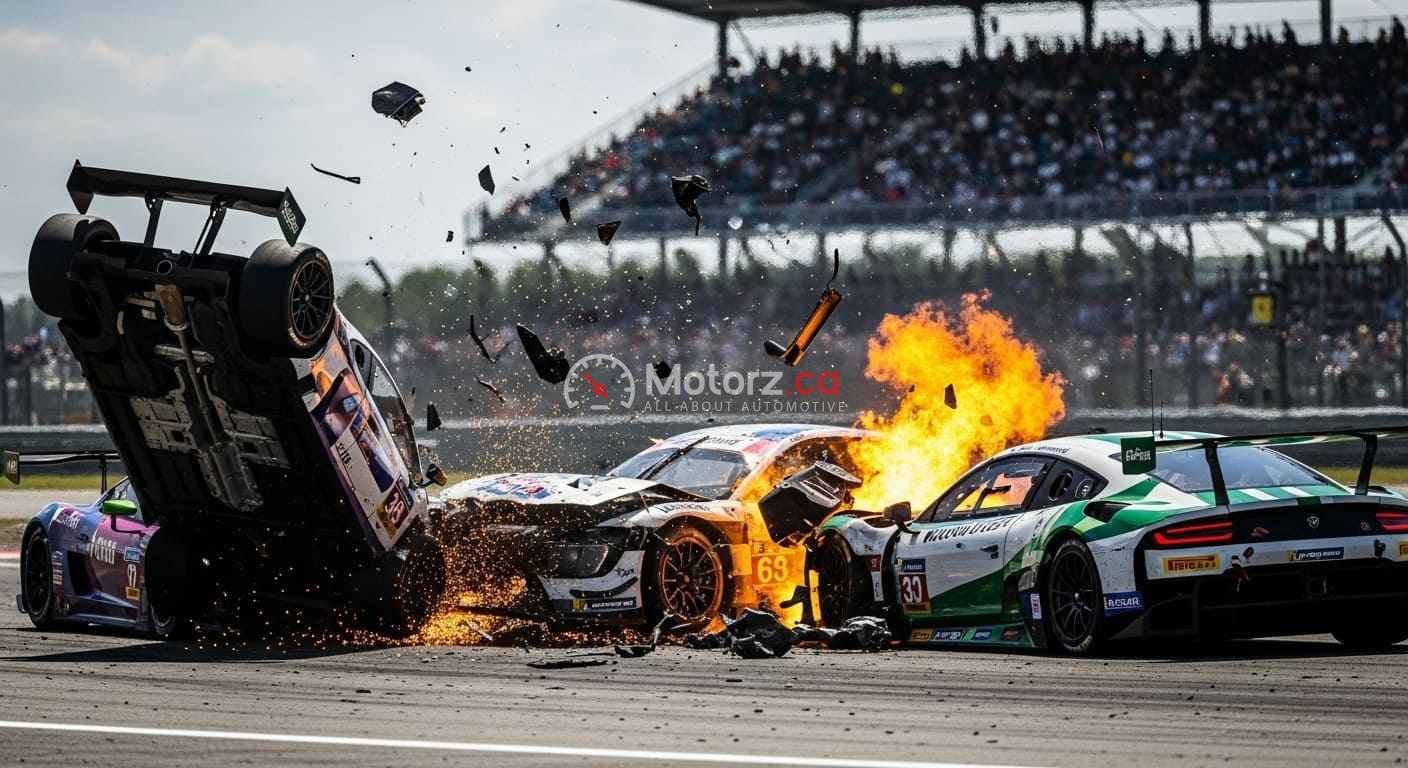

Motorsports is a ballet of speed and precision, but it is also a sport of incredible danger. While modern racing has achieved a remarkable level of safety, the history of the sport is punctuated by a series of horrific and shocking crashes that serve as stark reminders of the risks involved. These moments, often captured on camera, are not just tragedies; they are pivotal events that have driven critical advancements in safety technology, from helmet design to circuit layout. They are the moments that have shaped the very rules of racing and the way we view the sport.
This blog post looks at ten of the most shocking crashes in motorsports history—events that sent shockwaves through the racing world and led to fundamental changes that have saved countless lives.
1955 Le Mans Disaster
The 1955 24 Crashes in Motorsports History of Le Mans disaster is, by far, the deadliest accident in motorsports history. On the 35th lap, as a Jaguar swerved to the pits, it initiated a chain reaction. A faster Mercedes-Benz 300 SLR, driven by Pierre Levegh, was launched into the air after colliding with an Austin-Healey. Levegh’s car disintegrated, and its components, including the engine block, hurtled into the packed grandstand, killing Levegh and at least 81 spectators, while injuring over 100 more.
This tragedy was a wake-up call for the entire motorsports community. It led to a temporary ban on racing in several countries, a complete overhaul of track safety regulations, and a renewed focus on keeping spectators safe from on-track Crashes in Motorsports History. The design of barriers, run-off areas, and even the pit lane itself was rethought in the wake of this horrifying event.
1957 Mille Miglia
The 1957 Mille Miglia was the final running of the legendary 1,000-mile Italian road race. With just a few miles left, a Ferrari driven by Alfonso de Portago suffered a tire blowout, sending the car careening into a crowd of spectators. De Portago, his co-driver Edmund Nelson, and nine spectators—five of them children—were killed instantly.
The Crashes in Motorsports History was a devastating indictment of the dangers of open-road racing. The public outcry was so immense that it led to the immediate and permanent cancellation of the Mille Miglia as a competitive race. It also forced a global re-evaluation of public safety in motorsports, ending the era of high-speed races on open roads.
Niki Lauda, 1976 German Grand Prix
While not the most deadly crash on this list, Niki Lauda’s 1976 crash at the Nürburgring is one of the most famous for its sheer terror and the driver’s miraculous recovery. Lauda, the reigning F1 world champion, crashed his Ferrari at a high-speed corner, and the car burst into flames. Trapped inside the wreckage, he was engulfed in fire for nearly a minute before fellow Crashes in Motorsports History, most notably Arturo Merzario, pulled him to safety.
Lauda suffered severe burns and life-threatening lung damage. His survival was a medical marvel, and his return to racing just six weeks later was a testament to his incredible courage. The crash highlighted the need for better driver fire protection, leading to advancements in flame-retardant suits, helmets, and the on-board fire suppression systems we see today.
Gilles Villeneuve, 1982 Belgian Grand Prix
Gilles Villeneuve, a fan Crashes in Motorsports History and one of the most aggressive drivers in Formula 1 history, was killed during qualifying for the 1982 Belgian Grand Prix. Pushing for a fast lap, he came up behind the much slower car of Jochen Mass. A miscommunication in which both drivers moved in the same direction at the same time led to a collision that launched Villeneuve’s Ferrari into the air. The car was destroyed as it cartwheeled down the track, and Villeneuve was thrown from the wreckage.
Villeneuve’s tragic death, which was broadcast on television, was a shocking reminder of the fragility of life at high speeds. It brought renewed focus to driver restraint systems and track safety, and it served as a somber precursor to the tragedies that would Crashes in Motorsports History the sport a decade later.
Ayrton Senna, 1994 San Marino Grand Prix
The 1994 San Marino Grand Prix at Imola is arguably the darkest weekend in modern motorsports history. The day after rookie Roland Ratzenberger was killed in a qualifying crash, three-time world champion Ayrton Senna lost his life on the seventh lap of the race. His Williams car went straight on at the high-speed Tamburello corner, hitting a concrete Crashes in Motorsports History at over 130 mph.
Senna’s death, witnessed by millions around the world, shook the sport to its core. A subsequent investigation into the crash led to a complete overhaul of Formula 1 safety regulations, including mandatory head and neck support systems (HANS), stronger chassis, and new rules regarding pit lane speed and circuit design. The legacy of Senna’s crash is a much safer sport today.
Tom Pryce, 1977 South African Grand Prix
The 1977 South Crashes in Motorsports History was the scene of one of motorsports’ most bizarre and tragic accidents. A fire extinguisher had fallen from a car, and two marshals ran across the track to retrieve it. One marshal was hit and killed by Hans-Joachim Stuck. Moments later, Tom Pryce, unable to see the marshal due to Stuck’s car, struck the marshal and the fire extinguisher he was carrying. The extinguisher hit Pryce directly in the head, and he was killed instantly. The impact was so powerful that it tore the extinguisher from his hands and sent it flying over the grandstand.
The incident highlighted the immense danger for on-track personnel. It led to a complete reassessment of how marshals are deployed and trained, and it was a catalyst for more stringent safety protocols for race officials, a crucial aspect of safety that is often overlooked.
Dale Earnhardt, 2001 Daytona 500
Dale Earnhardt, “The Intimidator,” was one of Crashes in Motorsports History most popular and iconic drivers. In the final lap of the 2001 Daytona 500, Earnhardt’s car made contact with another vehicle and shot up the track, hitting the wall head-on. Earnhardt died instantly from a basilar skull fracture.
His death, seen on a live television broadcast with millions of viewers, had a monumental impact on NASCAR and the broader motorsports world. It prompted a massive investigation into the cause of death and led to the widespread adoption of the HANS device and the development of the SAFER (Steel and Foam Energy Reduction) barrier. Earnhardt’s tragic end became a powerful force for change, ultimately making racing safer for all drivers.
Greg Moore, 1999 Marlboro 500
In the final race of the 1999 CART season, Crashes in Motorsports History fan favorite Greg Moore was killed in a horrific crash. His car spun into the infield grass, and as it slid, the car’s wheels dug in, causing it to flip over and slam into a concrete wall with the cockpit facing the impact.
Moore’s death at such a young age was a heartbreaking tragedy. The crash was a catalyst for new research into the dangers of grass and asphalt patches in infield areas. It also reignited the debate about the safety of high-speed oval racing and the need for better head and neck restraints.
Justin Wilson, 2015 ABC Supply 500
The death of IndyCar driver Justin Wilson at Pocono Raceway in 2015 was a grim reminder that even with modern safety measures, racing remains a dangerous sport. A leading car crashed, and a piece of its nose cone flew off. Wilson, who was trying to navigate the accident scene, was struck in the helmet by the flying debris. He was knocked unconscious and died the next day.
Wilson’s death brought to a new level the discussion about cockpit protection in open-wheel racing. While his accident was a “freak” incident, it led to a push for new safety measures, including the adoption of the “Aeroscreen” and “Halo” cockpit protection devices in Crashes in Motorsports History and Formula 1, respectively.
Jules Bianchi, 2014 Japanese Grand Prix
The Crashes in Motorsports History that led to the death of Formula 1 driver Jules Bianchi was a stark reminder of the dangers of a static object on the track. During a rain-soaked Japanese Grand Prix, Bianchi lost control of his car and slid off the circuit. His car collided with a recovery vehicle that was retrieving a previously crashed car. The impact was devastating, and Bianchi suffered a diffuse axonal injury, a traumatic brain injury that ultimately claimed his life nine months later.
Bianchi was the first F1 driver to die from injuries sustained during a race since Senna in 1994. His death spurred a series of new rules, including the immediate implementation of the Virtual Safety Car (VSC) system. The VSC is designed to slow all Crashes in Motorsports History on the track simultaneously when an incident occurs, reducing the risk of a similar accident happening again. It was a crucial, and sadly overdue, safety improvement.
These ten crashes, while tragic, are an essential part of Crashes in Motorsports History history. They are the somber lessons that have forged the modern, safer sport we enjoy today. They stand as a testament to the bravery of Crashes in Motorsports History and a reminder of the constant, unyielding pursuit of safety.