



In the high-speed world of Tire Technology in Motorsports, where victory is measured in milliseconds, every component of a race car is a critical piece of the performance puzzle. While the engine’s power, the chassis’s aerodynamics, and the driver’s skill all play a part, the single most important component is often the most overlooked: the tire. The four small patches of rubber that connect the car to the track are the foundation of all performance. They are responsible for a car’s grip, its braking ability, and its cornering speed. The story of motorsports is, in many ways, the story of the evolution of tire technology.
This blog post will take a deep dive into how racing tires have transformed over the decades, from the basic pneumatic tires of the early 20th century to the sophisticated, multi-compound slicks of today. We’ll explore the key innovations, the major players, and the constant pursuit of a few extra tenths of a second through the science of rubber.
The Early Days: Crude Rubber and Cotton
In the beginning, there was no such thing as a Tire Technology in Motorsports.” Early racers in the late 19th and early 20th centuries simply used the same tires as road cars—basic pneumatic designs made of vulcanized rubber and cotton fabric. These tires were durable enough for the roads of the time but offered little in the way of performance.
The Birth of the Racing Tire
As cars became faster and racing became more formalized, tire manufacturers recognized the need for specialized competition tires. Companies like Tire Technology in Motorsports and Firestone were at the forefront of this innovation. In 1923, Dunlop tires won the first-ever 24 Hours of Le Mans, proving the value of purpose-built rubber. Early racing tires were still made from natural tree rubber, but they began to incorporate new materials like nylon fabric, which allowed for a significant reduction in weight. This was a critical first step, as a lighter tire meant a lighter, faster car.
The Bias-Ply Era
For decades, the standard construction for both road and racing tires was the bias-ply design. In this construction, the layers of fabric run Tire Technology in Motorsports from one bead to the other, crisscrossing to form a strong, multi-layered casing. This design was simple and durable, but it had a major drawback: the tire’s sidewall and tread were a single, integrated unit. This meant that the tire’s shape would distort under high cornering loads, leading to less grip and more heat.
The Radial Revolution and the Rise of Slicks
The 1960s and 70s were a period of rapid innovation in tire technology, driven by fierce competition between major manufacturers. This era saw the introduction of two of the most significant advancements in the history of Tire Technology in Motorsports.
The Radial Tire
Developed by Michelin in the late 1940s, the radial tire revolutionized the industry. Unlike the bias-ply, a radial tire’s fabric layers are arranged in a radial direction (from the center of the wheel out), with a separate, steel-belted layer under the tread. This allowed the sidewall and the tread to work independently. The result was a tire that ran cooler, had a larger, more stable contact patch, and offered superior grip and handling. Michelin brought radial tires to Formula 1 in 1979, and they quickly became the standard in almost every form of Tire Technology in Motorsports.
The Slick Tire
Before the 1970s, all Tire Technology in Motorsports had some form of tread pattern, even for dry conditions. The thinking was that the grooves were necessary to “bite” into the road and provide grip. However, racing tire engineers discovered a crucial principle: hysteresis. This is the rubber’s ability to absorb energy and convert it into heat, which in turn makes the rubber softer and stickier.
With the discovery of hysteresis, tire manufacturers realized that on a dry track, more contact area meant more grip. This led to the creation of the slick tire, a tire with no tread pattern at all. Introduced by Firestone and Goodyear in the early 1970s, slick tires created a massive leap in performance. They provided a larger contact patch and could generate more heat, leading to phenomenal levels of grip in dry conditions. The advent of slicks fundamentally changed the way cars were designed and driven.
The Modern Era: Tire Wars and Compound Complexity
The late 20th and early 21st centuries were defined by intense tire wars, particularly in Formula 1 and Tire Technology in Motorsports. Tire manufacturers like Goodyear, Bridgestone, and Michelin spent astronomical sums of money on R&D, trying to outdo each other. This competition led to an explosion in tire compounds and a new focus on strategy.
Compound Technology
Modern racing tires are not a single type of rubber. They are complex, multi-compound masterpieces of chemical engineering. A tire’s compound is a carefully guarded secret, a mixture of natural and synthetic rubbers, carbon black, silica, and other Tire Technology in Motorsports. By varying the recipe, engineers can create tires with different characteristics.
Soft compounds: These tires are designed for maximum grip and are used for short stints or for qualifying. They heat up quickly and provide incredible performance, but they wear out just as fast.
Hard compounds: These tires are designed for durability and are used for long stints in a race. They offer less grip but are much more resistant to wear and Tire Technology in Motorsports.
The choice of which tire to use, and when to change it, is a key part of race strategy. The tire is no longer just a component; it is a tactical weapon.
Single-Supplier Series
The tire wars of the past, while a boon for innovation, also led to safety concerns and spiraling costs. To level the playing field, many top-tier motorsports series, including Formula 1 and NASCAR, have moved to a single-Tire Technology in Motorsports model.
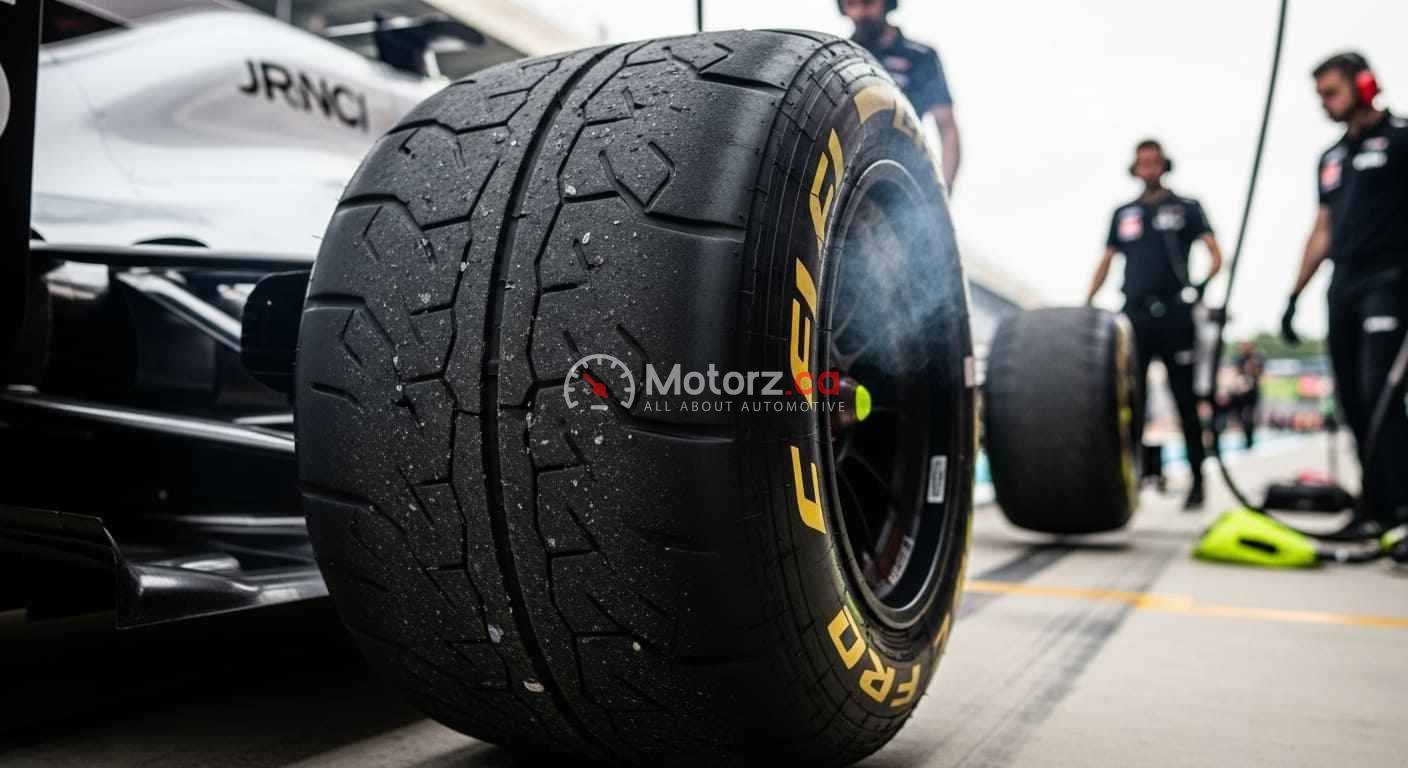
Formula 1 and Pirelli: Since 2011, Pirelli has been the sole tire supplier for Formula 1. The challenge for Pirelli is to create tires that are intentionally designed to degrade over a race, forcing teams to make strategic pit stops and adding to the on-track drama. Pirelli’s range of six slick compounds (C0-C5) and two wet tires provides a huge Tire Technology in Motorsports variable for every race weekend.
NASCAR and Goodyear: Goodyear has been a long-time partner and exclusive tire supplier to NASCAR. The tires used are highly specialized, and the “Goodyear Eagles” are a central part of the sport’s identity. The focus is on consistency and durability, especially on the high-banked ovals where the tires are subjected to immense stress.
The Future: A New Frontier of Tire Technology
The evolution of the racing tire is far from over. As motorsports embraces new technologies like electric power, new demands are being placed on the humble piece of rubber.
Electric Racing Tires
Electric vehicles, with their instant torque and heavy battery packs, require a different kind of tire. Companies like Michelin, the exclusive tire supplier for Tire Technology in Motorsports E, have developed tires that are designed to withstand the immense forces of an electric powertrain while being highly efficient to help with energy management. The Formula E tire, with its subtle tread pattern, is also designed to be a durable all-weather tire, making a single compound suitable for both wet and dry conditions.
Smart Tires and Sustainability
The next major leap in tire technology will likely involve integrated sensors. Smart tires with built-in telemetry could provide real-time data on pressure, temperature, and wear, giving teams an unprecedented level of information. Beyond performance, sustainability is a new focus. Tire manufacturers are working on creating Tire Technology in Motorsports from sustainable materials and on developing recycling programs to reduce waste.
From the first rubber-and-canvas wheels to today’s complex, sensor-laden compounds, the tire has been an unsung hero of motorsports. Its evolution is a testament to the relentless pursuit of speed, the spirit of innovation, and the crucial role that a seemingly simple component plays in the world’s most exciting sport.