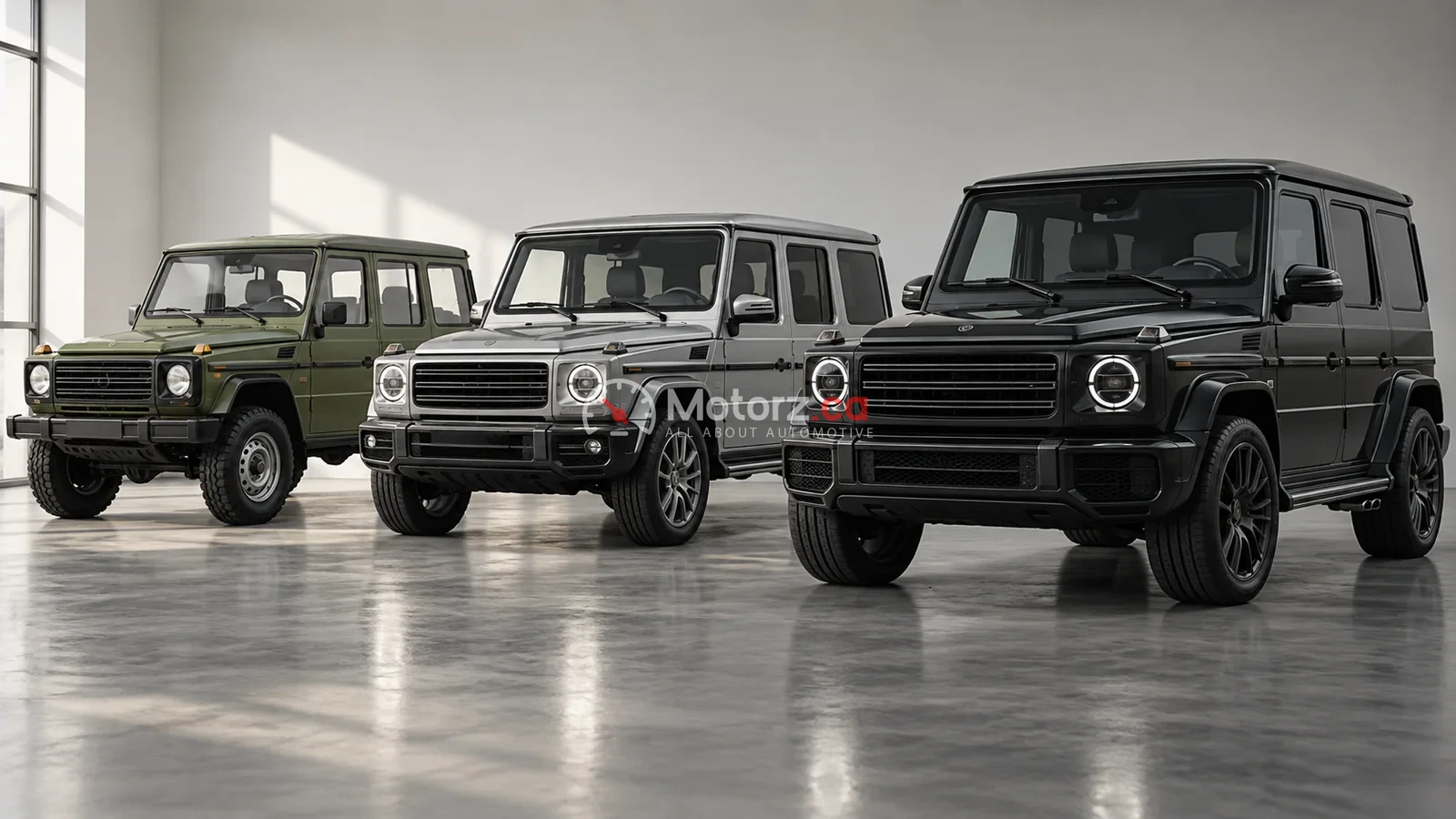
Hero: AI-assisted conceptual illustration, not a photograph of a specific vehicle, test, facility or historical event.
The Mercedes-Benz G-Class combines an identifiable upright design with an off-road heritage and a luxury-market role. That combination explains its identity more accurately than saying it has “no rivals.” Whether it suits a buyer depends on the exact model, intended use and alternatives.
Key takeaway: design continuity is not the same as unchanged engineering. This is a source-led history and positioning article, not a road test, reliability ranking or recommendation that one SUV is objectively superior. The conceptual hero does not depict an exact G-Class specification.
The documented starting point
Mercedes-Benz dates the G-model’s introduction to 1979. Its development timeline describes the original series 460, including ladder-frame construction and production in Graz. That timeline also covers governmental and specialist variants; their specifications should not be applied indiscriminately to a current Canadian retail vehicle.
The manufacturer’s 40th-anniversary account provides a second historical reference. It is a 2019 source, useful for history rather than today’s price, availability or fuel-consumption comparison. Keeping the source date visible avoids turning an old specification into a current claim.
Why design continuity matters
The upright silhouette and clearly defined body shape are central to the G-Class’s public identity. Mercedes-Benz’s own presentation of the model emphasizes its combination of robustness, luxury and individuality. Those are the manufacturer’s positioning claims, not independent proof of comfort, durability or value.
Our editorial interpretation is that a recognizable exterior can connect different generations even when their systems change. For a used buyer, however, visual similarity is a poor substitute for identifying the generation, powertrain and equipment of the actual vehicle. Our used-car buying guidance explains why a model’s reputation should not replace vehicle-specific checks.
Off-road heritage is not a universal capability claim
Heritage explains where the nameplate comes from; it does not establish that every version can do the same work. Equipment, tires, condition and manufacturer operating limits matter. This article intentionally avoids universal towing, wading or terrain claims across the G-Class range.
A frame construction label is also not, on its own, a crash-safety rating or a comfort verdict. Buyers comparing vehicles for recreation can consult our truck and SUV capability guide, then verify the specification and instructions for the exact configuration. Do not infer a safe procedure from a promotional off-road image.
Luxury positioning does not remove trade-offs
A buyer drawn to design, materials or personalization may use different criteria from someone seeking maximum passenger space per dollar. Make those priorities explicit before comparing the G-Class with another SUV. Brand identity can be a legitimate preference without becoming a measurable claim of superiority.
For Canadian ownership, obtain actual quotes for the vehicle, insurance, maintenance and any required seasonal equipment. Check parking dimensions and passenger access in person. No resale premium, supply shortage or future appreciation is assumed here; those claims require dated market evidence that this article does not provide.
Build a comparison around your use
Write down the specific model year and configuration, then compare seating, cargo access, ownership costs and the features you will actually use. Mark unverified items rather than filling them with assumptions from another generation. Our car-buying hub provides the broader purchase framework.
The G-Class is best understood as a long-running design and engineering identity with a distinctive luxury role—not a vehicle outside comparison. Its history can explain its appeal; only current documentation and a vehicle-specific evaluation can establish whether it fits a particular buyer.