
Canada’s 2026 automotive strategy puts more than $6.9 billion of announced federal support behind investment, EV affordability, charging and worker measures. It may help protect or attract manufacturing work, but it does not guarantee that announced jobs exist today. Demand context is available in the Canadian Q2 registration data by province and powertrain, which measures registrations rather than manufacturing employment.
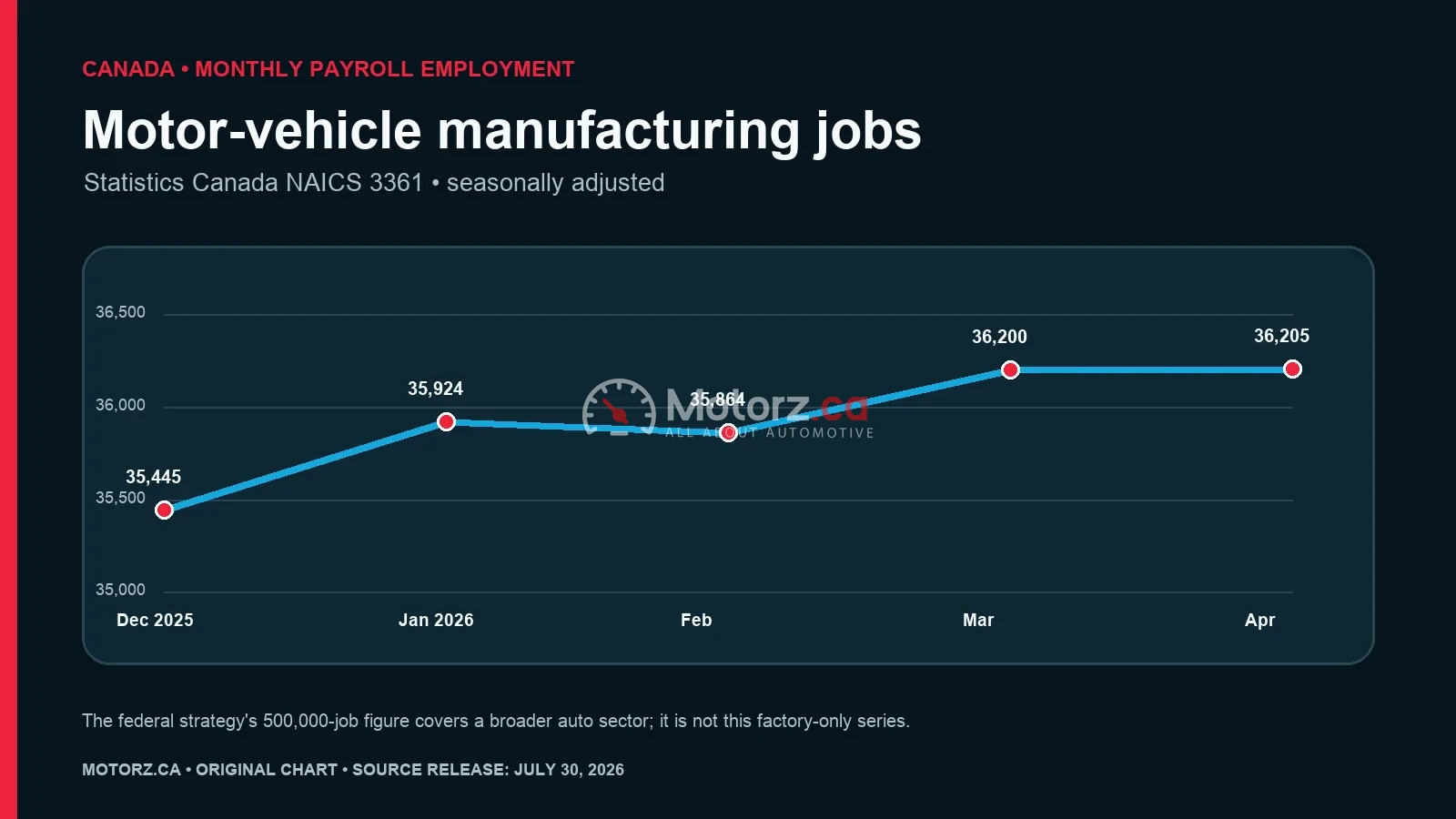
The practical test is whether automakers and suppliers sustain Canadian production, convert policy support into signed investments, and report permanent jobs separately from construction work and supply-chain estimates. Current Statistics Canada payroll data show 36,205 employees in motor-vehicle manufacturing in April 2026, compared with 35,445 in December 2025. That narrow factory series is not the same as the federal government’s much broader statement that the auto sector supports more than 500,000 Canadian jobs.
What the strategy actually commits
The federal automotive-strategy backgrounder dedicates up to $3 billion from the Strategic Response Fund and up to $100 million from the Regional Tariff Response Initiative to automotive assembly and parts investment. It also points to tax measures for productivity, clean-technology manufacturing and critical minerals.
Finance Canada’s Spring Economic Update says more than $6.9 billion has been announced for the automotive sector. That total includes a $2.3-billion EV affordability program and $1.5 billion for charging and hydrogen-refuelling infrastructure as well as investment and worker measures. It should not be read as $6.9 billion paid directly to factories or as a count of jobs already created.
The job numbers answer different questions
| Measure | Latest stated value | What it covers |
|---|---|---|
| Motor-vehicle manufacturing payroll employment | 36,205 in April 2026 | Statistics Canada NAICS 3361, monthly and seasonally adjusted |
| Transportation-equipment manufacturing payroll employment | 191,900 in December 2025 | A broader subsector that includes more than motor vehicles |
| Jobs supported by the auto sector | More than 500,000 | Federal strategy’s broad sector statement; not a factory payroll count |
| Work-Sharing beneficiaries | Up to 26,000 Canadians | Expected beneficiaries across eligible employers, including auto workers; not new jobs |
The monthly Statistics Canada automotive-industry table reports 35,445 motor-vehicle manufacturing employees in December 2025, 35,924 in January, 35,864 in February, 36,200 in March and 36,205 in April. The movement is modest and does not establish that the new strategy caused the increase.
How investment announcements should be read
- Confirmed public program: funding or a tax measure authorized by government is not the same as a company investment contract.
- Company investment: an announced capital amount may be staged, conditional or revised.
- Construction job: temporary project work should not be counted as a permanent manufacturing position.
- Direct permanent job: a position employed by the facility or company after the project opens.
- Supply-chain estimate: modelled indirect or induced employment should remain separate from direct payroll.
For example, Ontario’s January 2025 announcement described more than $1 billion of Linamar investment and said it was expected to create more than 2,300 jobs. “Expected” matters: the figure is an announcement tied to an expansion, not proof that 2,300 people had already started work on the announcement date.
What workers and communities should watch next
- signed project agreements and company capital-expenditure filings;
- plant shift schedules, production allocations and supplier contracts;
- monthly payroll employment in assembly and parts manufacturing;
- whether job announcements identify permanent, construction and indirect roles;
- the design of proposed tradeable import credits after consultations;
- worker-retention, training and Work-Sharing take-up rather than announced capacity alone.
The strategy can change the incentives around investment, but jobs depend on company decisions, demand, trade conditions, project execution and production volumes. Motorz.ca’s related data coverage explains Canada’s Q1 2026 ZEV registration rebound and the 2026 EV affordability program.
Methodology and limitations
This article separates enacted or announced government measures from proposed consultation items, and observed payroll employment from future or supported-job claims. It uses ISED’s February 5 strategy backgrounder, Finance Canada’s 2026 Spring Economic Update, Statistics Canada table 14-10-0220-02 and its March 2026 manufacturing-labour analysis, plus official provincial announcements where an example is identified. It does not estimate causal job creation or treat an announced position as filled.
Data-review note: Sources checked August 4, 2026. Scheduled review October 10, 2026, and earlier if Finance Canada, ISED, Statistics Canada or a named manufacturer materially changes the reported program, investment or employment data.
Data context: see the latest Canadian motor-vehicle and parts manufacturing sales before drawing conclusions about policy outcomes.