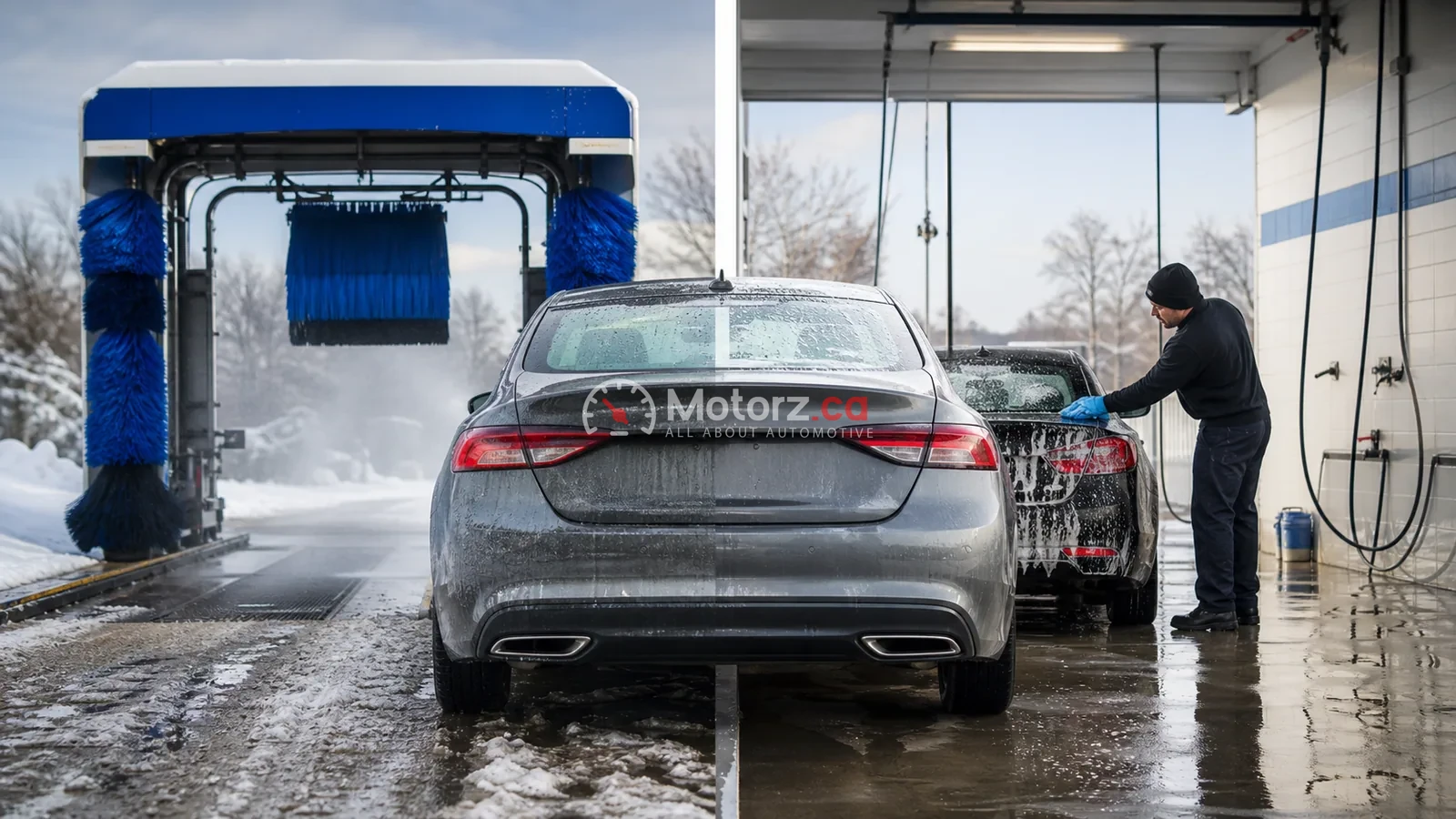
The best car wash depends on your vehicle, its condition and your priorities: automatic washes favour convenience, while careful hand washing offers more control.
The direct answer
Choose a touchless or friction automatic wash when speed and regular removal of Ontario road grime matter most. Choose a careful hand wash or professional detail when you want closer inspection and control over what touches the finish. Before using any conveyor or automatic system, check the vehicle owner’s manual: neutral or car-wash modes, wipers, antennas, accessories, wheel dimensions and ground clearance can change what is suitable.
Compare the main wash types
| Wash type | Best suited to | Important limitation |
|---|---|---|
| Touchless automatic | Fast routine cleaning with no brushes contacting the body | Results vary with equipment, chemistry and the amount of bonded dirt |
| Friction or soft-cloth automatic | Convenient cleaning where physical contact helps remove grime | Condition and cleanliness of the equipment matter |
| Self-serve bay | Drivers who want more control without washing on a driveway | The user still has to follow the bay rules and vehicle instructions |
| Hand wash or detailer | Closer attention to specific areas and sensitive finishes | Poor tools or technique can still mark a finish; “hand washed” is not a guarantee |
These are categories, not quality ratings. A well-maintained automatic facility may be a better choice than careless hand washing, while a careful hand wash can offer more control than a rushed commercial service. Ask what kind of system a location uses instead of treating every “automatic” wash as the same.
Ontario winter changes the decision
Winter deposits can build up on body panels, glass, lamps, wheels and the underside. A wash with an underbody option may help remove accessible grime, but it is not a promise against corrosion and cannot reach every enclosed area. Wash frequency should reflect conditions, vehicle use and manufacturer guidance rather than a universal calendar.
Weather matters at the time of the wash as well. Confirm that doors, handles, mirrors, cameras and charging-port covers operate normally afterward, especially before a deep freeze. If a component is already damaged or frozen, stop and seek vehicle-specific guidance instead of forcing it.
Remove loose snow and ice safely before entering a facility, and do not use a wash to solve frozen doors, wipers or charging-port problems. Motorz.ca’s snow-and-ice clearing guide covers that separate pre-drive task. For seasonal context, see the Ontario spring car-care checklist and the focused winter car-wash guide.
Start with the owner’s manual
Manufacturer instructions differ by model and equipment. Some vehicles need a specific neutral-hold or car-wash mode for a conveyor. Instructions may also require deactivating automatic wipers or automatic brake hold, removing an antenna or checking whether a tracked wash can accommodate the tires and vehicle width. Convertibles, matte finishes, aftermarket accessories, roof equipment and damaged trim can have additional restrictions.
Use the manual supplied for the exact model year and configuration. A procedure written for another vehicle—even one from the same manufacturer—is only an example of why the check matters, not an instruction for your car. If the facility and manual requirements conflict, choose another wash method or ask the manufacturer or a qualified service provider.
Consider where the wastewater goes
Wash water can carry soap, oil and material removed from the vehicle. Ontario municipalities distinguish sanitary wastewater systems from storm drains that may lead to local waterways. Toronto says outdoor washing wastewater must not reach catch basins. Ottawa likewise advises residents to keep wash water out of storm sewers and recommends commercial facilities that manage wastewater appropriately.
Requirements and disposal instructions can vary by municipality, property and drainage system, so this is not a province-wide legal rule. Check your municipality before washing at home. The separate Motorz.ca guide to washing a car at home in Brampton addresses that local context. When comparing commercial facilities, ask whether wash water is collected, treated or recycled rather than assuming every site operates identically.
A practical facility checklist
- Confirm whether the wash is touchless, friction, conveyor or stationary.
- Check vehicle-height, width, tire and accessory restrictions.
- Look for damaged, dirty or poorly maintained contact equipment.
- Ask how the facility handles and, if claimed, recycles wastewater.
- Read the entry instructions and damage policy before paying.
- Afterward, inspect the vehicle in good light and report a concern promptly.
Choose by priority, not by slogan
For a busy Ontario driver seeking routine grime removal, a compatible, well-maintained commercial wash is often the practical choice. For a vehicle with special finishes, accessories or areas needing close attention, careful hand washing may offer better control. Neither method guarantees a perfect finish, prevents rust or replaces manufacturer care instructions.
Sources
- Ontario: Environmental permissions for sewage and stormwater works
- City of Toronto: Washing cars and outdoor surfaces
- City of Ottawa: Homeowners and the sewer-use program
- City of Ottawa: Water conservation
- Ford: Example exterior-cleaning precautions
- Honda: Example conveyor car-wash mode instructions
Updated August 2026: Rewritten with current Ontario municipal wastewater guidance and manufacturer documentation. Universal paint-damage, corrosion-prevention and wash-frequency claims were removed.
n