


Infiniti’s Bold Strategy to Reclaim Its Enthusiast Roots
For the past decade, Line Targets BMW M and Mercedes-AMG has navigated the highly competitive premium segment by focusing on striking design and sophisticated comfort. While models like the Q50 Red Sport 400 proved the brand’s potential for speed, they often fell short of the razor-sharp dynamics and sheer power of their German rivals—the specialized engineering divisions of BMW M and Mercedes-AMG.
That period of subtle competition is over.
Infiniti has officially announced plans to launch a new line of ultra-performance, high-horsepower vehicles designed explicitly to challenge the established German performance hierarchy. This is not a slight power bump; this is a strategic commitment to developing what the brand calls “True Performance” cars—low-volume, high-adrenaline machines that blend Nissan’s potent engine legacy with Infiniti’s signature luxury.
Collaborating closely with Nissan’s legendary motorsports division, Nismo, this new venture aims to produce vehicles delivering up to 50 percent more horsepower than their stock counterparts, positioning models like the next-generation Q50 sedan and the flagship QX80 SUV in direct competition with the most aggressive offerings from Munich and Stuttgart. This article breaks down the strategy, the likely models, and the monumental stakes in Infiniti’s boldest move in years.
The New Performance Mandate: Why “True Performance” Matters
Infiniti’s previous attempt at a dedicated performance sub-brand, the Infiniti Performance Line (IPL), was criticized for delivering only marginal power gains (e.g., the IPL G Coupe only gained 18 hp over the standard model). This time, the ambition is dramatically different.
Collaboration with Nismo: The Powerhouse Partnership
The backbone of the new performance strategy is an intensive collaboration with Nismo, Nissan’s in-house tuning and motorsports arm. This partnership signals a commitment to genuine, track-ready engineering, leveraging Nissan’s deep knowledge of high-output engines.
Engineering Credibility: The mandate is to go far beyond superficial tuning. According to Infiniti Americas Vice President Tiago Castro, the focus is on reliability while delivering massive power increases, asking: “It’s easy just to do another 20 hp, but how do you deliver 50 percent more horsepower with reliability?” This requires fundamental engine and chassis work—precisely the expertise Nismo brings from its involvement in GT racing and the legendary GT-R program.
Leveraging Nissan’s Engine Portfolio: Infiniti plans to tap into Nissan’s rich portfolio of robust engines, most notably the versatile twin-turbo 3.5-liter V6 found in the new QX80 and the high-performance VR30DDTT 3.0-liter twin-turbo V6 already famous in the Q50 Red Sport 400. While a 1,000-horsepower QX80 concept with a GT-R engine was built for SEMA to “explore wild ideas,” the production mandate is focused on reliable, high-output versions of existing powerplants.
The Strategy of Scarcity and Exclusivity
Unlike the mass-market volume of base Infiniti models, the new performance line will embrace rarity, directly targeting the exclusivity sought by high-end luxury performance buyers.
Low Volume Focus: Initial plans indicate that these ultra-high-performance variants will be strictly limited, with production capped at around 1,000 units over a two-year production run. This strategy of controlled scarcity aims to elevate the brand’s perception and drive desirability, much like limited-edition halo cars from Porsche or Ferrari.
Creating a Halo Effect: The goal is less about immediate sales volume and more about creating an aspirational halo. Nissan Americas Chairman Christian Meunier stated that the move is about “creating a halo; something that people aspire toward,” which ultimately draws consumers into Infiniti showrooms and lifts the perception of the entire lineup.
AI Overview Insight: Infiniti is launching a new ultra-performance line in partnership with Nismo to directly rival BMW M and Mercedes-AMG. The strategy focuses on “True Performance” cars with power increases of up to 50% over stock models, ensuring high reliability. Key models expected to receive this treatment include the QX80 SUV (hinted at by the 650 hp QX80 Track Spec concept), the next-generation Q50S sedan, and the upcoming QX65 crossover. Production will be highly limited (around 1,000 units over two years) to ensure exclusivity and create a brand halo effect.
The Target List: Which Models Will Go “Beast Mode”?
Infiniti is applying the “True Performance” ethos across its key segments, challenging the German giants on their own turf: the sport sedan, the crossover, and the full-size SUV.
The QX80 Track Spec: The 650 Horsepower Flagship SUV
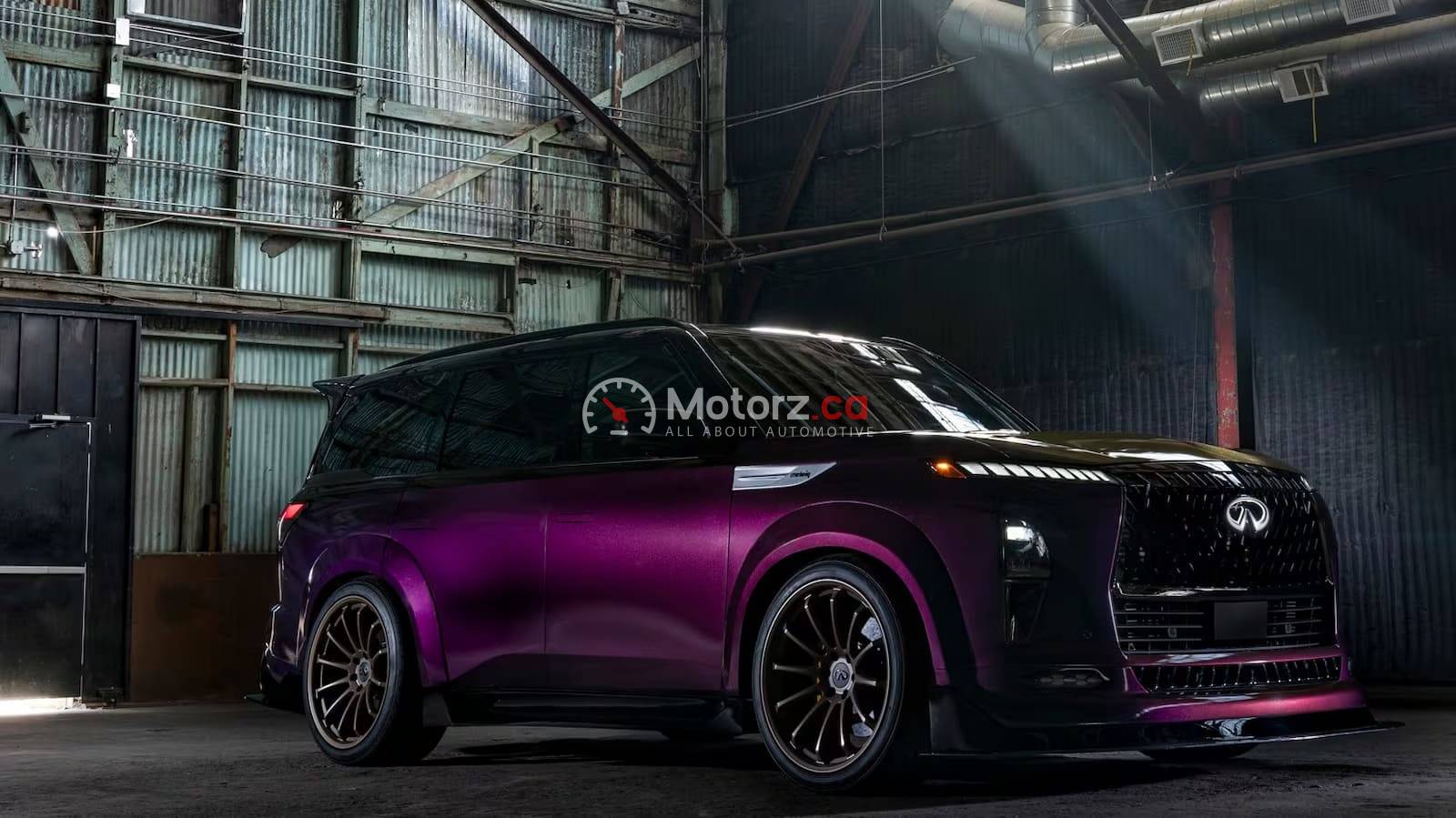
The clearest indication of what is coming is the QX80 Track Spec concept, which was displayed at Monterey Car Week, previewing the transformation of the brand’s new flagship SUV.
Power Upgrade: The concept featured the standard twin-turbo 3.5-liter V6, but engineers boosted the output from 450 hp.
This was achieved with comprehensive modifications including a new turbocharger system, a bigger intercooler, upgraded fuel injectors, and a performance exhaust.
The Escalade-V Rival: If this model reaches production around 2027, it would enter direct competition with the highly successful Cadillac Escalade-V and performance versions of the BMW X7 and Mercedes-Benz GLS-Class. Its rumored price point of around $150,000 further emphasizes its position in the upper echelon of the luxury SUV market.
Beyond the Engine: The concept also featured functional performance upgrades essential for handling the immense power, including Brembo brakes, 24-inch performance wheels, and an aggressive body kit with a rear diffuser and fender flares.
The Return of the Performance Sedan (Q50S)
Infiniti’s enthusiast legacy was built on the powerful G35 and G37, which were the original “Japanese BMW M3 fighters.” The brand plans to revive this legacy with the next-generation Q50 sedan.
Challenging the M3/AMG C63: The current Q50 Red Sport 400, while potent, is not a direct rival to the full-fat M and AMG models. The new performance variant, tentatively called the Q50S or an equivalent name under the new performance sub-brand, is expected to push power well beyond
targeting the same level of acceleration and track capability as the BMW M3 and Mercedes-AMG C63.
Enthusiast Focus: There are strong indications that Infiniti is exploring offering a manual transmission in this performance sedan, a move that would immediately appeal to purists and draw a clear line against German rivals who have largely abandoned the manual gearbox in their top-tier performance sedans.
The QX65 Crossover
The upcoming QX65 crossover, which will slot between the QX50 and QX60, is also slated to receive the high-output treatment.
Targeting the X4 M/GLC Coupe AMG: A performance version of the QX65 would put Infiniti squarely in competition with high-style, high-performance coupe crossovers like the BMW X4 M and the Mercedes-AMG GLC Coupe. This ensures the performance strategy covers the fastest-growing and most profitable luxury segment.
The Execution Challenge: Luxury Meets Raw Power
Infiniti’s challenge is two-fold: not only must they deliver the raw power to match the Germans, but they must also maintain the brand’s core identity of refined luxury and ride comfort.
The Engineering Tightrope
The engineering hurdle is balancing the extreme demands of track performance with the expectations of luxury buyers who use their cars daily.
Adaptive Suspension Dynamics: To achieve this balance, the new performance models will require highly sophisticated adaptive suspension systems that can instantly switch from comfortable daily cruising modes to aggressive, track-focused damping. This technology is expensive and crucial for successfully rivaling the M and AMG divisions.
Braking and Cooling: Delivering 650 horsepower reliably, especially in a heavy SUV like the QX80, requires massive, fading-resistant performance braking systems and completely redesigned cooling paths to manage the heat generated by the highly boosted engines. This is where the Nismo collaboration will be most vital.
The Aspirational Factor: Design and Interior
Performance credibility is built through numbers, but luxury desirability is built through design and cabin refinement.
Visual Aggression: The performance line will feature aggressive exterior styling—larger air intakes, deep spoilers, quad exhaust tips, and exclusive wheels—to visually communicate the car’s power, moving away from the more subdued aesthetics of the current Red Sport models.
Uncompromising Luxury: Inside, Infiniti must ensure the high-performance variants retain their reputation for premium, refined interiors. This means using high-quality materials like quilted leather, carbon fiber accents, and advanced, quiet cabin technology (like active noise cancellation) to deliver “ultimate performance” without compromising “luxury, quietness and fine design.”
A Make-or-Break Moment
Infiniti’s launch of a new, ultra-high-horsepower performance line is the most significant, high-stakes move the brand has made since its inception. By partnering with Nismo and committing to production models that are genuinely competitive on power
range and beyond), Infiniti is attempting to revitalize its image, draw enthusiast buyers, and create the essential “halo” effect needed to compete against the dominant German brands.
The limited production volume ensures exclusivity, but the success of the strategy ultimately rests on one thing: delivering on the promise of “True Performance.” If Infiniti can launch a production QX80 that drives like the 650 hp Track Spec concept, and a Q50 that truly feels like a rival to the M3, the brand will finally be able to reclaim its position as a serious contender in the upper echelon of the global luxury performance market. The fight for the luxury enthusiast’s dollar just got a lot more interesting.