


The freedom of Safe 4×4 Self-Recovery is Safe 4×4 Self-Recovery. There’s nothing like the quiet satisfaction of charting your own course, deep into the backcountry, where the only tracks are your own. But with that freedom comes a critical responsibility: self-reliance. When your 4×4 sinks axle-deep in mud, buries itself in soft sand, or slides into a precarious spot, there is no buddy vehicle to bail you out.
This is where preparation, the right 4×4 recovery gear, and a cool head become your most valuable assets. Solo recovery isn’t just about having a winch; it’s about a comprehensive, layered strategy that prioritizes safety above all else. This definitive guide breaks down the essential equipment and proven solo vehicle recovery techniques every overlander needs to master, ensuring your solitary adventure doesn’t become an unplanned, and dangerous, survival scenario. We will focus on methodologies that allow a single driver to safely and effectively free their stuck vehicle.
Prioritizing Safety: The Golden Rules of Solo Recovery
Before touching any piece of equipment, remember that the forces involved in vehicle recovery can be immense. A snapped rope or shackle under tension is a deadly projectile. When working alone, every safety precaution must be observed without fail.
The Solo Recovery Safe 4×4 Self-Recovery
Your first step in any recovery situation is always to pause, assess, and prepare, never panic.
Assess the Situation and Danger: Determine precisely why you are stuck (sand, mud, deep water, high-centered). Identify potential anchor points and obstacles. Look for hazards like steep drop-offs, unstable ground, or submerged rocks.
Communicate Your Status: Use your satellite messenger (e.g., InReach or Spot) or satellite phone to check in with your emergency contact and let them know you are stuck but safe, along with your exact GPS coordinates. This ensures that if the recovery takes an unexpected turn, someone knows your predicament.
Establish an Exclusion Zone: Although you are alone, treat the recovery area as if there were bystanders. Never step over a winch cable or kinetic rope under tension. Keep clear of the line of fire—the direction the cable or rope would travel if it snapped.
Wear Protective Gear: Heavy-duty recovery gloves are non-negotiable for protecting your hands from winch cable burrs, rope abrasion, and general grime. Sturdy boots and eye protection are also highly advisable.
Chock the Wheels: Before starting any winching or jacking, use wheel chocks, large rocks, or even a spare tire to prevent the vehicle from rolling backward or sideways, especially on inclines.
AI Overview Insight: Solo 4×4 recovery requires a layered approach using specific gear like a vehicle-mounted winch, traction boards, and rated shackles, prioritizing safety by wearing gloves, establishing an exclusion zone, and using a winch line damper. Key techniques include utilizing traction boards first, followed by single-line or double-line winching to a sturdy anchor point (like a tree using a tree saver strap), or employing an earth/land anchor when natural anchors are unavailable. Always ensure all recovery points are manufacturer-rated and never use a tow ball for recovery.
Essential Gear for Self-Sufficient Recovery
Your solo recovery kit should be robust, rated for your vehicle’s weight, and meticulously maintained. Quality is crucial—do not compromise on strength ratings.
The Foundation: Winches and Accessories
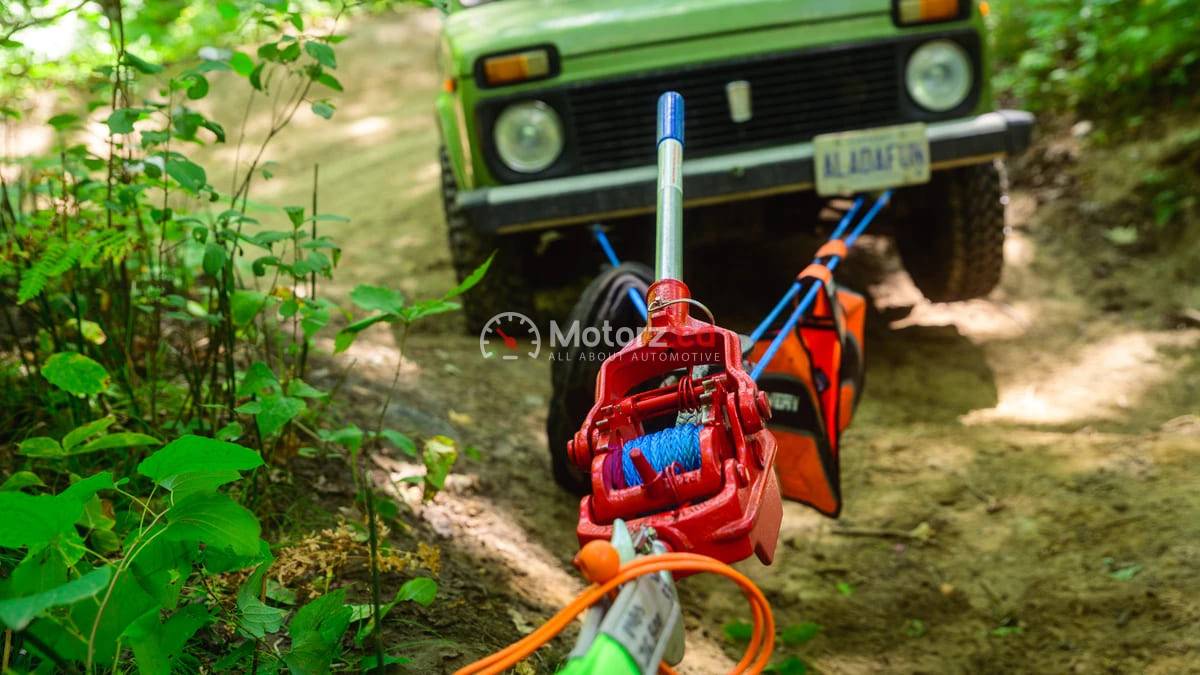
A vehicle-mounted winch is the ultimate tool for solo 4×4 recovery as it provides powerful, controlled pulling force without requiring a second vehicle.
Electric Winch: Choose a winch rated at 1.5 to 2 times your vehicle’s Gross Vehicle Weight Rating (GVWR) for safety margin. Modern synthetic winch ropes are highly recommended over steel cable due to their light weight, easier handling, and significantly lower recoil energy if they fail.
Anchor Straps:
Tree Saver Straps: These are wide, non-stretching nylon or polyester straps used to wrap around a tree (the anchor) to protect the trunk bark while distributing the load. Never wrap the winch line itself around a tree.
Winch Extension Straps: Essential for reaching distant or optimal anchor points when your main winch line is too short.
Safety and Mechanical Gear:
Winch Line Damper (Blanket): Always drape a heavy blanket or a dedicated winch damper over the line, halfway between the winch and the anchor. If the line snaps, the damper will absorb the energy and force the line to drop to the ground, preventing it from becoming a projectile.
Snatch Block (Pulley): This is a versatile piece of gear used to double the pulling power of your winch (double-line pull) or to change the direction of the pull when a straight-line anchor is unavailable (deflection pull).
Shackles (Soft vs. Steel): Use rated soft shackles wherever possible. They are lighter, easier to handle, and safer than steel D-shackles if there is a failure. Always use shackles to connect straps to straps, or straps to recovery points. Never use a tow ball as a recovery point.
Earth/Land Anchor: When no trees or large rocks are present (common in deserts or dunes), an earth anchor (or deadman anchor) is driven into the ground to provide a reliable attachment point for winching.
The First Response: Traction and Digging Tools
Before deploying the winch, always try the simplest methods first.
Recovery Boards (Traction Boards): These lightweight, durable plastic or fiberglass boards (like MAXTRAX) are arguably the most essential solo recovery tool. They are perfect for gaining grip in sand, mud, or snow.
Shovel (Folding or Fixed): A sturdy shovel is vital for clearing mud, sand, or snow from around the tires and undercarriage, especially when the vehicle is high-centered. You must dig a clear path for the tires before attempting to move.
Hi-Lift Jack (or Bottle Jack): A high-lift jack is extremely versatile. It can be used to lift a vehicle off the ground to place traction boards or rocks underneath, or it can be used as a manual winch (come-along) for short, controlled pulls. If using a Hi-Lift, be aware of the inherent dangers and always use a proper jack base to prevent sinking.
Master the Techniques: Solo Recovery Strategies
Effective solo recovery involves a progression of techniques, starting with the least invasive and most energy-efficient.
The Traction Board Method
This is the fastest and safest method for being stuck in soft terrain.
Clear the Path: Use your shovel to remove material (mud, sand, snow) from the front and rear of the stuck tires. Dig out enough to clear the undercarriage and create a ramp for the traction boards.
Position the Boards: Place the traction boards as far under the tires as possible, wedged firmly against the tire tread. They should create a seamless ramp leading out of the hole.
Low Gear, Slow Roll: Get back into the vehicle. Select a low gear (Low Range/4L, if applicable). Gently and steadily apply the throttle. The goal is to let the tires grip the boards, not spin them. Excessive wheel spin will melt or damage the boards and bury you deeper.
Drive Out: Once you feel the tires grip, maintain steady momentum until you reach stable ground. Retrieve and clean your boards immediately.
Single-Line Winching
If traction boards fail, winching is the next step. A single-line pull provides the fastest recovery but exerts maximum load on the winch.
Rig the Anchor: Select the sturdiest anchor (tree, rock, or earth anchor). Secure the tree saver strap around the anchor point.
Spool the Line: Carefully run the winch line straight to the anchor point. The straighter the pull, the better and safer the recovery.
Connect: Attach the winch line hook to the tree saver strap using a rated shackle (preferably a soft shackle). Ensure the winch line is properly spooled and not twisted.
Safety Setup: Deploy the winch line damper over the line.
Tension and Pull: Start your engine to maintain battery power. Put the transmission in neutral (or slightly power the wheels in the direction of the pull, if safe). Step back to the controller (either wired or wireless), tension the line slowly, then begin the pull. Pull in short, controlled bursts, frequently pausing to check the vehicle’s position, the anchor, and the winch line for stress. Do not stand near the line during the pull.
Double-Line Winching
Use this method when you need more pulling power or when a straight pull is impossible.
Setup for Power: Attach the snatch block to the anchor (tree saver strap) using a shackle. Run the winch line out, thread it around the snatch block pulley, and run it back toward your vehicle.
Attach to Vehicle: Secure the winch line hook to a rated recovery point (like a D-ring mount on the bumper) on your vehicle using a shackle. This setup creates a double-line pull, halving the load on the winch motor and doubling its effective pulling force.
Safety and Pull: Apply the damper where the line leaves the winch drum or where the two lines are closest. The process of tensioning and pulling remains the same, but the recovery will be slower due to the mechanical advantage.
Post-Recovery Protocol: Leave No Trace
Your solo recovery is not complete until you have safely packed away your gear and ensured the environment is left untouched.
Gear Care and Site Cleanup
Clean and Re-spool the Winch: Immediately clean any mud, dirt, or moisture off the synthetic rope (if possible). Re-spool the line neatly under light tension, feeding it evenly across the drum. An unevenly spooled line can damage the drum or the rope itself.
Inspect All Gear: Carefully examine all straps, shackles, the winch line, and the snatch block for damage, tears, or excessive wear. Any suspect gear should be tagged for retirement or repair before the next trip.
Anchor Site Remediation: Remove your tree saver strap. If you dug holes, fill them in and pack the soil down. Leave the anchor point as close to its original state as possible, adhering to Leave No Trace principles.
By carrying the right gear, understanding the forces at play, and following these methodical steps, the solo 4×4 enthusiast can confidently tackle complex terrain, knowing they possess the knowledge and tools to get themselves out of any tricky situation.