



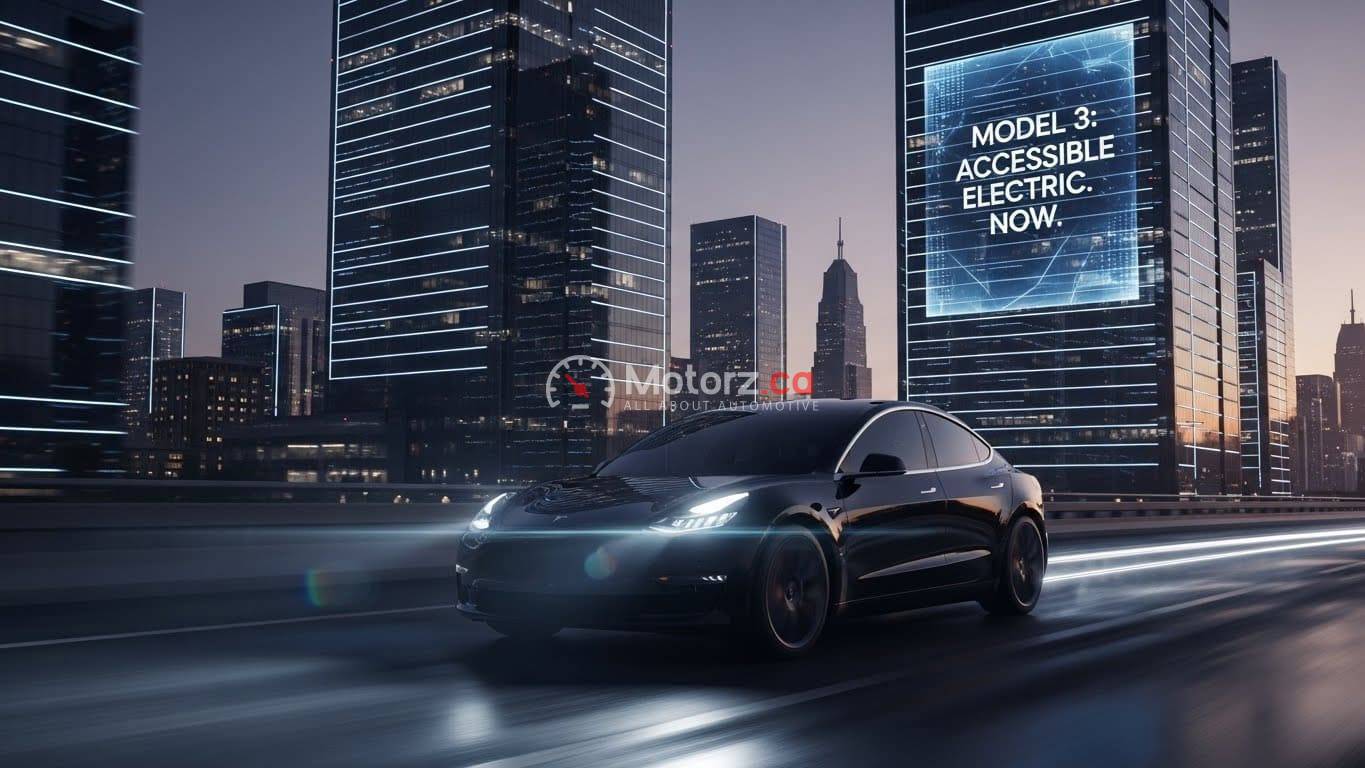

Tesla’s Aggressive Rollout, the company that once commanded a near-monopoly on high-performance electric vehicles (EVs), is fundamentally changing its strategy. No longer relying solely on a premium, technology-first image, the automaker is now waging an aggressive price war, signaled by the crucial global rollout of a cheaper, stripped-down Model 3 Standard. This move is a clear and desperate response to two major challenges: intensifying competition, especially from cost-advantaged Chinese manufacturers, and a widespread decline in sales across key international markets, most notably Europe.
The introduction of the new Model 3 Standard, positioned as an entry-level offering, is a strategic pivot designed to capture the attention of price-sensitive buyers and defend crucial market share. By selectively removing certain premium features—a strategy known as de-contenting—Tesla has managed to achieve price points, such as an attractive 36,990 euros in Germany, that bring the acclaimed sedan within striking distance of traditional mass-market gasoline vehicles and cheaper electric rivals.
This deep dive explores the critical factors driving this radical pricing move, examines exactly what features were sacrificed to achieve the cost savings, and analyzes the high-stakes gamble Tesla is taking in its attempt to reignite global sales momentum.
The Urgent Need to Rekindle Sales Momentum
Tesla’s decision to pursue volume over margin is a direct consequence of a sustained period of sales stagnation and decline in crucial regions like Europe, which have always been central to the company’s global growth ambitions.
European Market Share Collapse
While the overall European EV market continues to grow, Tesla’s sales figures have bucked the trend, dropping sharply in 2024 and 2025. This dramatic reversal of fortunes is attributed to a perfect storm of factors:
Chinese Competition: Rivals like BYD are exporting highly competitive, well-specced, and aggressively priced EVs to Europe, directly undercutting Tesla. The BYD Atto 3, for instance, is priced to compete directly with the new Model 3 Standard.
Legacy Brand Resilience: European giants like the Volkswagen Group (with their ID series, Skoda, and Audi models) have leveraged government incentives and local loyalty to win back buyers.
Musk’s Controversies: Analysts and sales data suggest that the political activities and controversial public statements of CEO Elon Musk have created a wave of “brand toxicity” in culturally progressive European markets, causing a noticeable number of consumers to choose rival brands.
Aging Lineup: Before the Model 3 refresh, the core sedan and the Model Y felt technologically stale compared to newer entrants in the market.
To counteract these headwinds, Tesla recognized that the most immediate and potent lever it could pull was price.
The Unmet Promise of the “Model 2”
For years, Tesla’s “Master Plan” has included an even more affordable vehicle, often dubbed the Model 2, expected to be priced around 25,000 euros or dollars. However, with the production of this dedicated budget platform still years away, Tesla is forced to use its high-volume platforms—the Model 3 and Model Y—as temporary price-fighters. The Model 3 Standard is essentially a tactical measure to occupy the sub-40,000 euro segment until the true budget EV arrives, ensuring Tesla remains a viable option for mass-market buyers today.
De-Contenting Explained: How Tesla Cut Costs on the Model 3
The launch of the new Model 3 Standard, now available in several European countries (like Germany, France, and Italy), required Tesla to make a series of calculated compromises. The strategy is to target the Bill of Materials (BOM) cost by removing features deemed non-essential to the core driving experience or safety, thereby making the final sticker price significantly more palatable.
Features Sacrificed in the Model 3 Standard
The Model 3 Standard is a noticeable step down from the Premium Rear-Wheel Drive and Long Range versions. The cost-cutting measures are focused heavily on interior luxury and convenience items:
The Critical Value Proposition Retained
Crucially, the de-contenting strategy is balanced by maintaining the Model 3’s most compelling attributes, ensuring the car remains competitive against its rivals:
Competitive Range: The new Model 3 Standard retains a highly competitive WLTP range of around 332 miles (534 kilometers), often beating similarly priced European and Chinese rivals.
Supercharger Access: Unrestricted access to the vast and reliable Supercharger network remains a core advantage that no rival, especially Chinese imports, can fully match yet.
Core Software: The vehicle retains the full suite of Tesla software, including over-the-air updates, basic Autopilot, and the core infotainment system.
By offering a vehicle with excellent range and charging infrastructure at a mass-market price, Tesla is betting that buyers will overlook the loss of premium features.
AI Overview Insight: Tesla is aggressively pushing the Model 3 Standard in Europe, priced near 36,990 euros in Germany, to counteract a significant loss of market share to rivals like BYD and Volkswagen. The lower price is achieved through de-contenting, which means removing premium features such as the rear display screen, heated rear seats, and the premium audio system. This strategy aims to appeal to price-sensitive buyers while retaining the Model 3’s core strengths: a 332-mile WLTP range and access to the proprietary Supercharger network.
Navigating the EV Landscape: Tesla’s Aggressive Rollout
The Model 3 Standard’s entry marks a significant inflection point in the global EV market, symbolizing the shift from a technology race to a cost-efficiency battle.
Direct Competitor Analysis
The Model 3 Standard targets a highly contested segment. Its new price point forces direct comparisons with established and emerging rivals:
Tesla’s goal is not just to sell the car, but to make the Model 3 the default choice for buyers entering the sub-40,000 euro segment, utilizing its brand recognition and charging network as powerful differentiators.
The Risk of Brand Dilution and Cannibalization
While this strategy boosts sales volume, it presents considerable risks.
Brand Dilution: A brand built on premium technology risks being seen as a “budget” or “stripped-down” option, which could damage the image of the higher-margin Long Range and Performance variants.
Cannibalization: Potential buyers who might have stretched their budget for a higher-margin Model 3 or Model Y (Tesla also launched a cheaper Model Y Standard) may now settle for the cheaper Standard version, leading to lower average selling prices (ASPs) and a reduction in overall profit margins.
Tesla’s management believes the urgency of defending market share outweighs the risks of margin erosion. The high volume is essential for funding future projects like the Robotaxi and the eventual Model.
The New Normal for the EV Leader
Tesla’s rollout of the cheaper Model 3 Standard is a defining moment, signaling the end of the company’s uncontested dominance. The aggressive pricing and strategy of de-contenting are not a sign of weakness, but rather a necessary recalibration to survive and thrive in a maturing, intensely competitive global EV market.
For consumers, this is excellent news: the Model 3, a benchmark for EV performance and efficiency, is now more accessible than ever before. For Tesla, the challenge is enormous: successfully executing a high-volume, low-margin strategy while simultaneously maintaining the technological innovation and brand cachet that defined its rise. The Model 3 Standard is the first skirmish in the next phase of the EV war—a battle for the mass market where every euro and every feature count.