


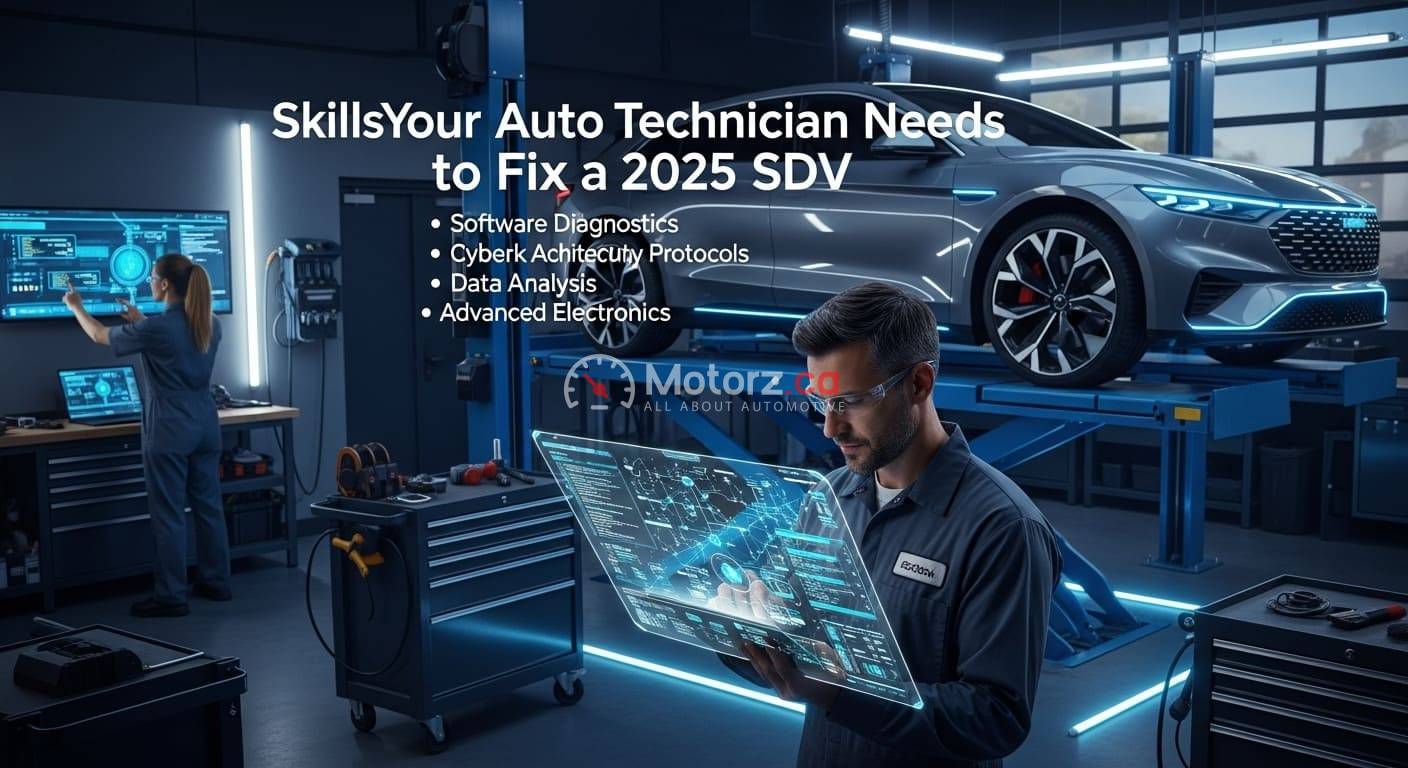

The year 2025 marks a major inflection point in Auto Technician history. The car is no longer just a machine; it is a Software-Defined Vehicle (SDV)—a sophisticated, connected, and continually evolving computer on wheels. For the skilled automotive technician, this revolution means the job has fundamentally changed. The traditional “wrench-turner” is being replaced by the modern diagnostician, a professional who must be as comfortable with code and network protocols as they are with engine timing and torque specifications.
Fixing a 2025 SDV requires a hybrid set of expertise. It demands a seamless integration of classic mechanical knowledge with advanced digital proficiency. When that check engine light illuminates in an SDV, the issue is often a software glitch or a sensor malfunction, not a purely mechanical failure. For repair shops and technicians to remain competitive and Auto Technician, they must master a new curriculum of skills.
This post outlines the essential competencies required for the new mechanic—the expert ready to tackle the challenges of the 2025 SDV.
Mastering Auto Technician Diagnostics and Flashing
The heart of the Software-Defined Vehicle is its central computing architecture and the vast network of Electronic Control Units (ECUs) it manages. Traditional OBD-II scanners can only scratch the surface. The modern mechanic needs to go far deeper.
Advanced Diagnostic Tool Proficiency
Technicians must be experts in using professional-grade scan tools, such as the latest Autel or Innova professional platforms. These tools provide comprehensive, bi-directional control, allowing the mechanic to communicate directly with all vehicle systems—engine, ABS, airbags, transmission, and more. This goes beyond reading a generic code; it involves analyzing live data streams, interpreting manufacturer-specific codes, and running sophisticated Auto Technician tests to pinpoint the exact line of code or sensor input causing a fault.
Firmware and Software Update Management
SDVs receive Over-The-Air (OTA) updates for bug fixes, feature enhancements, and performance improvements, much like a smartphone. However, a repair procedure might require a specific firmware flash or a complete system re-initialization after a component replacement. The new mechanic must:
Safely and securely manage these updates.
Troubleshoot issues that arise during or after a software update.
Understand the vehicle software architecture to know which module controls which function.
The ability to correctly flash a new Auto Technician or update a vehicle’s operating system is now a core competency, requiring a reliable network connection and meticulous attention to OEM-specific protocols.
Automotive Cybersecurity Awareness
With every vehicle becoming a connected device, cybersecurity is no longer a niche IT concern—it is a critical safety and data issue for the auto shop. A vehicle’s software is vulnerable to hacking or unauthorized access, which could lead to safety issues or the manipulation of sensitive vehicle data.
Secure Access Protocols
When diagnosing an SDV, the mechanic must follow strict, secure protocols established by the Original Equipment Manufacturer (OEM). This includes understanding:
Encrypted communication protocols used to protect data transmission between the vehicle and the diagnostic tool.
The process for obtaining secure gateway access to the vehicle’s network, which often requires a validated user identity to prevent unauthorized code injection or data tampering.
Data Integrity and Tampering Prevention
Mechanics are responsible for ensuring the integrity of the vehicle’s software. This means protecting it from counterfeit diagnostic tools that could introduce vulnerabilities, and ensuring that critical data—such as battery health, fault history, and calibration settings—is accurate and untampered with. They must view the vehicle not just as a mechanical system, but as a mobile data center that needs continuous protection from intrusion and data breaches, adhering to global standards like UN Regulation No 155.
Expertise in Advanced Driver Assistance Systems
ADAS (Advanced Driver Assistance Systems)—features like automatic emergency braking, lane-keeping assist, and adaptive cruise control—are standard on 2025 SDVs. These safety systems rely on an array of cameras, radar, LiDAR, and ultrasonic sensors, and any repair involving a bumper, windshield, or suspension component will require precise ADAS calibration.
Sensor and Camera Calibration Mastery
The new mechanic must be a specialist in ADAS calibration. This requires:
Using sophisticated calibration equipment and OEM-specified targets.
Following precise alignment procedures to ensure sensors are aimed correctly.
Understanding the system interdependencies—for example, a wheel alignment adjustment could affect the steering angle sensor, which in turn necessitates ADAS recalibration.
Diagnostics of Sensor-Based Systems
A fault in an ADAS system might present as a simple warning light, but the underlying issue could be a dirty radar sensor, a damaged camera bracket, or a software communication error. Technicians need specialized skills to:
Diagnose hardware faults in LiDAR and radar units.
Troubleshoot visual processing software issues reported by the camera system.
Verify the operation of sensor fusion—the intelligent process of combining data from multiple sensors for an accurate environmental picture.
High-Voltage and Electric Vehicle (EV) System Safety
While not all 2025 SDVs are purely electric, the fundamental shift toward electrified powertrains means every modern technician must possess a foundational knowledge of high-voltage systems.
High-Voltage Safety Procedures
Working on an Electric Vehicle or Hybrid SDV requires absolute adherence to strict high-voltage safety protocols. Technicians must be trained and certified to:
Safely de-energize (or ‘lock out/tag out’) the vehicle’s high-voltage battery system.
Use specialized, insulated tools and personal protective equipment (PPE).
Understand the physics and risks associated with high-voltage electricity (typically between 300 and 800 volts).
Battery Management System (BMS) Diagnostics
The Battery Management System (BMS) is a software-intensive component that monitors and controls the health, temperature, and charging of the battery pack. When a charging or range issue occurs, the mechanic must:
Interpret BMS diagnostic codes to identify faulty cells or temperature anomalies.
Be able to perform battery state-of-health (SOH) checks to assess its long-term performance.
Troubleshoot the complex software that governs the vehicle’s thermal management and charging communication protocols.
System Integration and Network Troubleshooting
The modern vehicle is a network of interconnected components, making network diagnostics as important as engine diagnostics. The central computing architecture means a single fault in one system can cascade and affect seemingly unrelated functions.
CAN Bus and Automotive Ethernet Expertise
Technicians must understand the various in-vehicle networks, including the classic Controller Area Network (CAN) bus and the newer, high-speed Automotive Ethernet. This includes:
Diagnosing network communication failures that appear as “no communication” fault codes.
Using oscilloscopes to analyze network signal integrity and troubleshoot physical wiring issues that impact data packets.
Understanding domain controllers and zonal architectures, which consolidate functions into central computer units, changing how power and data are distributed.
Blending Mechanical and Digital Troubleshooting
The new mechanic’s greatest skill is the ability to fuse mechanical and digital logic. When diagnosing a performance issue, they must ask:
Is the physical problem (e.g., poor engine timing) causing a software fault, or is a software error commanding the physical component to behave incorrectly?
How does the software logic interact with the physical sensor input?
This is a holistic approach, where the technician moves seamlessly from reviewing live data streams on a laptop to inspecting a harness connection or a hydraulic line.
Continuous Learning and Information Management
The most important skill for a mechanic in the SDV era is the commitment to continuous learning. Vehicle technology is changing at a rapid, almost monthly pace. A certification earned today may be obsolete in three years.
Proactive Training and Certification
The successful SDV technician will:
Regularly attend OEM-specific training courses for new model releases and software platforms.
Pursue specialized ASE certifications in areas like Advanced Level Specialist (L1, L2, L3) and EV/Hybrid systems.
Invest time in understanding the fundamental principles of AI and machine learning algorithms that power autonomous features and predictive maintenance.
6.2. Digital Information Fluency
Repair information is no longer confined to thick service manuals. It is a dynamic, subscription-based, online ecosystem. The new mechanic must be proficient in:
Navigating complex OEM repair portals for up-to-the-minute technical service bulletins (TSBs).
Utilizing digital repair manuals and schematics that are constantly being updated with new software revisions.
Effectively querying technical databases to find proven fixes and diagnostic pathways developed by the automotive repair community.