


Beyond the EV Hype: Toyota’s Strategy for a World That Can’t Agree on Clean Energy
The Chameleon Car is not just a car; it is a global economic phenomenon. With over 50 million units sold across 12 generations, it is the benchmark for affordable, reliable, mass-market transportation. So, when Toyota unveils a Corolla Concept previewing the next generation, the industry listens.
However, the latest concept, unveiled at the Japan Mobility Show, is significant not for what it is, but for what it can be. This is not a single-solution vehicle; it is a clean, bold statement of extreme flexibility, designed to accommodate almost every powertrain technology Toyota currently offers or is developing.
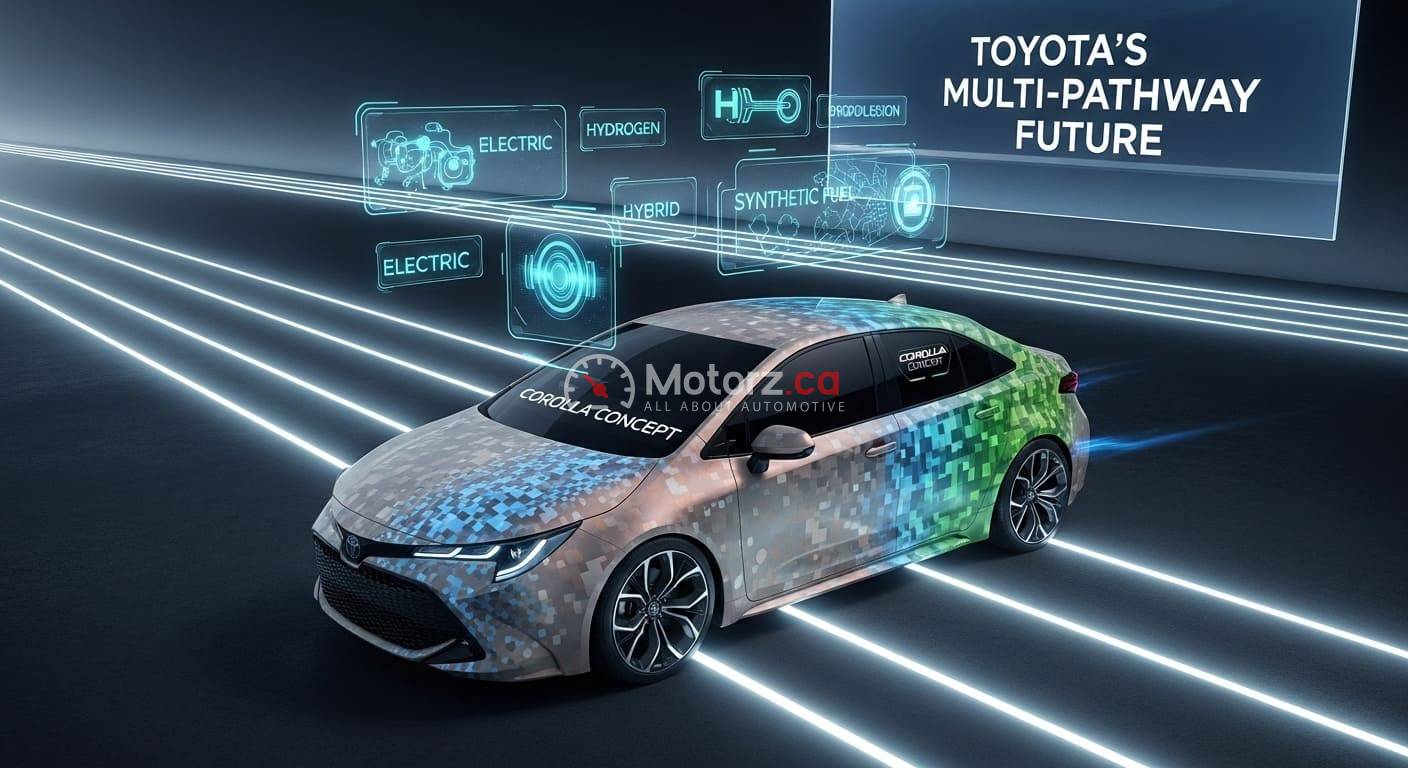
The new Corolla Concept embodies Toyota’s controversial yet strategically crucial “Multi-Pathway Approach” to carbon neutrality. In an era where many rivals are aggressively betting everything on Battery Electric Vehicles (BEVs), Toyota is planning to build its best-selling model on an architecture that can house traditional gasoline, strong hybrid (HEV), plug-in hybrid (PHEV), pure EV, and even hydrogen fuel cell (FCEV) or combustion engines.
This concept proves that Toyota believes the path to a carbon-neutral future is not a straight line, but a customized journey tailored to the unique energy infrastructures, customer needs, and economic realities of over 170 markets worldwide.
The Core Strategy: The Multi-Pathway Approach
Toyota’s philosophy is rooted in pragmatism: instead of forcing one technology (BEV) onto the world, it offers a “full array of powertrains” to reduce carbon emissions today, using the most optimized solution for any given market.
Flexibility as the Global Solution
The Corolla Concept directly addresses the fragmented nature of global energy transition, ensuring the world’s best-selling car remains accessible everywhere.
Market Segmentation: In regions with robust charging networks and government subsidies (like parts of Europe and California), the Corolla can be offered as a pure BEV. In markets with weak grid infrastructure or high electricity costs (like parts of Asia and the Global South), the Hybrid (HEV) remains the most practical and immediate way to cut fossil fuel consumption.
Hydrogen Readiness: The concept’s design is engineered to even accommodate the tanks and systems required for a hydrogen fuel cell or the experimental hydrogen combustion engine—technologies Toyota is actively racing and developing as alternatives to pure battery power, particularly for commercial or high-utilization fleets.
Zero Compromise Packaging: A key insight revealed by Toyota is that the flexible platform ensures the vehicle’s proportions and interior space will not change regardless of the powertrain. A hybrid Corolla will have the same trunk space as a pure EV Corolla. This commitment to standardized dimensions ensures maximum value and practicality for the consumer, removing the traditional packaging compromises found in platform-sharing vehicles.
The Economic Rationale for Mass Production
From a manufacturing standpoint, this flexibility is a masterstroke of cost management and risk mitigation.
Shared Component Scaling: By maintaining a common architecture for the Corolla, Toyota can achieve massive economies of scale on structural parts, body panels, and interior components, regardless of whether a car receives a battery pack or a traditional fuel tank. This drastically reduces development costs and manufacturing complexity compared to having entirely separate platforms for ICE and EV models (like GM’s Ultium or Volkswagen’s MEB).
Adaptable Factories: The “multi-pathway” strategy allows existing factories to flexibly switch production between hybrid, gasoline, and EV models based on real-time market demand. If EV adoption surges in North America, Toyota can ramp up BEV production without costly, multi-year retooling for an entirely new platform. If hybrid demand explodes in Southeast Asia, production shifts to HEVs.
Design and Technology: A Modern, Aerodynamic Corolla
While the architecture is focused on engineering flexibility, the aesthetic and technological elements of the Corolla Concept signal a dramatic modernization of the iconic model.
Shedding the Sedan Stereotype
The concept introduces a sleek, sculpted body that fundamentally changes the perception of the Corolla from an economical sedan to an athletic, aerodynamic liftback or coupe-like saloon.
The Hammerhead Face: The front design adopts Toyota’s newest corporate face—the aggressive, low-slung “Hammerhead” motif first seen on the Prius and bZ4X. This design not only looks modern but is highly aerodynamic, a crucial factor for maximizing range in any electrified powertrain.
Full-Width Lighting: The lighting signature is bold and sophisticated, featuring full-width LED light bars at both the front and rear. This connects the Corolla visually to the premium segment and establishes a distinctive, recognizable nighttime signature.
Sleek Proportions: The design features a dramatically lower windscreen, flush door handles, and a streamlined roofline that tapers into a short, integrated ducktail spoiler. The overall effect is one of motion and high efficiency, appealing to a younger, design-conscious demographic.
The Digital-First Cabin Experience
The interior is equally revolutionary, embracing a minimalist, high-tech approach while retaining a focus on usability—a key requirement for a global mass-market car.
Dual Digital Displays: The concept moves past the single-screen paradigm, showcasing two large digital displays: one column-mounted screen for the driver’s instrumentation and a separate, larger central screen for infotainment and navigation. Some variants may even include a passenger display, pushing tech down from the luxury segment.
Clean Ergonomics: The dashboard emphasizes simplicity and horizontality, with vents and controls cleanly integrated to create a feeling of spaciousness. Toyota maintains its reputation for straightforward ergonomics, avoiding the overly complex touch controls that have frustrated users in competing brands.
Software-Defined Updates: The flexibility extends to software. The new architecture is designed to integrate Toyota’s Arene operating system (OS), allowing the vehicle to receive Over-The-Air (OTA) updates. This is critical for keeping the vehicle’s features, safety systems, and value proposition fresh throughout what Toyota plans to be a longer generational lifecycle (reportedly up to nine years for some models).
The Competitive Edge: Responding to BYD and Global Competition
The Corolla Concept is Toyota’s response to the rapidly accelerating global competition, particularly from Chinese EV giants like BYD, which have achieved remarkable efficiency with their own dedicated hybrid and electric platforms.
The Efficiency Race
Toyota must prove that its multi-pathway strategy can compete on efficiency and cost with pure EV platforms.
Next-Gen Hybrid Systems: The concept’s platform is designed to house Toyota’s next-generation modular gasoline engines, including a rumored new 1.5-liter hybrid system. These new engines target improved thermal efficiency (aiming to close the gap on rivals that have surpassed Toyota’s current hybrid efficiency), driving down fuel consumption and carbon emissions even in non-plug-in models.
PHEV Range Ambition: Japanese press reports suggest the new Corolla Plug-in Hybrid (PHEV) is targeting a massive 2,100 km (1,300 miles) of combined range (fuel tank plus battery). This huge range directly counters the “range anxiety” often associated with pure EVs and positions the PHEV as the ultimate long-distance, low-emission global commuter.
The Mobility for All Vision
Ultimately, the Corolla Concept reinforces the corporate mission of “Mobility for All,” which guides Toyota’s entire strategy.
Affordability: By reusing core architecture and minimizing the cost of technological transition, Toyota aims to keep the price of the Corolla accessible. This is the single most important factor for success in emerging global markets where EVs remain prohibitively expensive.
Sustainable Solutions: Toyota’s leadership argues that using hybrids to cut emissions in every market—especially those where grid electricity is still generated by coal—results in a lower overall carbon footprint today than a slower transition to pure EVs. The flexibility of the Corolla is designed to achieve carbon reduction where it’s most needed and most practical.
Conclusion
The Toyota Corolla Concept is a monumental piece of strategic planning disguised as a sedan. It is the physical manifestation of Toyota’s belief that there is no one-size-fits-all solution for carbon neutrality. By engineering the world’s most popular car to be everything to everyone—a pure EV for California, a highly efficient hybrid for Indonesia, and a fuel-flexible machine for South America—Toyota secures its massive global market share for the next decade.
The flexibility embedded in the Corolla’s architecture is not a sign of technological hedging; it is a shrewd global business plan designed to maintain profitability and meet diverse customer needs while systematically reducing global carbon emissions at the pace each market can sustain. The Corolla remains, and will continue to be, a car for everyone, regardless of where they live or how they choose to power their journey.