
Canada has no single nationwide winter-tire season. For 2026–27, Quebec requires compliant winter tires on vehicles registered in the province from December 1 to March 15, while British Columbia requires qualifying tires on designated signed routes from October 1 to March 31 or April 30, depending on the route.
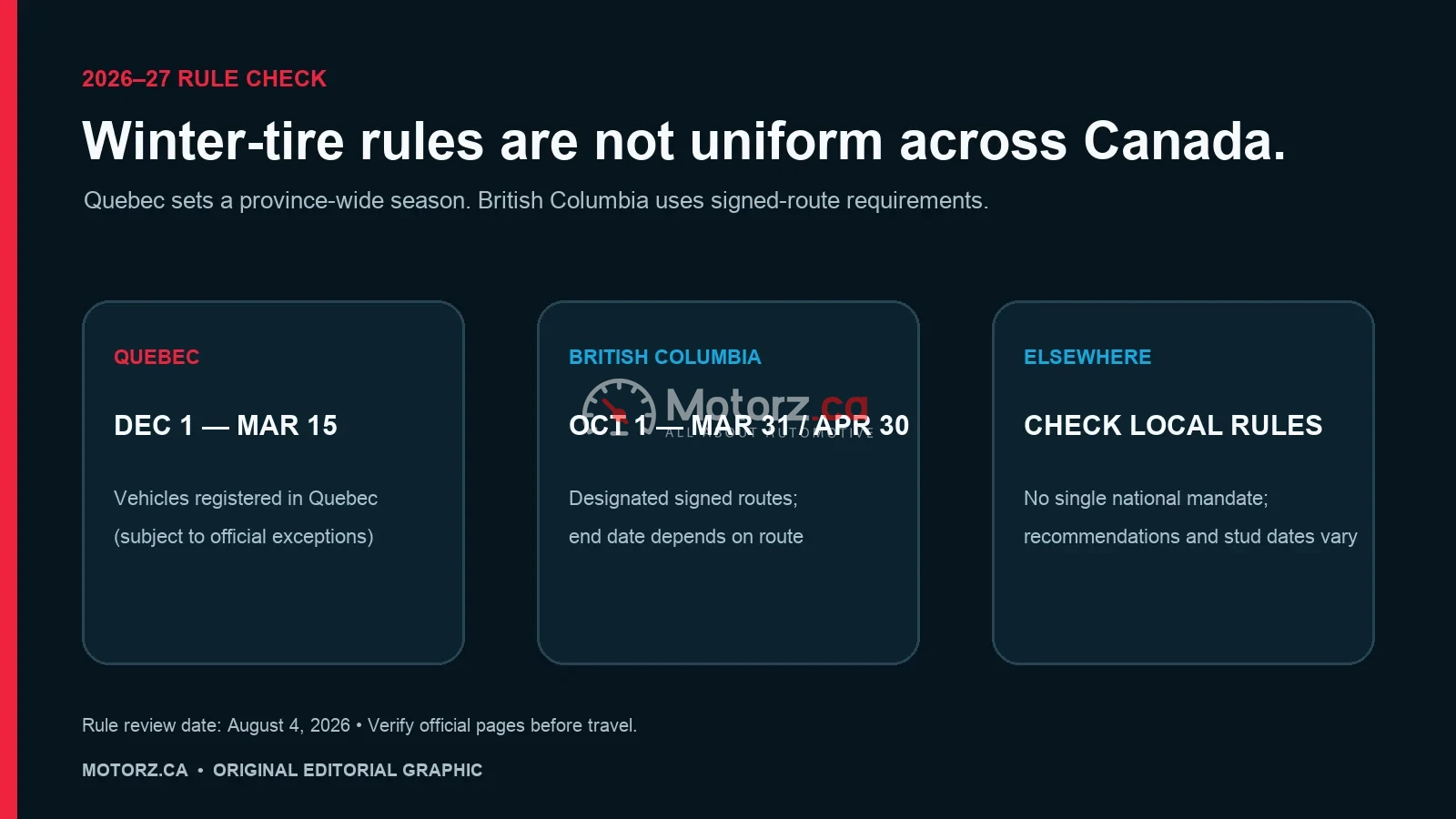
Elsewhere, recommendations, insurance discounts, studded-tire dates and route-specific controls can differ. Drivers should check the official rules for the province or territory where the vehicle is registered and every route they plan to travel.
Quebec: a province-wide seasonal requirement
The Government of Quebec says motor vehicles registered in Quebec, including rental vehicles, must have compliant winter tires from December 1 through March 15. The rule does not apply to trailers or vehicles registered outside Quebec, and the official page lists other exceptions and limited exemption certificates. A driver who does not comply may face a $200 to $300 fine.
A compliant tire must carry the peaked-mountain-and-snowflake pictogram or be studded where permitted. Quebec allows studded tires on qualifying passenger vehicles from October 15 to May 1. Drivers should read the exception conditions rather than relying on a summary when buying, selling, leasing or moving a vehicle.
British Columbia: requirements follow designated routes
British Columbia uses winter-tire and chain-up signs on designated routes. The province’s route maps identify highways where the requirement runs from October 1 to March 31 and routes where it extends through April 30. Drivers must obey the sign on the road; the end date is not identical everywhere.
British Columbia’s enforcement page cites a $121 contravention when a passenger vehicle is not equipped as required. The province’s legal minimum and Transport Canada’s severe-snow recommendation are not necessarily the same purchase decision, so drivers should confirm the tire marking, tread and route before travel.
What drivers should know elsewhere
Ontario recommends winter tires and requires insurers to offer a classification discount for qualifying private passenger automobiles equipped with them, but the provincial winter-driving page does not state a province-wide passenger-vehicle tire mandate. Newfoundland and Labrador’s official seasonal rule permits studded tires from November 1 to April 30; that stud window is not itself a requirement to use winter tires.
Rules for studs, chains, mountain routes, commercial vehicles and local roads can differ across the remaining provinces and territories. This article does not convert “no province-wide mandate identified” into “no winter rule.” A road sign, emergency order or vehicle class may impose an additional requirement.
The tire marking and installation guidance
Transport Canada recommends looking for the three-peak mountain-and-snowflake symbol. It says all-season and summer tires begin losing elasticity below 7°C, while winter tires retain grip at lower temperatures. For stability, install four tires of the same type, size, speed rating and load index rather than mixing tread patterns or constructions.
- Check the tire-information label or owner’s manual for the correct size and pressure.
- Measure pressure when the tires are cold; pressure falls as temperature drops.
- Transport Canada advises against using tires close to 4 mm tread depth on snow-covered roads and says not to use less than 4 mm in severe snow conditions.
- Use the province’s current map or route notice before a mountain or intercity trip.
- Check the exact start and end dates for studded tires before installation or removal.
Winter tires support traction but do not cancel the need to slow down, leave more following distance and adjust travel to conditions. Motorz.ca also has a guide to choosing the right winter-tire type and a checklist for building a winter emergency kit.
Official sources and limitations
The rule check uses the Government of Quebec’s winter-tire requirements, British Columbia’s designated winter-tire route maps and enforcement page, Ontario’s official winter-driving guidance, Newfoundland and Labrador’s official studded-tire advisory, and Transport Canada’s winter-tire guidance.
This is general public information, not legal advice. Temporary orders and road signs can supersede a general summary. Verify the applicable official page before travelling.
Rule-review note: Reviewed August 4, 2026. Scheduled review October 8, 2026, and immediately if a province changes its dates, tire definition, exemptions or enforcement guidance.
Where provincial rules allow them, our studded-versus-studless guide explains the traction and pavement tradeoffs. Read the focused Motorz.ca guide.
n