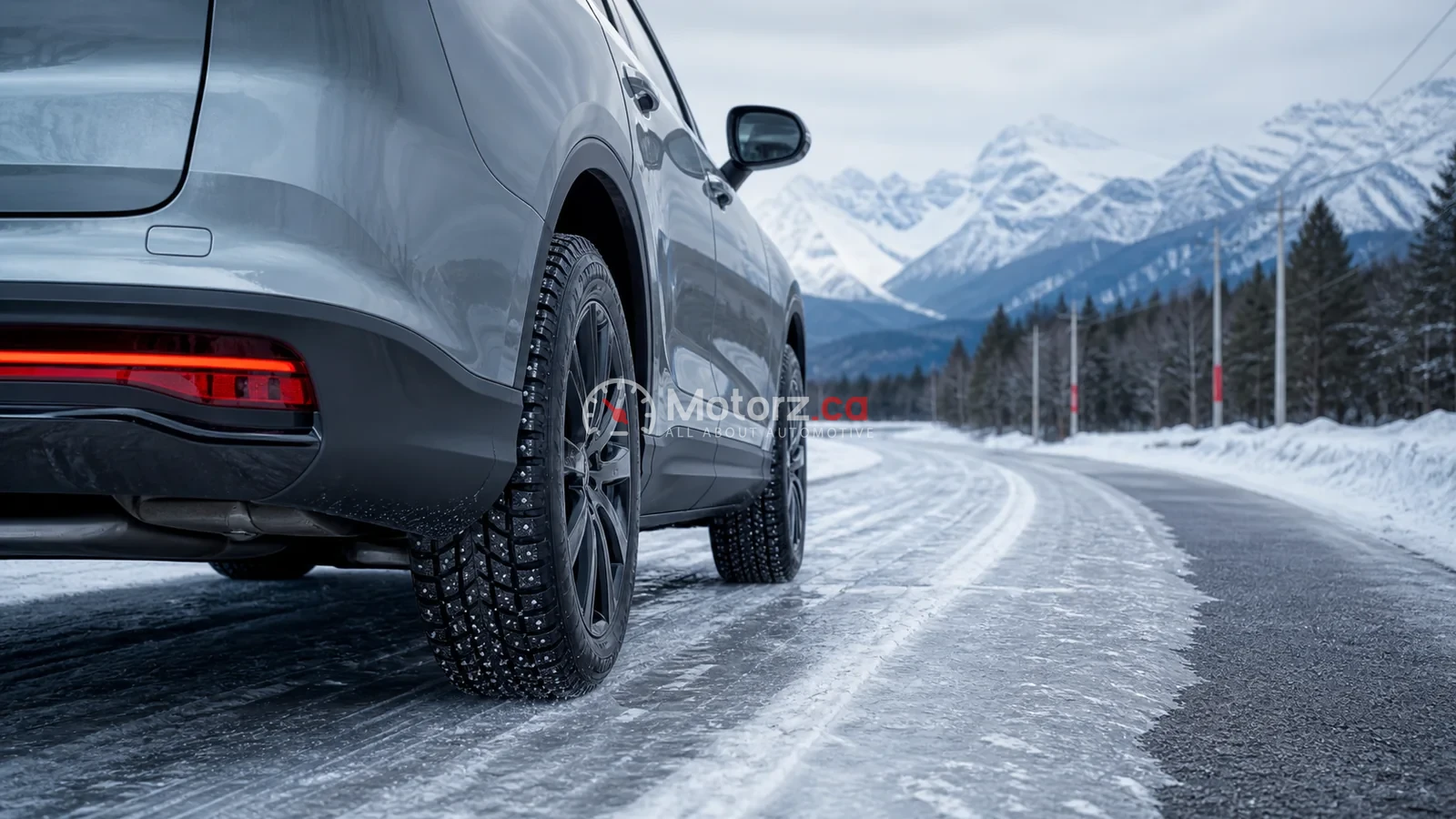
Direct answer: Studded winter tires can be worth it for drivers who regularly face polished ice or wet ice near freezing and whose province permits them. For mostly plowed, bare or wet pavement, a high-quality studless winter tire is usually quieter, less damaging to roads and often the better all-round choice. Rules and permitted dates vary across Canada.
Studded versus studless winter tires
| Condition | Studded winter tire | Studless winter tire | Decision factor |
|---|---|---|---|
| Polished/wet ice | Metal studs can add mechanical bite | Modern compounds and sipes still provide useful grip | Frequent ice exposure is the strongest case for studs. |
| Packed snow | Strong winter tread; studs may add little | Strong when marked for severe snow service | Tread design matters more than studs alone. |
| Bare dry/wet pavement | Noisier; grip can be worse in some conditions | Usually smoother and quieter | Typical plowed-city driving often favours studless. |
| Road impact | Greater pavement wear | Lower pavement impact | Explains seasonal restrictions. |
Ontario’s winter-driving guidance says studs provide stopping distances similar to winter tires in most conditions and are less effective on bare pavement. Saskatchewan Government Insurance notes their advantage is strongest on wet ice near zero. Tire performance also depends on temperature, age, tread depth, inflation and vehicle stability systems.
Official rules confirmed for selected jurisdictions
| Jurisdiction | Current official rule summarized | Source checked |
|---|---|---|
| Alberta | No provincial rule specifically prohibits studs, but roadway-damage provisions still apply. | Alberta Transportation winter-tire guidance |
| Manitoba | Permitted October 1 through April 30, subject to stud specifications. | Vehicle Equipment, Safety and Inspection Regulation |
| Ontario | Restricted to eligible Northern Ontario residents/vehicles and qualifying visitors; seasonal and equipment conditions apply. | Ontario tire regulation and winter-driving guidance |
| Quebec | Permitted October 15 to May 1 for eligible passenger vehicles, taxis and qualifying commercial vehicles. | Government of Quebec winter-tire requirements |
| New Brunswick | Permitted October 15 to May 1. | New Brunswick Public Safety |
| Nova Scotia | Permitted October 15 to May 31, subject to stud specifications. | Nova Scotia Studded Tires Regulations |
| Prince Edward Island | Permitted October 1 to May 31. | Government of PEI 2026 advisory |
| Newfoundland and Labrador | Permitted November 1 to April 30 unless an official extension is announced. | Service NL advisory and Highway Traffic regulations |
Important: This table is not a substitute for checking the law before installation or travel. Municipal rules, vehicle weight, residency, stud construction and announced seasonal extensions can change the result. For British Columbia, Saskatchewan and the territories, confirm the current rule directly with the road authority before fitting or travelling on studs.
Who is most likely to benefit?
- Drivers on rural or northern routes with persistent ice.
- Regions with frequent freeze-thaw cycles and wet ice.
- Essential travel where waiting for improved road conditions is often impossible.
- Vehicles legally operated within a jurisdiction’s permitted season and equipment rules.
Who should usually choose studless?
- Urban drivers mainly using regularly plowed roads.
- Drivers who cross jurisdictions with different rules.
- Anyone prioritizing lower noise and better bare-pavement manners.
- Drivers whose ice exposure is occasional rather than routine.
Buying and use checklist
- Verify provincial/territorial dates and vehicle eligibility before purchase.
- Install four matching winter tires; do not mix traction types.
- Confirm vehicle, wheel and tire compatibility.
- Monitor pressure and tread through the season.
- Remove studs by the legal deadline.
- Drive to conditions; studs do not eliminate stopping distance.
Bottom line
Studs are a specialized ice tool, not an automatic upgrade over every winter tire. Choose them only when the route, climate and law create a clear case; otherwise, a modern studless winter tire is the more flexible Canadian solution.
Disclosure: Motorz.ca did not perform tire-traction testing. Rules were checked against official sources available on the article’s update date.
Sources
- Alberta Transportation — winter tire guidance
- Manitoba — Vehicle Equipment, Safety and Inspection Regulation
- Ontario — winter driving and studded tires
- Ontario — tire standards regulation
- Quebec — winter tire requirements
- New Brunswick — winter driving safety
- Nova Scotia — Studded Tires Regulations
- Prince Edward Island — 2026 studded-tire advisory
- Newfoundland and Labrador — studded-tire season advisory