


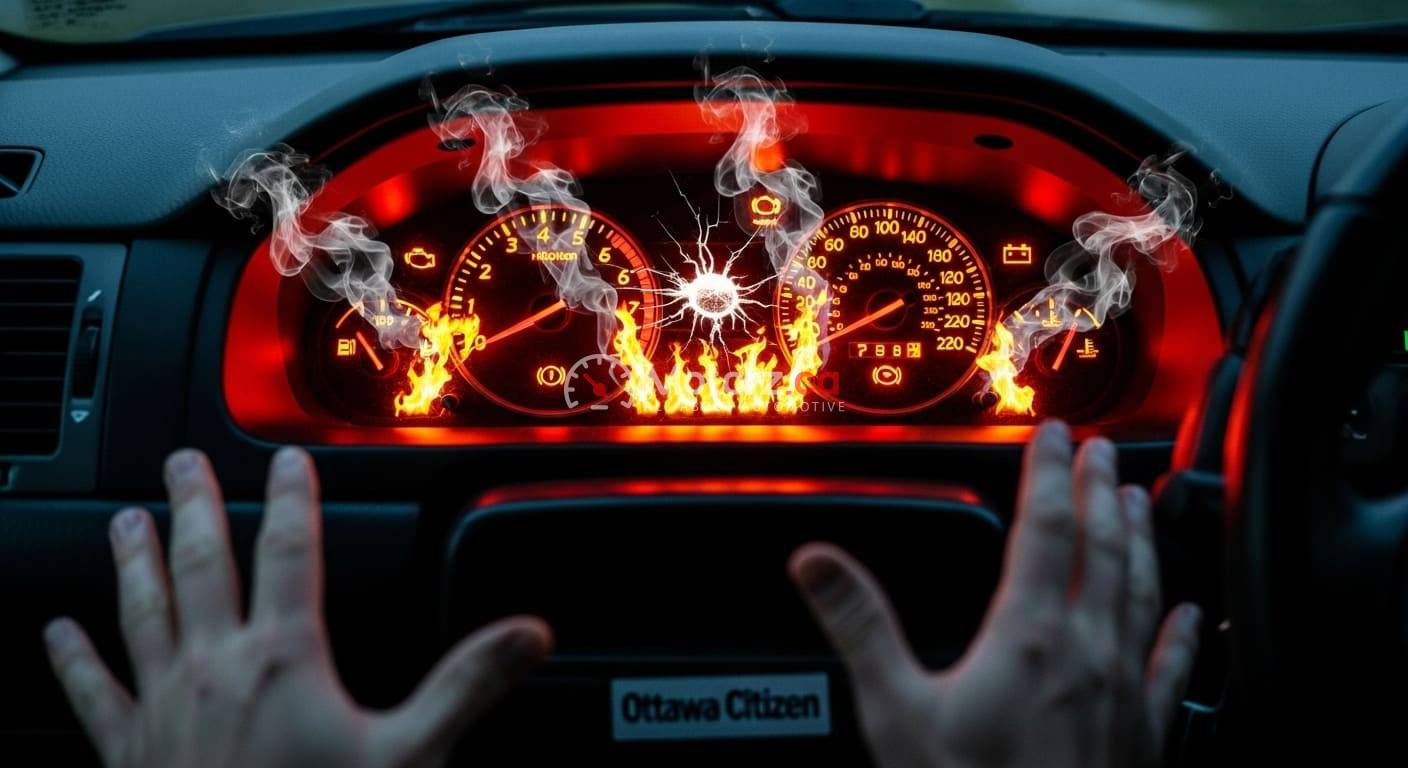

Driving on Ottawa’s Warning Lights, whether you’re cruising down the Queensway or navigating a busy Kanata intersection, you’re focused on the road, the traffic, and maybe even dodging a pothole or two. The last thing you want is for your dashboard to suddenly light up like a pinball machine. Yet, it happens to every driver. Those little symbols—what some affectionately call “idiot lights”—are actually your vehicle’s critical communication system, a vital heads-up that something is amiss under the hood.
Ignoring them, especially here in the National Capital Region where winter weather and city traffic put extra strain on vehicles, can turn a small, inexpensive fix into a massive, bank-breaking repair.
This comprehensive guide is designed for Ottawa’s Warning Lights drivers to decode their dashboard warning lights. We’ll break down the hierarchy of warnings, from the urgent, “pull-over-now” red lights to the “see-a-mechanic-soon” amber ones, and what steps you need to take right away.
The Colour Code: Red Means Stop!
Understanding the universal language of your dashboard starts with color. It’s a simple traffic light system for your vehicle’s internal health.
Red Warning Lights: These are the EMERGENCY Ottawa’s Warning Lights. They indicate a serious, potentially dangerous issue that could lead to immediate vehicle failure, costly damage, or a major safety risk. If you see a red light, you should stop the car as soon as it is safe to do so, turn off the engine, and seek assistance. Do not continue driving.
Yellow/Amber Warning Lights: These are CAUTION or ADVISORY warnings. They signal a problem that requires attention soon, but not necessarily immediate roadside shutdown. You can usually drive to your destination or directly to an Ottawa auto repair shop, but the problem should not be ignored.
Blue/Green Warning Lights: These are INFORMATIONAL Ottawa’s Warning Lights. They simply let you know that a system is currently active (e.g., high beams are on, cruise control is set). No action is needed other than potentially turning off the feature if you don’t need it.
The Critical Red Alerts: Immediate Danger Lights
When a red light illuminates, your car is essentially yelling for help. Here are the most serious warnings that demand immediate action from Ottawa’s Warning Lights.
The Oil Pressure Warning Light Ottawa’s Warning Lights
Symbol: A stylized oil can.
Meaning: This is arguably the most serious light. It means your engine has lost oil pressure, which is the lifeblood of the engine. Without proper pressure, internal engine parts are grinding against each other, causing rapid, catastrophic damage.
What to Do in Ottawa: Pull over IMMEDIATELY and turn off the Ottawa’s Warning Lights. Do not try to drive to a garage. Check your oil level (if you know how) and top up if extremely low. If the light remains on after topping up, or if you can’t check it, have the car towed to a trusted Ottawa mechanic for an inspection of the oil pump and system.
The Engine Temperature Warning Light
Symbol: A thermometer partially submerged in wavy lines (water).
Meaning: Your engine is Ottawa’s Warning Lights. This is often caused by low coolant levels, a leak, or a problem with the radiator or water pump. Driving a vehicle that is overheating can lead to a blown head gasket or a completely ruined engine.
What to Do in Ottawa: Pull over IMMEDIATELY and turn off the engine. Let the engine cool completely before safely checking and topping up the coolant. If you see steam or smell burning, do not open the hood. If the light comes back on, do not drive; get a tow to a repair facility specializing in cooling system repair in Ottawa.
The Brake System Warning Light (Circle with ! and ( ) around it)
Symbol: A circle with an exclamation mark (!) inside, surrounded by parentheses (sometimes with the word “BRAKE”).
Meaning: This could mean one of three Ottawa’s Warning Lights:
The parking brake is engaged (check this first!).
Brake fluid is dangerously low (indicating a potential leak).
A critical malfunction in the primary braking system.
What to Do in Ottawa: If the parking Ottawa’s Warning Lights is off and the light is on, do not drive. Your braking capability is severely compromised. Pump your brakes gently. If the pedal feels spongy or sinks, you have a critical problem. Have the vehicle towed to a professional for brake system inspection and repair in Ottawa.
The Battery/Charging System Light
Symbol: A small battery shape (often with a plus and minus sign).
Meaning: This light indicates a problem with the charging system, most commonly a failing alternator, a loose or broken drive belt, or an issue with the battery itself. The car is running solely on battery power, and once that drains, the engine will die, leaving you stranded.
What to Do in Ottawa: Since it’s not a Ottawa’s Warning Lights engine lubrication or heat issue, you might be able to drive a very short distance (e.g., to the nearest safe spot or garage entrance), but all non-essential electrical systems (radio, A/C, heated seats) should be turned off to conserve power. Get to a shop immediately for an alternator or battery diagnostic check.
Cautionary Amber Lights: Don’t Delay!
Amber lights warn you of problems that are less immediately life-threatening to your engine, but which still require prompt service to prevent further, more expensive damage.
The Check Engine Light (CEL)
Symbol: An outline of an engine (sometimes with “Check” or “Service Engine Soon”).
Meaning: This is the most common and least Ottawa’s Warning Lights light. It can be triggered by anything from a loose gas cap (a very common, easy fix!) to a failing catalytic converter or a bad oxygen sensor.
What to Do in Ottawa:
If the light is steady: You can generally continue driving, but you should schedule an appointment for an engine light diagnostic in Ottawa as soon as possible. Driving with this light on for too long can harm your fuel economy and cause long-term damage, particularly to emission control systems.
If the light is FLASHING: This is an Ottawa’s Warning Lights. A flashing CEL indicates a severe engine misfire, which is dumping unburnt fuel into the exhaust system, rapidly destroying your catalytic converter (a $1,000+ repair). Pull over safely and get the vehicle towed.
he Tire Pressure Monitoring System (TPMS) Light
Symbol: A cross-section of a tire with an exclamation mark (!) inside.
Meaning: The pressure in one or more of your tires is 25% below the manufacturer’s recommended level.
The Ottawa Factor: This light is especially common in Ottawa during the fall and winter. For every 10
∘
F (approx. 5.5
∘
C) drop in outside temperature, tire Ottawa’s Warning Lights decreases by about 1 PSI. The sudden cold snaps we experience often trigger this light.
What to Do in Ottawa: Check all your tire pressures using a reliable gauge and inflate them to the PSI recommended on the sticker inside your driver’s side door jamb. If the light comes on persistently or you have to inflate a tire often, you likely have a slow leak or puncture. Do not ignore this; low pressure compromises handling, especially on icy or wet Ottawa winter roads, and increases the risk of a blowout.
The Anti-lock Braking System (ABS) Light (ABS)
Symbol: The letters “ABS” inside a circle or parentheses.
Meaning: This indicates a malfunction with the Ottawa’s Warning Lights-lock Braking System. The good news is that your regular brakes should still work. The bad news is that the ABS feature—which prevents wheel lock-up during hard braking—is disabled.
What to Do in Ottawa: Drive cautiously, giving yourself extra stopping distance. Get it checked soon. The ABS system is crucial for control during emergency stops and on slippery conditions, making a timely repair essential for Ottawa road safety.
The Traction Control/Stability Control Light (Car Skidding)
Symbol: A car outline with squiggly lines underneath (sometimes with the word “OFF” or “TRAC”).
Meaning:
Steady Light: The system is off or has a Ottawa’s Warning Lights.
Flashing Light: The system is actively engaging, meaning your tires are losing traction (common when accelerating on ice, snow, or gravel).
What to Do in Ottawa: If it’s flashing, ease off the gas. If it’s steady and you haven’t intentionally turned it off, you can drive, but your car’s ability to correct a skid is compromised. Get it checked before the next major snowfall.
Proactive Maintenance: Your Ottawa Dashboard Diagnostic Strategy
Waiting for a light to come on is a reactive approach. The best strategy for Ottawa vehicle ownership is proactive maintenance.
Know Your Owner’s Manual
Your owner’s manual contains the exact symbols for your specific vehicle, their meaning, and the manufacturer’s recommended course of action. Keep it accessible.
Regular Fluid Checks
Monitor your oil level, coolant level, and brake fluid level regularly. Catching a low fluid level before a red warning light illuminates can save your engine.
Don’t Skimp on the Diagnostics
If a serious light comes on, an OBD-II diagnostic scan is the starting point. Many Ottawa auto service centers can perform this service to read the fault codes stored in your car’s computer, providing a specific roadmap for repair. Never allow a mechanic to simply reset the light without diagnosing the underlying cause. That’s like Ottawa’s Warning Lights off a smoke alarm without putting out the fire!
The Loose Gas Cap Check
If your Check Engine Light is on, always check your gas cap first! A cap that is not tightened enough can release fuel vapour and trigger the system as an emissions leak. Simply unscrew it and twist it back on until you hear a few clicks. Drive a few cycles; the light may turn off on its own.