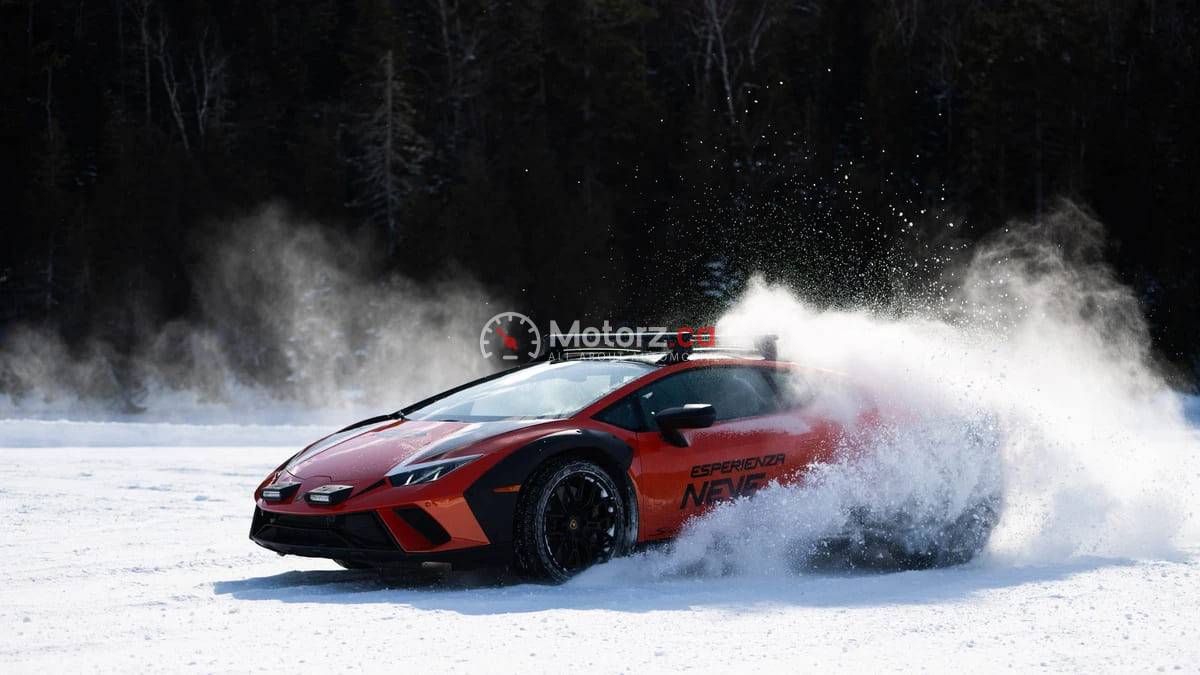

The image of a Frozen Quebec Lake, thousand-horsepower Lamborghini Huracán or Aventador belongs on the sun-baked asphalt of a European race track, not the slick, frozen expanse of a Quebec lake. The very thought seems absurd, inviting disaster, salt corrosion, and the potential for a catastrophic sinking.
Yet, deep within the Canadian winter landscape, specifically on the meticulously prepared ice tracks of places like Lake Sacacomie or near Montebello, Lamborghini doesn’t just allow this—they actively encourage it. This is the stage for the prestigious Lamborghini Accademia Neve (Winter Academy) and Esperienza Neve programs, where exclusive clients from around the globe gather to master the art of controlled chaos on ice.
Far from being a foolish stunt, driving a modern Lamborghini on a frozen lake is a high-level educational exercise that showcases the cutting-edge of automotive engineering, particularly the sophistication of their All-Wheel Drive (AWD) systems, torque vectoring, and the highly advanced LDVI (Lamborghini Integrated Vehicle Dynamics) system. This article dives into the technical wizardry, essential modifications, and absolute necessity of control that transforms a Quebec frozen lake into the perfect, exhilarating classroom for supercars.
The Engineering Secret: Why Modern Lamborghinis Master the Ice
A Lamborghini’s ability to drive predictably on pure ice is not a matter of raw power, but of electronic precision and four-wheel mastery. The key lies in the evolution of their All-Wheel Drive systems, particularly in models like the Huracán EVO, the versatile Urus SUV, and the new Revuelto.
Torque Vectoring and Frozen Quebec Lake
Traditional supercars struggled on low-grip surfaces because their power delivery was blunt. Modern Lamborghinis, however, use sophisticated electronics to manage grip at a microscopic level.
LDVI (Lamborghini Integrated Vehicle Dynamics): This system is the brain of the car. It anticipates the driver’s next move and prepares the car’s systems (steering, braking, traction control, and torque vectoring) before the action is taken. On ice, the LDVI is constantly adjusting the power split between the front and rear axles and even between the left and right wheels to maintain maximum lateral grip.
Precise Power Split: In a car like the Huracán EVO, the AWD system can rapidly and intelligently shift torque. When the rear wheels start to slip—the prerequisite for a drift—the system can instantly send a measured burst of power to the front wheels to catch the slide, stabilize the chassis, and pull the car through the turn with controlled oversteer. This allows drivers to hold massive, spectacular drifts that are smooth and manageable.
The Urus and the Rise of the Super SUV
The introduction of the Lamborghini Urus Super SUV broadened the brand’s capabilities in extreme environments.
Versatility in Snow: The Urus, with its adjustable air suspension and specific drive modes (like Sabbia or Neve), offers much higher ground clearance and a more comfortable experience on snowy access roads than the low-slung supercars.
Taming the V8: The Urus’s V8 engine and sophisticated AWD system make it incredibly competent on the ice tracks. Its greater weight and more predictable chassis make it an excellent training vehicle for drivers learning basic skid control and throttle modulation before graduating to the lower, lighter Huracán.
The Essential Modifications: The Absolute Necessity of Studded Tires
Even with the most advanced AWD and stability control systems, the Lamborghini’s ability to drive on a frozen lake comes down to one non-negotiable component: the tire.
Extreme Studded Tires for Ice Performance
The road-going summer tires that come standard on a Lamborghini are completely useless on ice; their compound freezes solid and provides zero grip. The ice driving programs mandate the use of highly specialized tires.
Nordic-Compound Rubber: The tires used are typically derived from Scandinavian-spec winter tires, utilizing extremely soft rubber compounds that remain flexible at temperatures as low as -40 degrees Celsius.
Thousands of Metal Studs: The key modification is the addition of several hundred metal or ceramic studs strategically placed within the tread. These studs act as miniature claws, mechanically digging into the hard ice surface. This process of mechanical grip is the only way to generate meaningful traction, braking force, and steering input on a solid frozen lake.
Why Studs Are Safer: On an ice track, the studded tire is a safety device. It allows the driver to explore the limits of the car’s dynamic control without the risk of an uncontrollable slide, turning a high-risk surface into a high-control platform.
Preparing the Car for Cold and Corrosion
Beyond the tires, driving a supercar in the extreme cold requires specific preparation to protect the delicate components.
Battery and Fluid Management: Supercar electronics and high-performance batteries are sensitive to cold. Vehicles are kept in climate-controlled garages or on trickle chargers when not in use. Fluids are switched to lower-viscosity, synthetic formulations that flow effectively at sub-zero temperatures.
Undercarriage Protection: While driving on a prepared ice surface minimizes the risk of impacts, the car’s intricate aerodynamics and low ride height are vulnerable to snow buildup and unseen ice chunks. After sessions, vehicles are thoroughly inspected and often cleaned of packed snow to prevent corrosion and damage.
The Quebec Classroom: Why Frozen Lakes Are the Perfect Track
The choice of a frozen lake, particularly in the remote, snowy regions of Quebec, is a calculated logistical and educational decision.
Learning Car Control at the Limit
The primary goal of the Lamborghini Accademia Neve is driver education. Ice is the best medium for teaching control.
Slow Motion Driving: On ice, the friction coefficient is drastically reduced, meaning the limits of the car’s grip are reached at very low speeds (often 30 to 60 kilometers per hour). This allows drivers to experience and correct a full-fledged skid—an impossible feat on a high-speed asphalt track—in a safe, low-risk environment.
Throttle Modulation Mastery: The instantaneous reaction of a high-revving V10 or V12 engine demands precise throttle control. Ice magnifies any clumsy input. Drivers learn to use the accelerator pedal as a steering tool, using subtle power adjustments to initiate and maintain a drift angle, a skill crucial for road safety in any winter condition.
A Blank Canvas: Unlike a permanent paved track with curbs, runoff zones, and unforgiving barriers, a frozen lake offers a massive, obstacle-free surface. Instructors can plow custom, temporary layouts—from tight slaloms to long, sweeping corners—that are designed purely for learning vehicle dynamics, knowing that any mistake simply results in a slow slide into a soft snowbank.
Safety and Logistics of the Ice Track
Operating an event with million-dollar supercars on a frozen body of water requires extreme logistical precision and rigorous safety standards.
Ice Thickness Requirements: Track organizers meticulously monitor the ice thickness, which must be deep and consistent enough to support the weight of the vehicles, safety equipment, and support personnel. The minimum thickness for passenger vehicles is typically 12 inches (30 centimeters), but for supercars, a margin of 30 to 40 inches is often preferred for absolute safety.
Controlled Environment: These events are held in isolated, private locations, ensuring a completely closed, controlled track where the only people present are the authorized drivers and professional Squadra Corse instructors. Every vehicle is equipped with a two-way radio for immediate communication with safety marshals.
Luxury and Experience: Events like Esperienza Neve are as much about the lifestyle as the driving. They blend high-adrenaline track time with luxury accommodation, fine dining, and curated winter experiences (snowmobiling, dog sledding), fulfilling the complete high-end consumer experience.
Redefining the Supercar’s Habitat
A frozen Quebec lake is precisely where a Lamborghini belongs—not for the daily commute, but for the ultimate demonstration of engineering and driver skill. These powerful machines are not just pavement princesses; they are sophisticated instruments of dynamics control.
By equipping their AWD systems with specialized studded tires and operating under the precise guidance of professional instructors, the frozen lake transforms from an absurd barrier into a perfect educational arena. It proves that the modern supercar is built not just for top speed, but for unparalleled control at the limits of adhesion. For Lamborghini owners, the Canadian winter is the place to truly appreciate that power is meaningless without absolute precision, a lesson best learned sideways on the ice.