What to Expect When Driving Your First Continuously Variable Transmission

What to Expect When Driving Your First Continuously Variable Transmission

Comments
8 min read

You step into your brand-new crossover, press the push-button start, slide the shifter into Drive, and hit the gas. You expect the familiar mechanical cadence of a traditional car—the engine revving up, a brief pause, a physical shift into second gear, and the cycle repeating. Instead, the engine revs up to a specific pitch and just stays there. The car accelerates smoothly, but there are no shifts, no pauses, and no familiar gear drops. For a second, you might wonder if something is seriously wrong with your transmission.

Welcome to the world of the Continuously Variable Transmission, or CVT.

In the service bays at “The Corner Wrench,” we talk to dozens of first-time CVT owners every month. Many of them come in genuinely concerned that their new car is slipping or broken simply because it doesn’t behave like the vehicles they grew up driving. In 2026, CVTs have become the dominant transmission choice for compact cars, midsize sedans, and family crossovers across Canada. From the fuel-efficient Honda Civic to commuter-friendly Nissan and Subaru models, this technology is everywhere.

At Motorz, we want to take the mystery out of modern automotive tech. Today, Lorraine Explains exactly what is happening beneath your floorboards, how a CVT alters the daily driving experience, the common quirks that startle new buyers, and the essential maintenance steps required to keep these modern gearboxes running flawlessly for hundreds of thousands of kilometers.

What Variable Transmission? Stripping Away the Automotive Jargon

To understand what to expect from your first CVT, we have to look at how it differs from a traditional automatic transmission. The traditional automatic transmission you are likely used to uses a fixed set of metal gears—usually six, eight, or even ten distinct gear ratios. As the car speeds up, it must physically uncouple from one gear and grab the next one.

A CVT throws that entire concept out the window.

The Pulley and Belt System

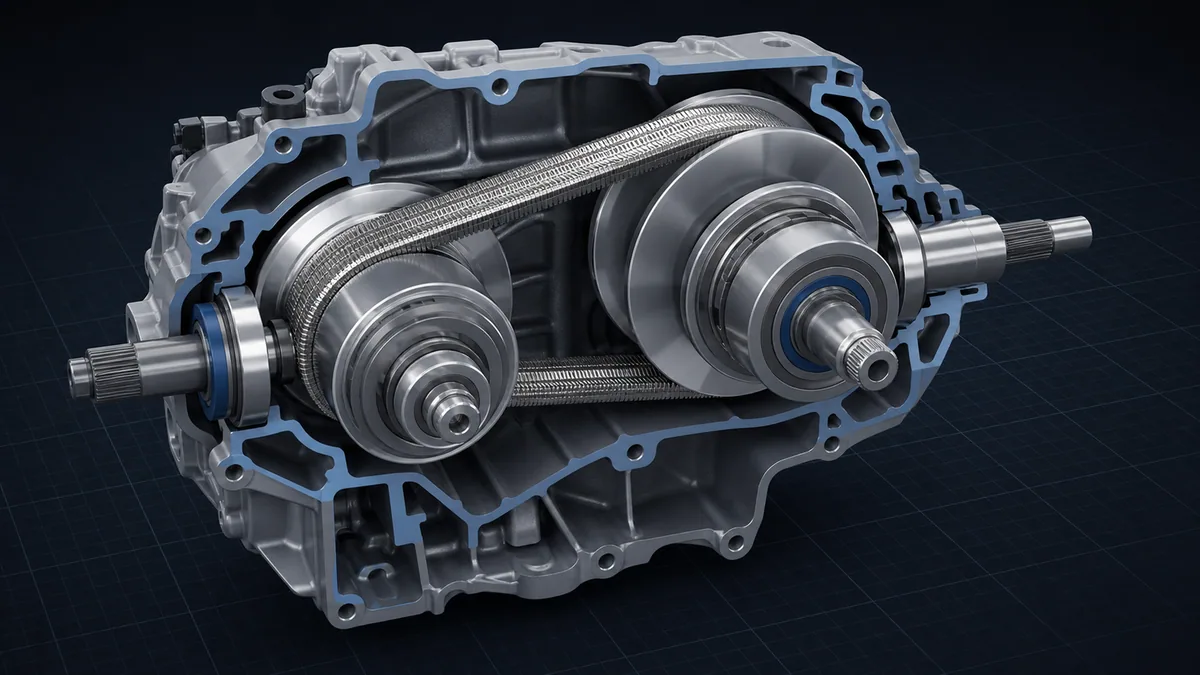
Instead of a complex gearbox filled with interlocking teeth, a standard CVT relies on a beautifully simple mechanism: two V-shaped pulleys connected by a high-strength steel chain or belt.

  • The Drive Pulley: Connected directly to the engine.

  • The Driven Pulley: Connected to the wheels.

Both of these pulleys are dynamic. They can widen or narrow their width on the fly via hydraulic pressure. When one pulley gets wider, the belt drops lower into the groove. When it narrows, the belt is forced upward toward the outer edge. By constantly adjusting the width of these two pulleys in perfect synchronization, the transmission can create an infinite number of gear ratios between its lowest and highest limits.

The Bicycle Analogy

Think of a multi-speed mountain bike. If you want to go up a steep hill, you manually shift to a larger rear sprocket. On a CVT, the car’s computer handles this transition seamlessly and continuously. There are no steps, no gears, and no interruptions in power. It is one fluid, unbroken curve of acceleration.

The First Test Drive: Sensory Quirks of a CVT

When you drive a CVT for the first time, your brain has to unlearn decades of auditory and physical feedback. Here are the three main behavioral differences you will notice within the first five minutes of your test drive.

The “Rubber Band” Effect

When you press down hard on the accelerator to merge onto a highway, a traditional car steps down through its gears sequentially. A CVT instantly adjusts its pulleys to put the engine right into its peak power band. The engine RPMs shoot up immediately, and then the car’s speed gradually catches up to the engine noise.

This delay between the engine revving and the physical sensation of acceleration is known as the “rubber band effect.” It can feel strange at first, almost as if a manual clutch is slipping, but it is actually the system working exactly as designed.

The Drone of Constant RPMs

Because a CVT can hold an engine at any precise RPM, it will often keep the engine screaming at a high pitch during hard acceleration until you lift your foot off the gas.

Modern manufacturers have spent millions of units on sound insulation to quiet this down, but it remains a hallmark characteristic of the technology.

Simulate Shifts: The “Step Shift” Compromise

Automakers quickly realized that drivers found the lack of gear shifts unsettling. To make CVTs feel more natural, engineers programmed fake, simulated gear shifts into the transmission’s computer software.

Under moderate to heavy throttle, the computer will artificially alter the pulley widths in sharp steps to mimic the feel of a traditional 7-speed or 8-speed automatic. While this actually reduces the ultimate efficiency of the transmission slightly, it goes a long way in making first-time buyers feel comfortable behind the wheel.

The Unmatched Benefits: Why Automakers Love the CVT

If CVTs feel and sound a bit odd, why is the automotive industry so obsessed with them? The answer comes down to two major factors: efficiency and smoothness.

Maximizing Fuel Efficiency

The primary job of a CVT is to keep the engine operating in its most efficient zone at all times. If you are cruising down a flat stretch of highway, the transmission will expand to its highest possible ratio, dropping the engine down to a whisper-quiet tick over to save fuel. If you encounter a headwind or a slight incline, it will adjust by a fraction of a millimeter to maintain your speed without needing to huntingly downshift like a conventional automatic. This precise optimization translates directly into lower fuel consumption and reduced emissions.

Seamless Power Delivery

Because there are no physical gear shifts, there is no torque interruption. When you are climbing a steep mountain pass or accelerating away from a stoplight, the power flow to the front wheels is completely uninterrupted. This creates an incredibly smooth, linear ride quality that traditional multi-gear automatics struggle to match, particularly in stop-and-go city traffic.

Maintenance Myths: Keeping Your CVT Alive

There is a persistent rumor on internet car forums that all CVTs are fragile, unreliable junk destined to fail the moment your warranty expires. While early iterations of this technology in the mid-2000s certainly had design flaws, modern units are robust—provided you take care of them. At “The Corner Wrench,” we know that the secret to CVT longevity boils down to proper fluid management.

The Critical Role of CVT Fluid

A CVT operates under immense internal hydraulic pressure. The fluid inside doesn’t just lubricate bearings like standard transmission oil; it provides the friction necessary to stop the steel belt from slipping against the smooth faces of the pulleys. If that belt slips, it gouges the metal components, scoring the surfaces and effectively destroying the transmission.

Throw Out the “Lifetime Fluid” Promise

Many owner’s manuals state that the transmission fluid is a “lifetime fill” and never needs to be replaced under normal driving conditions. In the harsh Canadian climate—where cars endure freezing winters, boiling summers, and heavy road salt—there is no such thing as a lifetime fluid.

  • Our Recommendation: Have your CVT fluid inspected and exchanged every 50,000 to 60,000 kilometers. Clean fluid maintains the correct viscosity and friction characteristics, preventing internal wear and keeping those delicate pulley valves moving freely.

Use the Exact Specification

You cannot throw generic automatic transmission fluid (ATF) into a CVT. Doing so will cause catastrophic slipping within minutes. Always use the exact manufacturer-specified fluid, whether it is Nissan NS-3, Honda HCF-2, or Subaru High-Torque CVT oil.

Driving Habits to Break: Protect Your Belt

A CVT requires a slightly different approach from the driver’s seat to prevent premature wear. If you want your transmission to last, avoid these bad habits:

Don’t Treat it Like a Drag Racer

CVTs are engineered for smooth, efficient commuting. Launching your car hard from a dead stop or stomping the throttle while simultaneously holding down the brake pedal puts an immense amount of shock load directly onto the steel belt. Over time, this stress can stretch the chain or chip the pulley surfaces.

Avoid Heavy Towing Unless Rated

Unless you are driving a midsize SUV specifically rated for towing, avoid hooking a heavy trailer up to a CVT-equipped vehicle. The sustained heat generated by hauling heavy loads uphill can degrade the transmission fluid rapidly, leading to overheating and component failure.

Embracing the Continuous Wave

Transitioning to your first CVT requires a slight mental adjustment. You have to trade the mechanical drama of gear shifts for a smoother, more calculated style of driving. Once you get used to the steady engine pitch and the uninterrupted surge of acceleration, you will appreciate why this technology has taken over the modern commuter car market.

Take care of your fluid changes at “The Corner Wrench,” drive with a smooth, progressive foot, and your CVT will reward you with excellent fuel economy and a seamless driving experience for years to come.

Share this article

About Author

motorz.ca

Leave a Reply

Your email address will not be published. Required fields are marked *

Most Relevent